EN
EN  DE
DE  RU
RU  PT
PT  JA
JA  ES
ES  IT
IT 
Protection Barriers: The Importance of Warehouse Logistics Racking Protection

In the bustling world of warehousing and logistics, the safety and security of both employees and valuable inventory are of paramount importance. Among the various safety measures employed, protection barriers play a crucial role in safeguarding the integrity of warehouse logistics racking systems. These barriers act as a reliable line of defense, preventing potential accidents and damage. This article explores the significance of protection barriers in warehouse logistics, highlighting their essential role in maintaining a smooth and secure operational environment.
Enhanced Warehouse Safety
One of the primary reasons why protection barriers are indispensable in warehouse logistics is their ability to enhance overall safety. Warehouses often involve the storage and retrieval of heavy goods and equipment, which can pose significant risks if not appropriately managed. Protection barriers, such as guardrails and bollards strategically placed around racking systems, create a physical barrier between personnel, equipment, and the racks. This serves as a protective shield, mitigating the impact of collisions caused by forklifts or other moving machinery. By minimizing the chances of accidental collisions, these barriers help prevent injuries to employees and reduce the risk of damage to valuable inventory.
Preserving Warehouse Infrastructure
Warehouse logistics racking systems represent a substantial investment for any business. These racking structures form the backbone of the storage process, allowing for efficient organization and space utilization. Without adequate protection, these racks are susceptible to damage from unintended impacts, potentially compromising their structural integrity. By implementing protection barriers, warehouse operators can safeguard their racking systems against accidental collisions and impacts. Whether it’s a minor nudge from a pallet truck or a more substantial collision with a forklift, protection barriers absorb much of the force, preventing significant damage to the racks and ensuring they remain in optimal condition for prolonged use.
In conclusion, protection barriers play a vital role in ensuring the smooth and safe functioning of warehouse logistics operations. By enhancing warehouse safety and preserving the integrity of racking systems, these barriers contribute significantly to the overall efficiency and productivity of the facility. Businesses involved in warehousing and logistics should prioritize the installation of robust protection barriers to create a secure work environment for their employees and protect their valuable inventory and infrastructure. Through this proactive approach to safety, warehouse operators can not only minimize the risk of accidents but also demonstrate their commitment to the well-being of their workforce and the longevity of their logistics infrastructure.
Interlock Switch Mounting Without Drilling: Why Alfence T-Slot Posts End Phantom Stops
Bolting an interlock switch bracket through a powder-coated steel post drills the coating, drops swarf into the cell and leaves a rust line — and when the hinged leaf sags, the tongue misaligns and the PLC reports a phantom guard fault. Alfence mounts sensors, e-stops and conduit in the T-slot groove of a 40×40 mm or 45×45 mm aluminum post, with door hardware sized to keep the safety switch aligned.
Phantom Safe Torque Off Stops: T-Slot Guarding Fence Posts Mount Interlocks Without Drilling
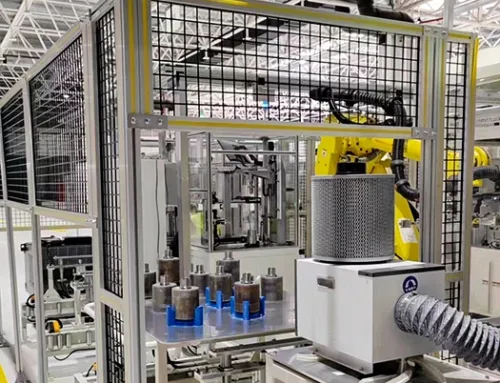
Painted steel guarding posts force maintenance to drill for interlock switches, dropping swarf in the cell and breaking the coating where rust starts. Sagging hinge doors then misalign the interlock tongue and the PLC trips Safe Torque Off while the gate is closed. Alfence industrial safety fence mounts sensors, e-stops and cable routing into the T-slot aluminum profile post without drilling, and uses hinged, folding or sliding door frames that keep interlock geometry stable - protecting OEE through phantom stops and line changes.
Automotive Plant Industrial Safety Fence: Keep the Robot Cell Close to the Hazard
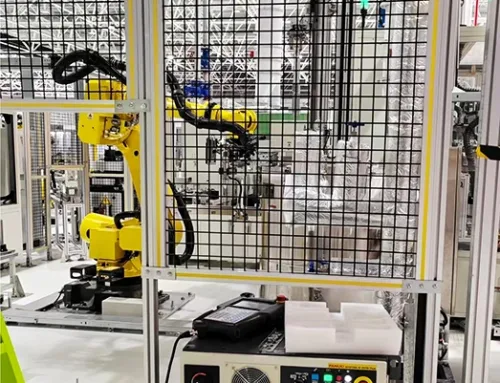
Automotive plants cannot afford to lose production floor to an oversized machine guarding perimeter. Alfence combines 20×100 mm mesh with slim 40×40 mm or 45×45 mm aluminum posts for a compact, reconfigurable industrial safety fence layout, with final clearance confirmed by the project risk assessment.