EN
EN  DE
DE  RU
RU  PT
PT  JA
JA  ES
ES  IT
IT Industrial Safety Fencing for steel coil transfer risk
Industrial Safety Fencing is built for the kind of warehouse damage that never happens gently: repeated forklift scrapes, hard corner hits, and full-load impact around steel coil and sheet handling lanes. When the barrier has to stay standing after a real collision, the structure matters more than the appearance.
Why steel coil handling areas need a different fence
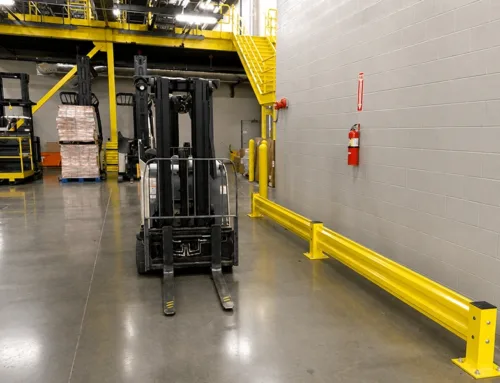
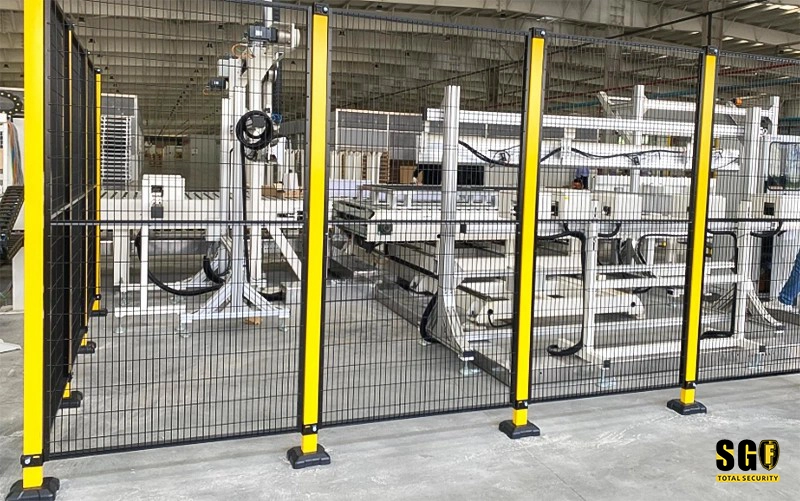
In steel coil and sheet warehouses, forklift traffic is not occasional. It is constant, narrow, and heavy. The problem is not just that a pallet truck or fork arm can scratch a fence; the real risk is a high-energy strike that bends posts, breaks mesh, and opens a gap in the protection line. Once that happens, the barrier is no longer a barrier.
| Issue in the bay | Why Industrial Safety Fencing fits |
|---|---|
| Repeated forklift contact at aisle corners | 60x60mm Q235 carbon steel posts are built for structural recovery under impact, not fragile cosmetic resistance. |
| Fence failure after one collision | The system is designed for up to 1600 J extreme impact force, so a loaded forklift hit does not instantly destroy the line. |
| Fast layout changes in logistics bays | Modular post-and-panel construction lets teams replace, relocate, or extend sections without rebuilding the whole run. |
| Unsafe repair cycles after damage | Bolted base plates and fixed panel clamps make damaged modules easier to service than welded one-piece barriers. |
What makes the structure survive real impact
1. The post is doing the real work
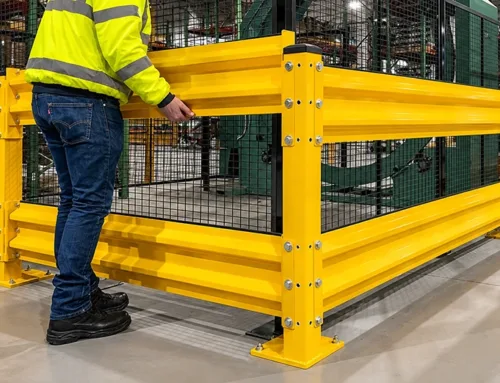
Industrial Safety Fencing uses 60x60mm Q235 carbon structural steel as the main post material. That matters because impact resistance in a forklift zone is not about looking thick; it is about how the steel behaves when energy enters the frame. Q235 offers plastic deformation instead of brittle failure, which helps absorb the force and keep the system from splitting apart under a full-load strike. The result is a barrier that acts like industrial armor, not a light warning fence.
2. The anchor details control the failure mode
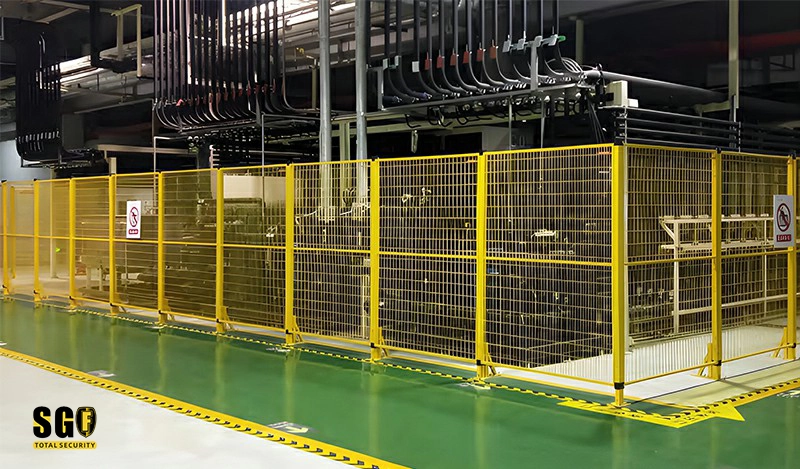
If a fence is only strong in the panel but weak at the base, the collision load simply moves into the anchoring point and the whole line becomes unstable. The installation detail shown here matters: base plate positioning, drilling, expansion bolts, and retaining ring assembly lock the structure into the floor. That makes the protection line behave as a fixed system, not as loose shop-floor hardware that shifts after the first hit.
3. The panel layout keeps the protection line readable
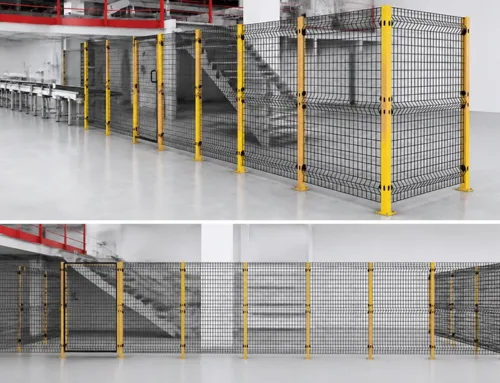
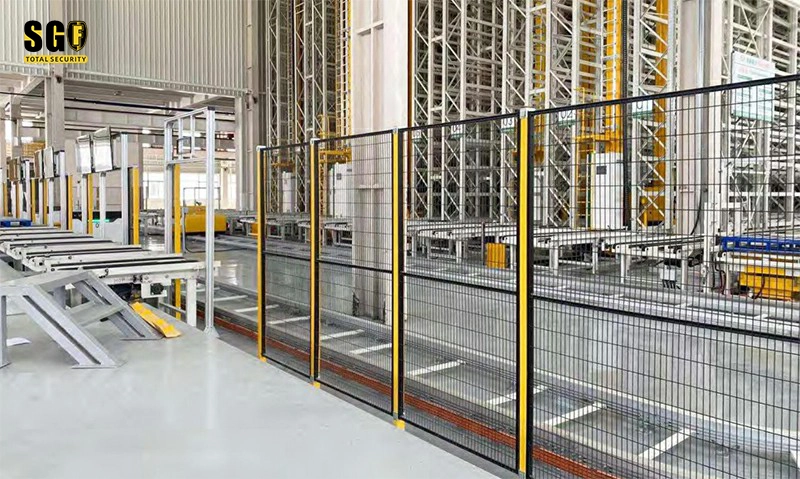
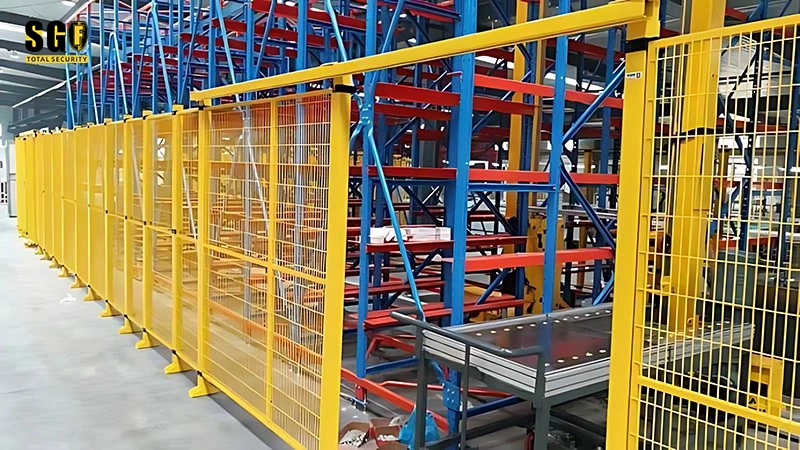
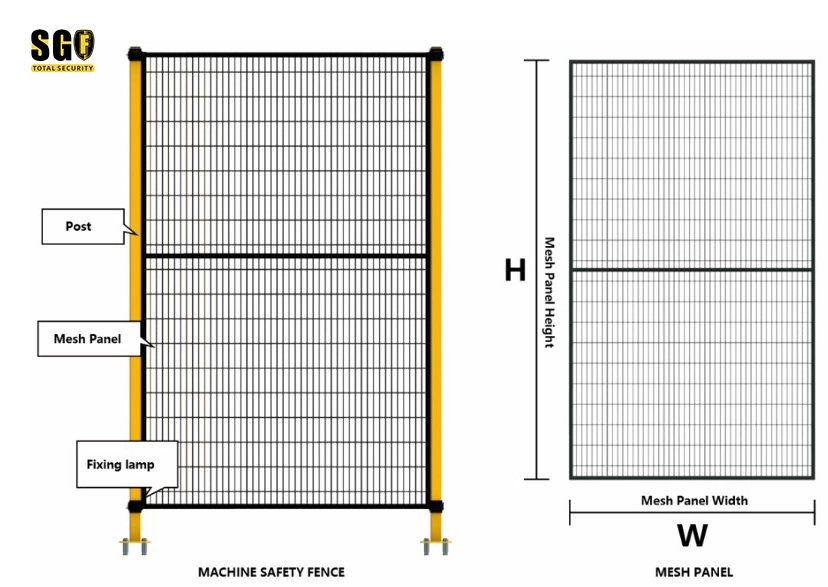
The post, mesh panel, and fixing clamp relationship is what makes the fence practical in an active warehouse. The structure is visually clear for operators, easy to inspect after traffic, and simple to segment around transfer paths. That is important in a steel coil bay, where people, forklifts, and moving stock all share limited space. A line that is easy to read is a line operators are more likely to respect.
Where this fence earns its keep
- Steel coil transfer aisles with dense forklift movement
- Sheet storage lanes that need a hard boundary against accidental intrusion
- Warehouse edges near conveyors and loading paths
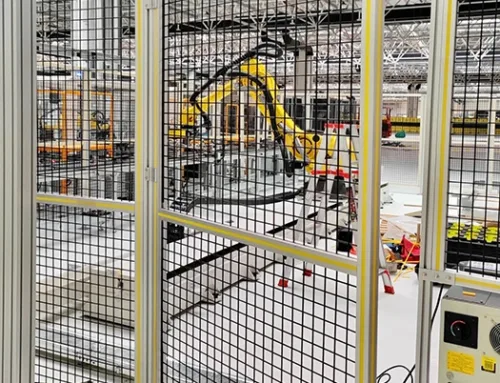
- Machine zones that need a visible separation line and repeated access control
- Retrofit projects where the old solution was a fragile mesh barrier that failed too early
For these applications, Industrial Safety Fencing does not try to “absorb” impact by being soft. It survives by being engineered: Q235 steel, 60x60mm posts, TUV-certified structure, and an impact rating of up to 1600 J. That combination is what turns a fence into a lasting protective asset instead of a recurring repair item.
Evidence matters more than claims
The product photos show the details that matter on site: welded seams, coating quality, base plates, clamp positions, and the full modular arrangement around the work area. In a heavy logistics environment, those details are the difference between a fence that looks right and a fence that remains in service after impact.
Final result: fewer repairs, fewer shutdowns, stronger boundary control
When a warehouse fence is built for real forklift abuse, the outcome is simple: fewer emergency repairs, less downtime, and a protection line that still stands after a collision. Industrial Safety Fencing is the right fit when the job calls for a heavy-duty industrial barrier, not a decorative mesh partition.