EN
EN  DE
DE  RU
RU  PT
PT  JA
JA  ES
ES  IT
IT WAREHOUSE SAFETY / LOADING BAY PROTECTION
Repeated forklift impact is a floor-and-repair problem, not only a rail problem
At a loading bay, dock approach or tight turning zone, the first collision may bend a steel barrier. Repeated collisions can then turn the posts, anchors and surrounding concrete into a recurring maintenance point. A flexible crash barrier should be selected from the vehicle, speed, impact angle, floor condition, protected asset and available clearance—not from a product photo or one maximum joule number.
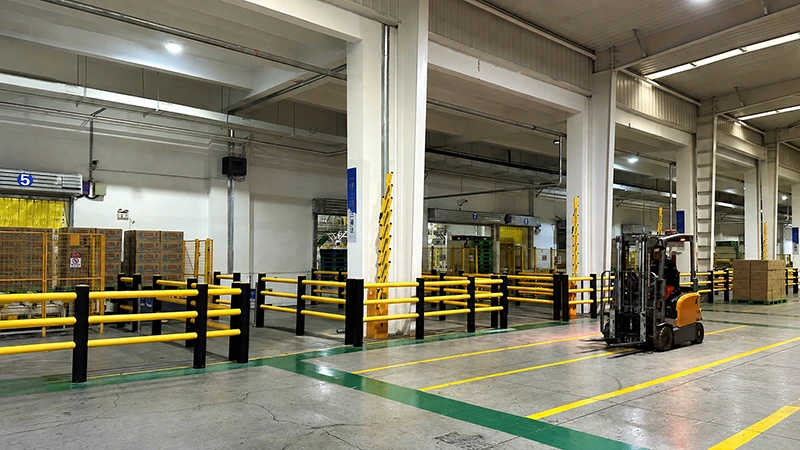
Why loading bays and narrow turns keep getting hit
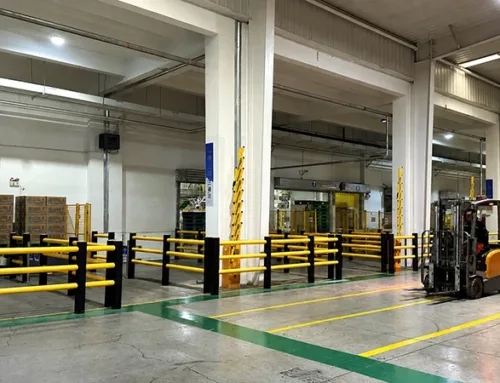
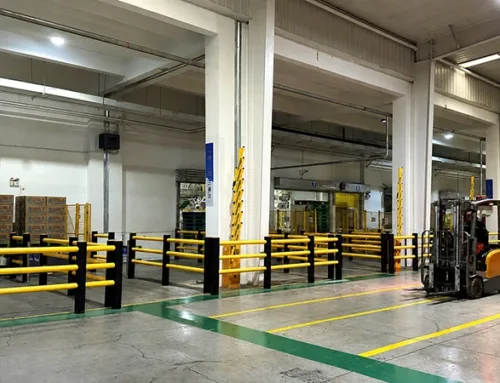
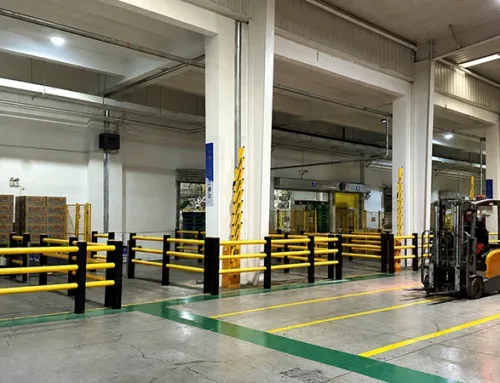
Loading bays combine reversing, turning, queueing and edge constraints in one operating area. A forklift may approach a barrier at a changing angle rather than square-on; a dock edge, rack end, column or pedestrian route can leave little recovery space. When the same vehicle path repeats, a small alignment issue becomes a repeat-collision pattern.
| FCBarrier reference | Verified impact rating / selection context |
|---|---|
| SR100 / SR148 / SR190 | 3,850 J / 14,400 J / 21,350 J; single-rail options for layouts where the protected object and traffic path call for this configuration. |
| DR100 / DR148 / DR190 | 6,500 J / 19,000 J / 28,950 J; double-rail options, with DR190 listed as the highest verified DR rating. |
| TR100 / TR148+ / TR190+ | 8,200 J / 19,000 J / 28,950 J; traffic and pedestrian-segregation configurations. |
| CTR100 / CTR148+ / CTR190+ | 8,200 J / 19,000 J / 28,950 J; column-protection configurations. |
| Top-model reference | The 28,950 J figure is described with an equivalent reference of an 8-ton forklift at 9.6 km/h. It is not a substitute for a site-specific assessment. |
What changes when the barrier is designed to absorb impact
1. A rigid rail can move the repair point behind the rail
A steel guardrail that permanently deforms after a forklift strike may need rail or post repair. With repeated contact, the load path can also leave a maintenance burden at the post base, expansion bolts and nearby concrete. That does not mean every damaged slab was caused by the barrier: anchor type, installation, floor condition, impact direction and vehicle behavior all matter. The practical warning is to inspect the complete system after a collision, rather than replacing only the visibly bent rail.
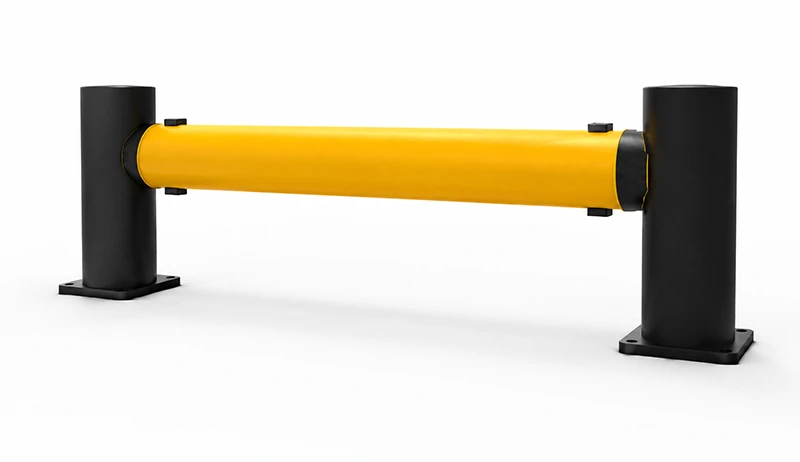
2. Energy absorption and modular replacement change the maintenance response
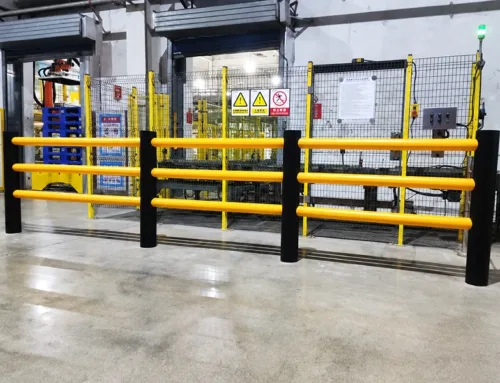
FCBarrier is positioned as an ARMORFLEX polymer flexible crash barrier. Its product brief describes absorption of up to 80% of collision energy and self-rebounding after impact. The system is modular, so a damaged local section can be considered for partial replacement instead of automatically replacing a whole continuous line. The image supports the bolted base-plate and modular layout; it does not, by itself, prove rebound performance. A flexible safety barrier still needs correct series selection, layout and floor anchoring.
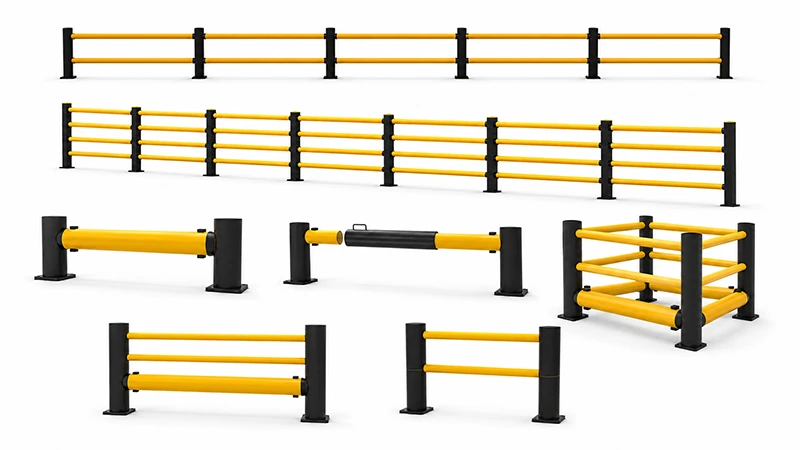
3. Choose SR, DR, TR or CTR from the operating case
Start with the forklift or vehicle mass and real operating speed, then consider the collision angle, the asset being protected and the available clearance. SR is the single-rail family; DR is the double-rail family; TR is the traffic and pedestrian family; CTR is the column-protection family. The listed ratings help create a first comparison, but they do not decide a loading-bay design by themselves. A tight turn, a column face, a rack end and a pedestrian boundary can require different geometries even when the nominal impact energy appears similar.
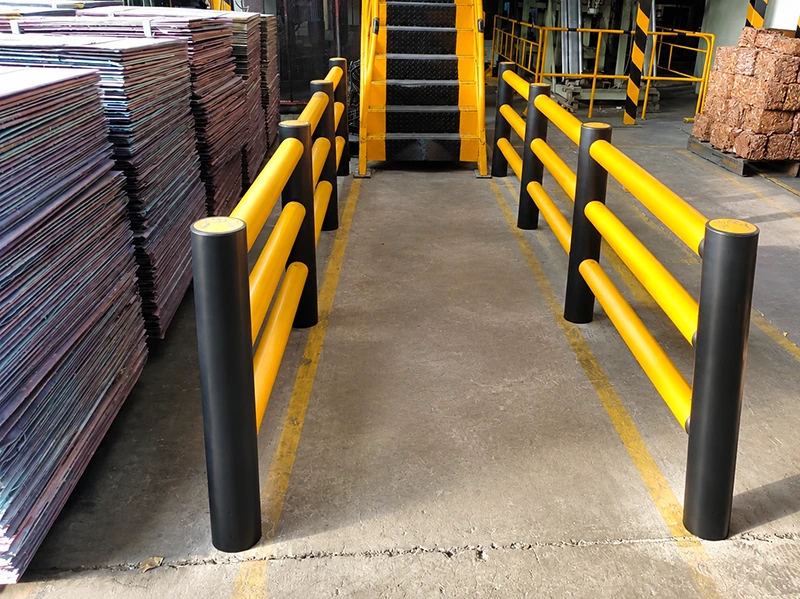
Where to review the full loading-bay protection layout
- Dock edges and approaches: check reversing and turning paths, edge exposure, and the clearance needed for the vehicle and load.
- Narrow turns and rack ends: identify the recurring contact point and whether a single rail, double rail or traffic configuration protects the actual asset without obstructing operations.
- Columns and building structures: consider the CTR column-protection family where vehicle routes pass close to structural supports.
- People and vehicle interfaces: use the TR family as a starting reference for traffic and pedestrian segregation, then confirm sightlines and access routes.
- Existing warehouses: use the modular structure for retrofit planning, with local dimensions and floor conditions checked before installation.
Floor anchoring is a prerequisite, not an afterthought. The installation demonstration shows a concrete floor, expansion bolts, a torque wrench and a professional two-person workflow. The available product information does not establish a concrete grade, slab thickness or anchor pull-out value. Those items must be checked by the responsible installer or engineer for the actual site.
Do not size a barrier from a photo or a maximum joule value alone
Images can show a floor-mounted base, rail count, modular joints and a continuous run. They cannot prove the energy absorbed in a collision. Likewise, a maximum rating is only a reference point: it does not describe every vehicle speed, impact angle, load condition, floor state or clearance constraint. Ask for a site review when the concrete is damaged, anchors are loose, the collision path is angled, the protected object is critical, or the available space is too narrow for recovery. FCBarrier public materials do not confirm PAS 13 or another third-party certification, and they do not publish a concrete specification, anchor pull-out value, fire rating or temperature range.
For a useful recommendation, prepare the forklift model or load rating, vehicle mass or load condition, actual operating speed, likely collision angle, protected object, aisle and turning dimensions, available net clearance, concrete floor information, existing anchor and damage photos, and a marked-up layout drawing.
Send the site data before replacing another damaged rail
Submit the forklift model or load, actual speed, collision angle, protected object, available clearance, concrete-floor information and layout drawing. SGF can use those inputs to develop a protection-level and layout recommendation for the loading bay, dock approach or turning zone.