EN
EN  DE
DE  RU
RU  PT
PT  JA
JA  ES
ES  IT
IT CORRUGATED & PACKAGING PLANT ZONING
A 14-day peak-to-lean swing turns a welded safety fence into scrap metal
Corrugated and packaging plants do not run a stable layout. They run a peak-season overflow zone in week one, a lean converter bay in week two, and a temporary baler buffer in week three. A welded industrial safety fence becomes fixed sunk cost at that exact moment; Mefence frameless 3D safety fence is redeployable equipment that travels with the next layout, not against it.
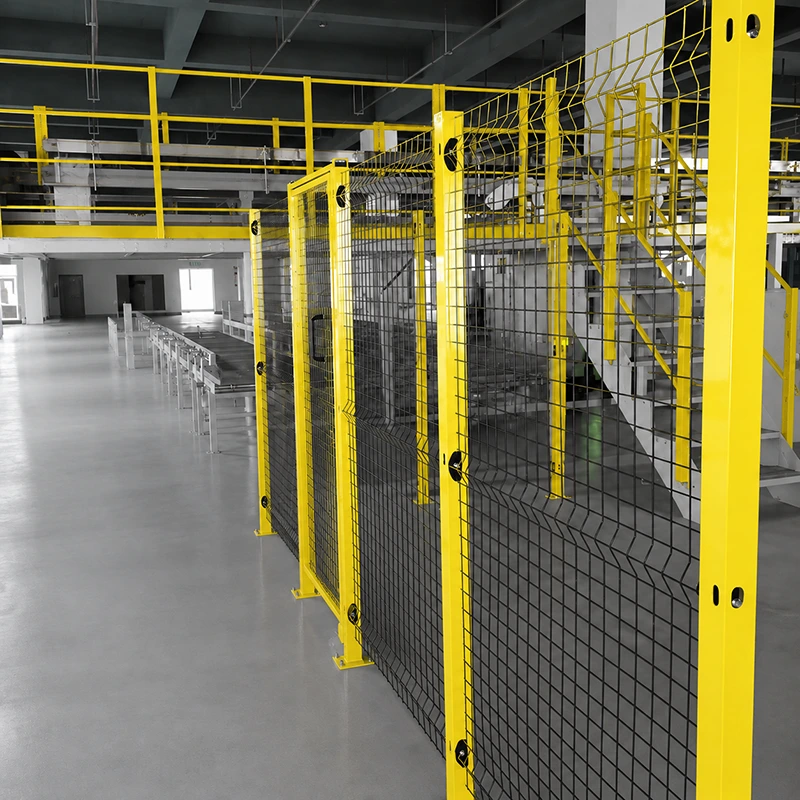
Mefence at the line — the physical numbers behind the redeploy
Five physical facts from the Mefence spec sheet turn the perimeter from sunk cost into reusable equipment. Every line below is what allows one weekend crew to move a warehouse zone without cutting torches, fab scrap, or a hot-work permit.
| Spec | Value |
|---|---|
| Panel structure | Frameless welded wire mesh, multiple horizontal T-shaped ridges / bends, no perimeter frame border |
| Panel width range | 200 – 1400 mm (on-site cuttable to non-standard column lines) |
| Panel height range | 200 – 3000 mm |
| Wire diameter | 3 mm / 4 mm |
| Mesh opening | 20 × 100 mm / 50 × 50 mm |
| Material | Q235 carbon steel, electrostatic powder coated (yellow + black standard, custom color on request) |
| Post size | 40 × 60 mm / 60 × 60 mm steel post, base plate + expansion bolt, slotted mounting holes |
| Connection | Plastic clip + self-tapping screw (no site welding, no fab lead time) |
| Install method | One person, three-step assembly; 50%+ install time reduction vs framed fence |
| Ground clearance | 140 mm |
Why a corrugated plant can redeploy Mefence every 14 days
Clip-fixed assembly turns the perimeter into a kit, not a steel cage
A corrugated plant that swaps a converting line every two weeks cannot bolt a welded fence to the floor and expect it to survive the next move. Mefence uses a plastic clip plus self-tapping screw to fix each welded wire mesh panel to a 40×60 or 60×60 mm powder-coated steel post. Disassembly is the reverse motion — no torch, no grinder, no fab scrap. The same modules go back up at the new layout line; the only consumable is the floor anchor, and even that reuses the existing expansion bolt if the new column line sits within 200 mm of the old one. That is how the perimeter becomes redeployable equipment instead of welded sunk cost.
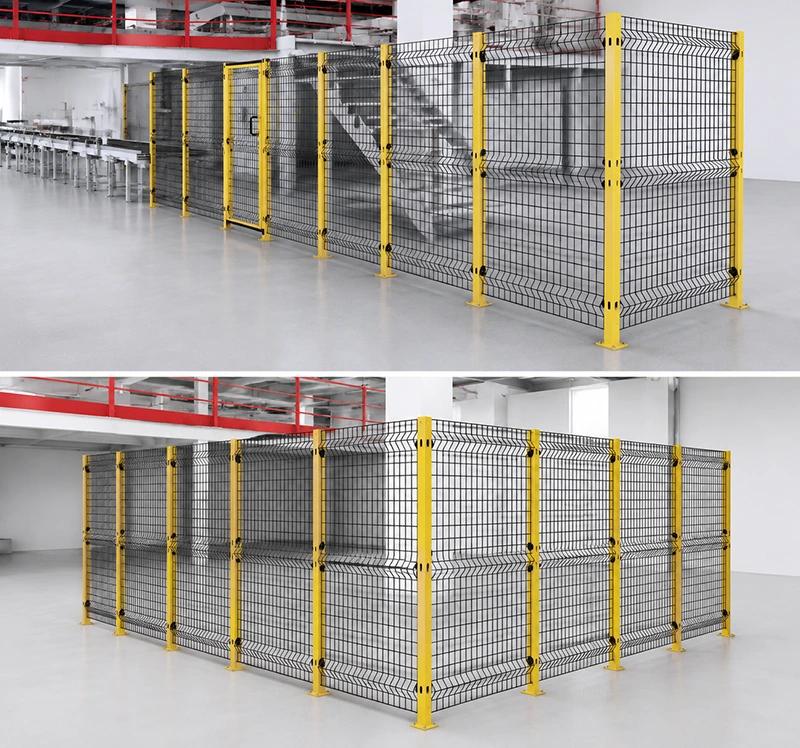
On-site cuttable mesh fits irregular column lines and existing pipelines
Real factory floors are not 20×200 grids. The new peak-season overflow zone might wrap around an existing fire-suppression pipe, sit 80 mm off the structural column line, or end at an angled dock door. A framed fence forces a custom re-fab and a multi-week lead time. Mefence frameless welded wire mesh — without a perimeter frame border — cuts cleanly on site with a standard angle grinder. The slotted mounting holes on the post, visible in the close-up, then absorb the residual offset without re-drilling the floor. The plastic clip absorbs the residual mesh tolerance, so the panel still sits flush against the post. That is how a clip-fix retrofit satisfies a 14-day turnover window with no plant-side rework.
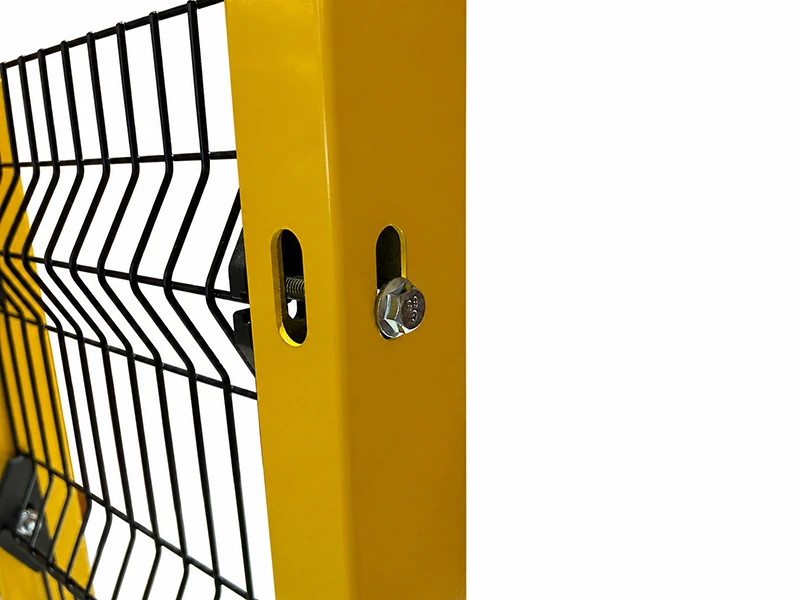
Pre-engineered size range covers both the lean week and the peak week
The Mefence panel range — 200 to 1400 mm wide and 200 to 3000 mm tall, in 3 mm or 4 mm wire diameter with 20×100 or 50×50 mm mesh opening — covers the converter-bay-to-storage swing without a single custom fab. Lean week: drop the high-bay partition and reuse the panels along the converter feed. Peak week: stack the same panels into a multi-section warehouse enclosure with corner posts at each L-junction, base-plate anchored through the existing expansion-bolt grid. The yellow-and-black powder-coated steel reads through the dust and forklift traffic; the 140 mm ground clearance keeps a pallet jack off the mesh; the post base plate sits on the standard 200 mm bolt grid without surface grinding. Same SKU list covers both weeks.
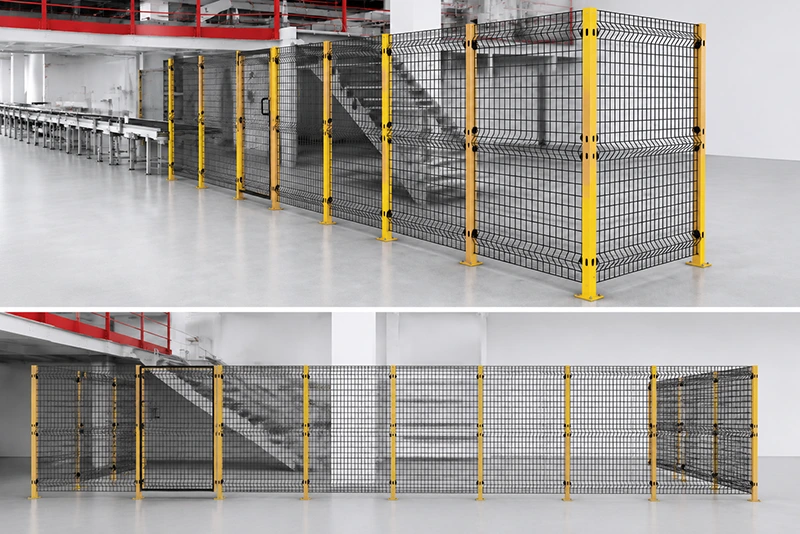
Where the 14-day redeploy model actually applies in corrugated and packaging plants
- Peak-season overflow storage next to the slitter — panels redeploy from the dock perimeter
- Converter-line swap from E-flute to B-flute — perimeter moves with the new feed direction
- Temporary buffer zone at the baler during bale stack reorganisation
- Tool crib enclosure that relocates between maintenance windows
- Forklift-pedestrian hard barrier along the QC and sample aisle, repositioned with each shift rebalance
- Pallet jack staging area on the dock, pulled down when the truck schedule thins
- Visual-shielding inserts using charred or oiled wood slats in the T-ridge for the print-finish inspection room
The same Mefence inventory covers all seven layouts in any given quarter; the only thing that changes is where the plastic clip plus self-tapping screw are pointing. The fence travels with the order book, not against it.
Spec sheet, post drawing, and the on-site cut guide
Download the Mefence panel size chart, the 40×60 and 60×60 mm post-and-base-plate drawing, and the on-site cut plus clip-fix three-step install sequence. Quote-ready BOM with 200 mm width increments from 200 mm to 1400 mm and three standard heights; the cut guide covers grinder selection, mesh-opening preservation after cut, and post-slot alignment tolerances for an off-column-line install.
Plan the next 14-day peak-to-lean swing without welding the floor
Send the corrugated or packaging plant floor plan, the peak-season overflow zone, and the converter-bay line you need to redeploy around. We will return a clip-fixed Mefence layout with panel counts, post base-plate positions, and the on-site cut points marked on your drawing — priced as a kit of redeployable equipment that travels across every rebalance, not as a one-shot welded sunk cost.