EN
EN  DE
DE  RU
RU  PT
PT  JA
JA  ES
ES  IT
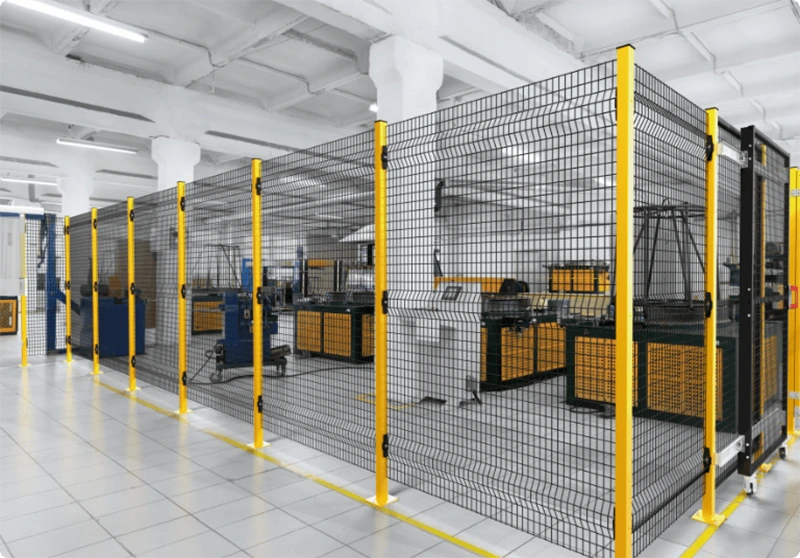
IT A corrugated or packaging plant running a two-week order book cannot write welded fixed perimeter fencing into the floor anymore. Peak e-commerce buffer expansion before a Q4 promotion and slack contraction after it — plus a new converting line every product-mix flip — move the perimeter faster than the slab. Mefence clip-fixed, on-site cuttable, modular frameless 3D industrial safety fencing turns perimeter zoning from sunk CapEx into a redeployable logistics asset: the same Q235 welded wire mesh modules carry cost across every 14-day turnover, in one weekend of work.
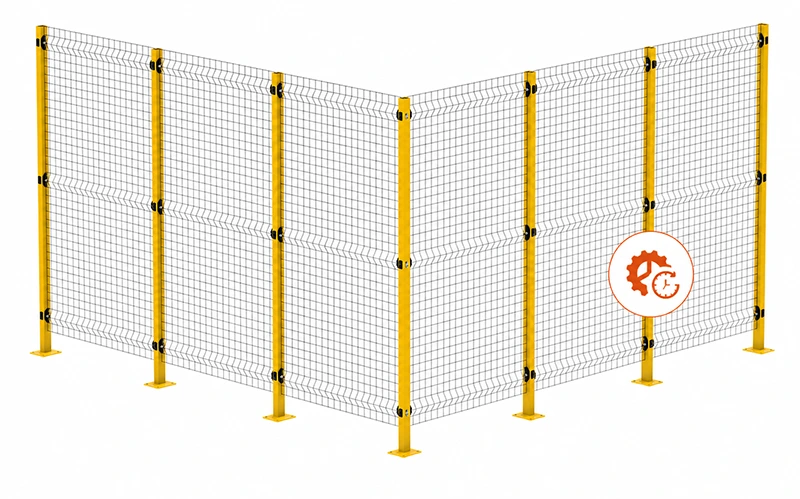
Mefence Frameless 3D Industrial Safety Fence — Engineering Specification
| Item | Specification |
|---|---|
| Material | Q235 carbon steel, electrostatic powder coated |
| Wire diameter | 3 mm / 4 mm |
| Mesh opening | 20 × 100 mm / 50 × 50 mm |
| Panel width | 200 – 1400 mm |
| Panel height | 200 – 3000 mm |
| Ground clearance | 140 mm |
| Post size | 40 × 60 mm / 60 × 60 mm |
| Standard color | Yellow + black (custom colors available, including orange) |
| Connection | Plastic clip + self-tapping screw — no site welding |
| Ground fix | Base plate + expansion bolt, slotted mounting holes for alignment |
| Structure | Frameless welded wire mesh with multiple horizontal T-shaped ridges |
| Install | One person, three steps; ~50% install time reduction vs framed welded fence |
Why 14-Day Turnover Forces the Perimeter to Be Reusable
From Welded Sunk Cost to Clip-Fixed Reusable Asset
A pre-promotion peak buffer needs a 600 m² expansion bay off the slitter. A post-promotion slack run needs that bay collapsed so the next converting line gets the floor. A new B-flute conversion line in March needs the QC sample aisle re-routed around it. The fence that was welded into the November floor is in the way of the January floor — and in the way of the March floor.
Welded framed fencing cannot survive that cadence. Cutting the anchor bolts, grinding the welds, and re-fabricating a new perimeter costs roughly the same as the original install — minus the steel waste. Three layout shifts inside one fiscal year means the same fence line is paid for twice. That is sunk CapEx in the literal sense: capital that cannot be redeployed because it is welded to the slab.
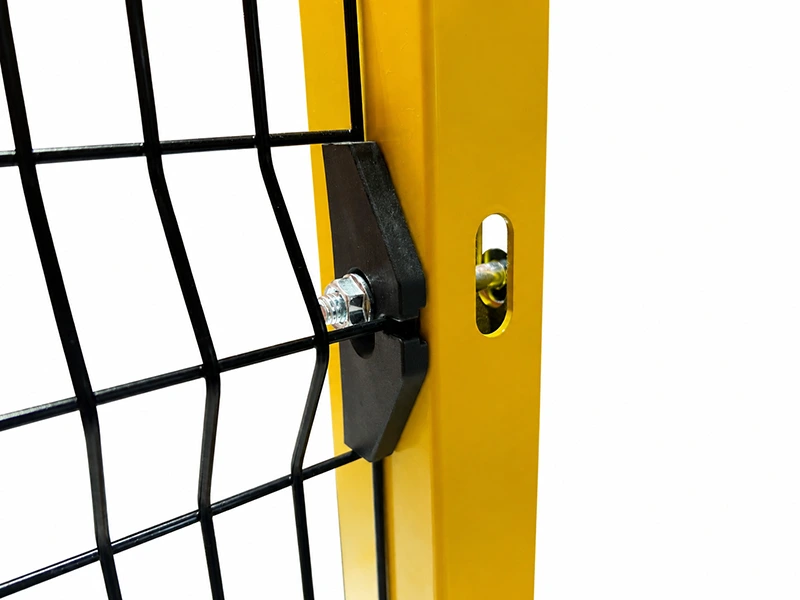
Mefence frameless 3D panels are bolted to a 40 × 60 mm or 60 × 60 mm yellow powder-coated Q235 steel post via plastic clips and self-tapping screws, with slotted mounting holes for alignment adjustment. The base plate anchors through expansion bolts. The panel-post-anchor stack is mechanical from end to end — no welding at the factory frame and no welding on the floor. When the next 14-day shift arrives, the base plate is unbolted, the clip is freed, and the panel-post pair is lifted intact to the new bay. No torch, no slag, no hot-work permit, no fire watch.
On-Site Cutting for Peak-Season Irregular Geometry
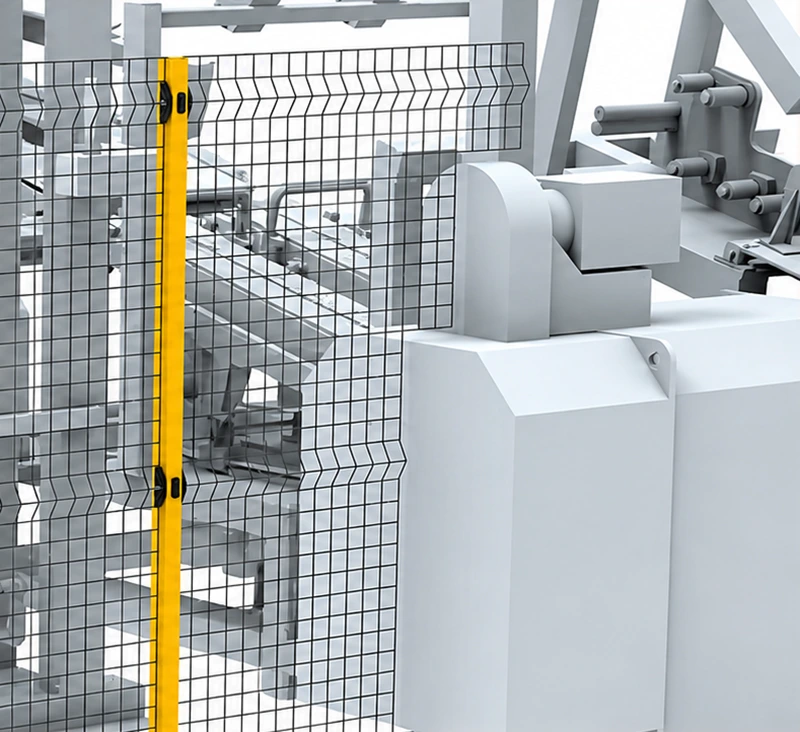
A peak-season buffer bay in a corrugated plant rarely sits on a 1,400 mm post grid. It runs into a slitter support column, a baler infeed, a corrugated stack conveyor, an HVAC duct drop, or a fire sprinkler riser. A framed fence has to be re-engineered around each obstruction — the factory cuts a non-standard panel, ships it, and the customer waits two weeks. That delay is precisely when the buffer needs to be live.
The frameless 3D panel cuts on-site with a standard abrasive disc or reciprocating saw. Wire diameter is 3 mm or 4 mm Q235 carbon steel; the cut edge takes a coat of touch-up paint and the panel is back in service inside an hour. Mesh opening stays at 20 × 100 mm or 50 × 50 mm — whichever the customer has standardized — so a hand-cut narrow panel still reads as the same fence system to the floor team. The mesh panel width range of 200 – 1400 mm and height range of 200 – 3000 mm covers every geometry the peak-season bay throws at the perimeter.
The horizontal T-shaped ridges pressed into every panel do two jobs in parallel: cable management trough for the temporary stack-light cable and the safety switch POS drive during rebalance, and a wood-slat slot when the next rebalance calls for visual shielding at the QC sample aisle. One panel, two functions — and that panel still moves with the next layout shift.
One-Person, Three-Step, 50% Faster Re-Zoning
Mefence installs in three steps: anchor the base plate post, drop the clip into the slotted post hole, set the mesh panel. One person — the customer’s own maintenance fitter. No welder qualification card, no arc-flash permit, no third-party installer. Independent installer feedback on the frameless 3D mesh system pegs the install time at roughly 50% of a conventional framed welded mesh fence — about 6 minutes per running meter against 12 – 14 minutes for framed welded equivalents.
A 60-meter buffer bay perimeter that would have taken a welded crew 14 hours to install and another 14 hours to dismantle now takes one fitter one shift. A full peak-to-slack re-zone — including the new line changeover — fits inside a weekend window: Friday teardown, Saturday reassembly, Sunday line trial. The converting line is live again on Monday with the new buffer bay, the new sample aisle, and the new pedestrian-vehicle separation aisle, all demarcated by the same Q235 mesh modules that served the layout three months earlier.
The same yellow + black high-contrast palette runs across every shift change, so supervisors and forklift drivers read the perimeter the same way in peak season and slack season. For direct strike-point containment at robot palletizing or slitter infeed stations, route the customer to SGF’s higher-spec Machine Fence / Industrial Safety Fence line — Mefence is the area demarcation and traffic guidance layer around that impact-rated boundary, not a substitute for it.
14-Day Turnover Re-Zoning Scenarios in Corrugated and Packaging Plants
- Pre-promotion peak buffer expansion bay (Q4, pre-Prime-Week, pre-Singles-Day, pre-Black-Friday)
- Post-promotion slack buffer contraction bay (Q1)
- Converting line re-balancing: slitter / die-cutter / flexo bay rotation
- QC sample aisle re-route around a new converting line
- Pedestrian-vehicle separation aisle re-section for a new order book pattern
- Tool crib enclosure redeployment for new line staffing
- Pallet buffer zone resizing for a new order mix
- Temporary partition for retrofitting slitter or flexo bay during annual shut-down
- Yellow + black hard barrier along forklift path beside converting equipment
- AGV / AMR lane control with a visibly separate pedestrian aisle
Specification Sheet
Mefence Frameless 3D Industrial Safety Fence specification sheet, panel-post schedule and on-site cut detail drawings, with reference to OSHA 29 CFR 1910.212, ANSI B11.19 and ISO 14120 area-demarcation layers.
Request Mefence Frameless 3D Safety Fence Specification Sheet
Re-Zone a 14-Day Peak Buffer Bay This Weekend
Send the next buffer bay layout — peak expansion, slack contraction, or converting line re-balance — and Mefence engineering will return a clip-fixed, on-site cuttable frameless 3D mesh panel schedule, post layout, and re-zone timing in one working day.