EN
EN  DE
DE  RU
RU  PT
PT  JA
JA  ES
ES  IT
IT End-of-Line Automation Boundary
Block the wrong step. Don’t block the robot cell.
A robotic palletizing cell at a packaging plant end-of-line needs a boundary that stops the wrong step but does not stop the operator’s eyes, the camera, or the AGV. Solid panels hide robot status, kill machine-vision coverage, and swallow LiDAR returns. Mefence frameless 3D welded mesh gives a yellow-black see-through perimeter that keeps ISO 10218 robots observable, keeps AGV / AMR navigation clean, and uses a lockable maintenance gate so access discipline survives retrofit windows. For the small set of strike points that do need rated impact containment, the honest escalation is SGF Machine Fence — not a thicker Mefence.
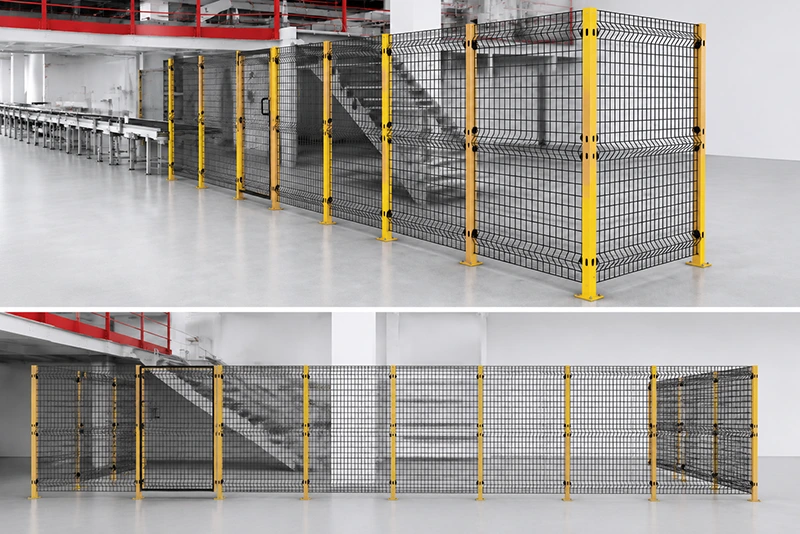
What the boundary has to cover at end-of-line
A boundary around a robotic palletizing cell is doing five things at once — keeping people out, keeping sensors clean, surviving pallet impacts on the floor edge, surviving forklift parking near the panel, and surviving the layout changes that come every time a SKU flips. Solid panels break two of those by accident: they hide robot status from the operator and they reflect LiDAR back into the AGV. Mefence spec lines stay narrow on purpose so the same panel does both jobs without inflating the panel weight or the panel cost.
| Spec line | Mefence value for EOL palletizing boundary |
|---|---|
| Material | Q235 carbon steel, electrostatic powder coating (yellow + black) |
| Mesh opening | 50 × 50 mm or 20 × 100 mm (see-through, supervisor-visible) |
| Wire diameter | 3 mm / 4 mm |
| Panel width | 200 – 1400 mm, cut to pallet lane width on site |
| Panel height | 200 – 3000 mm (typical 2000 – 2400 mm for pallet cell) |
| Post size | 40 × 60 mm / 60 × 60 mm with slotted mounting holes for floor alignment |
| Connection | Plastic clip + self-tapping screw, no site welding |
| Base fixing | Base plate + expansion bolt |
| Functional cavity | T-shaped ridge — built-in cable channel + wood slat slot |
| Standard color | Yellow + black (highest-contrast warning scheme); custom colors incl. orange |
| Install time | One person, three-step assembly; 50% faster than welded framed fence |
| Compliance scope | Area demarcation and traffic guidance under ISO 10218, ISO 14120, ANSI B11.19, OSHA 29 CFR 1910.212 — non-impact zone |
Three features the end-of-line boundary needs
See-through mesh keeps the robot cell visible for ISO 10218 work
ISO 10218-1 and ISO 10218-2 assume the operator can see the robot at all times during reduced-speed control, pendant teaching, and safe-state monitoring. A Mefence 50 × 50 mm or 20 × 100 mm welded mesh keeps that line of sight open from the operator station to the palletizing robot’s end-effector. The same openness is what lets overhead cameras, machine-vision lights, and barcode readers on the infeed conveyor keep their coverage map without a reflective glare bounce. Solid steel, polycarbonate, or acrylic panels reflect the light back into the camera and force a re-lighting study that the line never budgets for.
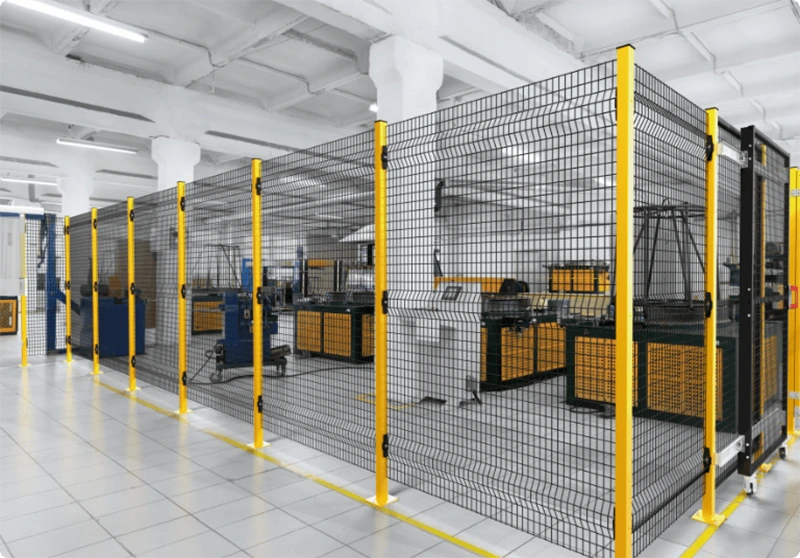
Mesh passes AGV / AMR LiDAR and lets the floor re-route around the cell
Most AGV and AMR fleets run safety-rated LiDAR on the floor ring around the palletizing cell. A solid panel shows up as a hard return and forces the fleet software to map the cell into an exclusion zone — every palletizer cycle that crosses that zone takes a 1-3 second safe-stop, which is ghost downtime the line never reports on a Pareto. Mefence’s welded mesh returns a controlled, low-density LiDAR signal that most SLAM stacks either map or filter, so the AGV keeps its lane through the pallet transfer area. When the next SKU flips and the conveyor moves 1.5 m east, the panels lift off the base plates, slide to the new footprint, and re-bolt in a single shift — no torch, no arc sparks, no fire watch.
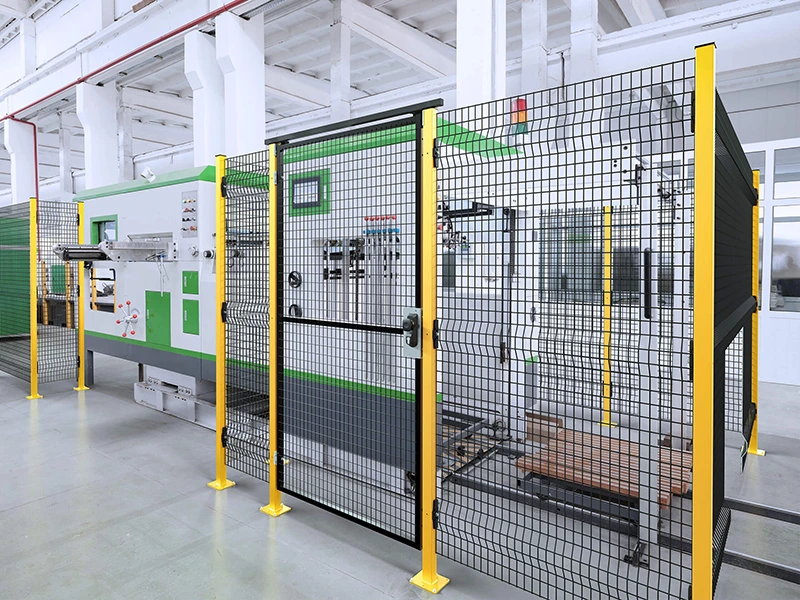
T-shaped ridge for cable routing + lockable maintenance gate
A robotic palletizing cell is also a sensor cell: safety light curtains, muting sensors, conveyor photo eyes, robot status lights, and interlock wiring all need to cross the boundary without hanging outside it. Mefence’s T-shaped ridge pressed into every panel is a built-in cable channel that carries those lines along the panel edge instead of stapling them to the floor where a pallet jack will eventually cut them. A single hinged access gate with a lockable latch on the operator side turns that gate into the only controlled entry — “normally blocks the person, maintenance lets the person in” — without anyone climbing over a yellow panel to reach a tripped safety relay at 02:00.
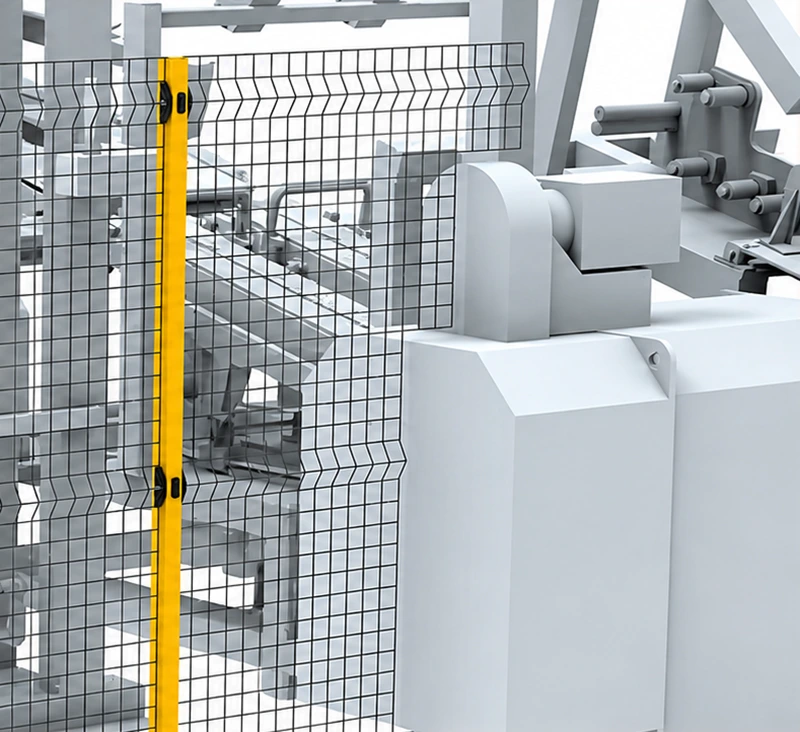
Where the boundary earns its keep at end-of-line
- Robotic palletizing cell perimeter (carton, bag, bottle, drum)
- AGV / AMR pallet transfer lanes around the cell
- Robotic case packer and depalletizer zones
- Robotic pick-and-place conveyor transitions
- Maintenance access bays for end-of-arm tooling changeovers
- Mixed-traffic end-of-line aisles (forklift + pallet jack + pedestrian)
- Cold-store and dairy packaging end-of-line cells where visibility through fog is required
- Pharma and food packaging lines where camera-based inspection must stay online
Across packaging end-of-line, the same mesh boundary earns its keep at palletizing, case packing, AMR transfer, and depalletizing — the visual story is consistent because the underlying boundary needs are consistent.
Spec the boundary before you spec the floor
Send us your palletizing cell footprint, the conveyor / AGV path around it, and which side needs a maintenance gate. We return a panel-and-post layout, a T-ridge cable channel layout, and a gate hardware schedule that separates the non-impact zone (Mefence) from any certified strike point that needs to escalate to SGF Machine Fence.
Tell us the cell. We’ll send the cut list.
Send the palletizing cell drawing or a quick sketch of the AGV lane around it. We come back with a Mefence panel-and-post layout, a T-ridge cable channel, and the gate schedule — and we flag the small set of strike points that have to escalate to Machine Fence so the audit file is honest.