EN
EN  DE
DE  RU
RU  PT
PT  JA
JA  ES
ES  IT
IT End-of-Line Packaging Automation
End-of-Line Packaging Automation Fencing: Why Mefence Frameless 3D Mesh Beats Solid Walls Around Robotic Palletizing + AGV Cells
End-of-line packaging automation is no longer a roadmap slide — robotic palletizing cells, AGV pickup lanes, and stretch-wrapper handovers now share the same dock. ISO 10218 robot safety standards keep tightening, supervisors need visual rounds, AGV/AMR LiDAR needs clean reflections, and line cameras need to read barcodes through the boundary. A solid steel wall solves one problem and breaks the other three. Mefence frameless 3D industrial safety fence blocks the person, leaves the sight line open, and turns the panel ridge into a cable runway — so the palletizing cell perimeter, the AGV corridor, and the cable bundle share one clip-fixed module instead of three welded jobs.
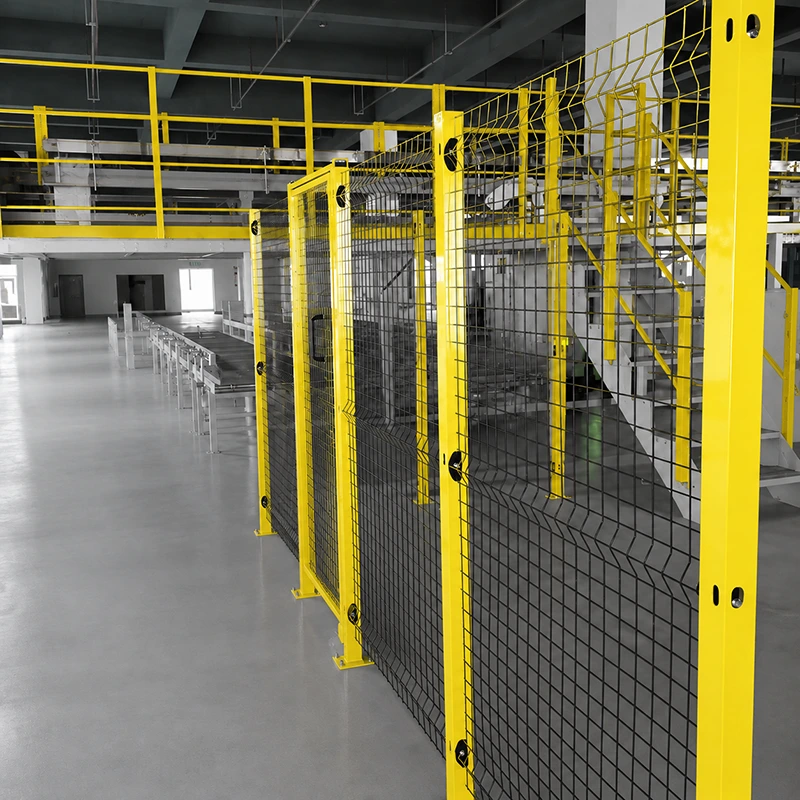
What a See-Through Palletizing Cell Fence Has to Carry on One Module
An end-of-line fence is not just a perimeter. It carries the visible boundary, the cable bundle for safety interlocks and vision cameras, the AGV/AMR corridor line, the access door, and the future retrofit handle. The spec table below is what Mefence brings to that job — and what a solid steel wall cannot.
| Specification | Mefence Frameless 3D Industrial Safety Fence |
|---|---|
| Mesh opening | 20 × 100 mm (primary) / 50 × 50 mm (heavy-duty) — open enough for LiDAR return, closed enough to stop a hand |
| Wire diameter | 3 mm (standard) / 4 mm (high-traffic palletizing cells) |
| Panel width | 200 – 1400 mm, cut on site with a hand grinder for irregular cell footprints |
| Panel height | 200 – 3000 mm — pick 2000–2200 mm for a typical palletizing cell with overhead camera clearance |
| Post size | 40 × 60 mm or 60 × 60 mm yellow powder-coated Q235 steel post, slotted base plate for alignment on a dock floor |
| Material and surface | Q235 carbon steel wire mesh, electrostatic powder coated (yellow + black as standard, custom colors including orange) |
| Connection | Plastic clip + self-tapping screw on the post; base plate post + expansion bolt to the floor — no site welding, no hot-work permit |
| T-shaped ridge (panel bend) | Multi-row pressed bend across each panel — doubles as a cable routing trough for light-curtain, interlock, and line-camera cables; accepts a wood-slat insert for visual shielding where needed |
| Ground clearance | 140 mm — keeps the LiDAR cone of the AGV/AMR clear of the panel base |
| Standard posture toward ISO 10218 / OSHA 1910.212 | Non-high-impact area demarcation; visual boundary; AGV/AMR lane control; impact-rated strike points remain a Machine Fence scope |
Three Reasons a 20 × 100 mm Mesh Wins the End-of-Line Boundary
1. Mesh vs. Solid Wall, Side by Side at the Palletizer
A solid steel panel stops the person and stops everything else with it. The line camera on the palletizer head can no longer read the case label as the conveyor feeds the cell; the supervisor doing a visual round can no longer see the robot arm reach into the slip-sheet tray; the AGV/AMR LiDAR cone gets a blank reflective face where it expected a clean return. Mefence’s 20 × 100 mm welded wire mesh — Q235 carbon steel, 3 mm or 4 mm wire — keeps the cell boundary visible to all three. Operators visually confirm the palletizer head without entering the cell. Line cameras read the case barcode through the boundary. AGV/AMR LiDAR returns register against the mesh frame instead of bouncing off a solid plate, which keeps the safety-rated reduced-speed zone predictable at the cell door.
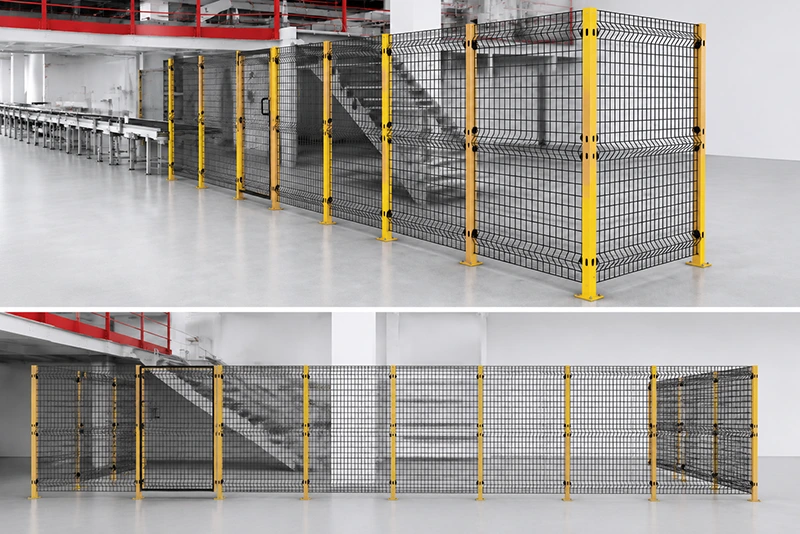
2. The T-Shaped Ridge Becomes the End-of-Line Cable Runway
An end-of-line cell is a cable jungle: light-curtain transmitter and receiver pairs, safety interlock loops, the line camera PoE run, the palletizer encoder cable, and the E-stop loop all want a clean home. The Mefence panel is press-bent with multiple T-shaped ridges across its height, and the ridge channel runs the full panel width. Cables lay in the trough, a single plastic clip + self-tapping screw locks them down, and the cable bundle disappears from the AGV/AMR corridor instead of being strung across it. The 40 × 60 mm or 60 × 60 mm Q235 yellow powder-coated post adds the second cable route — slotted mounting holes on the post face accept standard cable ties, so interlock and 24 VDC cables do not drape over the cell floor. When the next SKU changeover pulls the palletizer three meters east, the cables lift out of the ridge, the panel cuts on site with a hand grinder, and the runway reassembles at the new position.
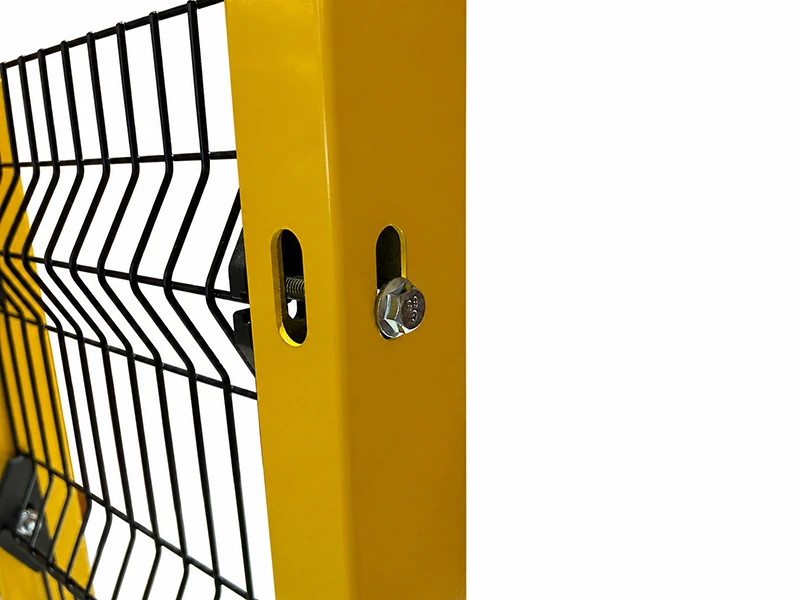
3. Split-Scope with Machine Fence — Honest About the Strike Zone
Mefence is positioned as non-high-impact area demarcation — that is honest by design and the blog_brief says so plainly. The end-of-line cell has two risk profiles that need two different fences. The palletizer’s high-speed head, the stretch-wrapper turntable, and the pallet stack quarantine bay all sit inside reach of a moving mass; those are the strike points. SGF’s higher-spec Machine Fence / Machine Guard Fence line takes those — certified anti-collision containment. The rest of the cell — the conveyor infeed, the AGV/AMR pickup lane, the vision check station, the operator side of the safety door — is exactly where Mefence earns its keep: a yellow + black frameless 3D modular safety fence with 50 mm ground clearance for LiDAR, an open mesh for line cameras and supervisor visibility, and a clip-fixed assembly that lets maintenance relocate the perimeter over a weekend between SKU changeovers. Telling the customer this split early is what makes the proposal read like engineering, not a catalog quote.
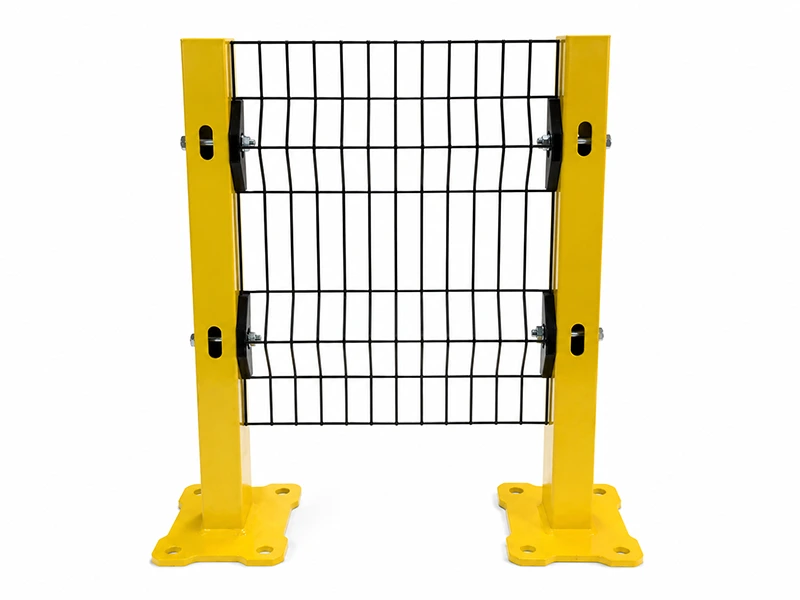
Where Mefence Fits on an End-of-Line Packaging Floor
- Robotic palletizing cells — carton, case, bag, and shrink-bundled palletizers — where the operator needs a visible boundary that still lets the line camera see through.
- AGV / AMR pickup lanes feeding the palletizer, where LiDAR returns must register against the fence instead of reflecting off a solid wall.
- Stretch-wrapper and conveyor handover zones, where the boundary moves two to four meters east during a SKU changeover.
- Pallet stack quarantine bays with see-through visibility for the forklift driver at the inbound staging lane.
- Vision-system check stations at the cell boundary, where the line camera has to read labels and 2D codes through the panel face.
- Forklift–pedestrian dock doors at the end of the packaging hall, where the boundary must be visible from the cab and from the pedestrian side at the same time.
- Tool crib enclosure and maintenance cart parking beside the palletizer, where the same Q235 module walls off the storage area without hiding it from a supervisor’s visual round.
Across all seven, the deliverable is the same: a clip-fixed, on-site-cuttable, modular Q235 industrial safety fence industrial mesh with a yellow + black post, a 40 × 60 mm or 60 × 60 mm profile, no hot-work permit, and a T-ridge cable channel — the same module reassembled at the next cell footprint when the line moves.
Pull Down the End-of-Line Fencing Spec Sheet
The Mefence spec sheet carries the full mesh opening table (20 × 100 mm / 50 × 50 mm), wire diameter options (3 mm / 4 mm), the 40 × 60 mm and 60 × 60 mm post sizes, the T-shaped ridge cable channel dimensions, the clip-fix assembly sequence, and the standard yellow + black powder-coated finish. Pair it with our end-of-line retrofit checklist (cell footprint, AGV/AMR lane direction, line camera height, palletizer strike-point count, ISO 10218 / OSHA 1910.212 reference) when you send us the cell drawing.
Send the Palletizing Cell Drawing, Get a Mefence Layout Back
Tell us the cell footprint, the AGV / AMR lane direction, the line camera count, and where the high-speed strike points sit. We will mark the Mefence perimeter (yellow + black frameless 3D industrial safety fence, clip-fixed) and the Machine Fence strike zones (certified containment) on the same drawing, so procurement, EHS, and the controls team are looking at one split-scope plan.