EN
EN  DE
DE  RU
RU  PT
PT  JA
JA  ES
ES  IT
IT Modular Warehouse Guard Rails · Q235 Corrugated Steel
Four Workshop Zones, 58 m of Guard Rail, Zero Site Welding — Modular Corrugated Steel Panels That Re-Track With Every Re-Zone
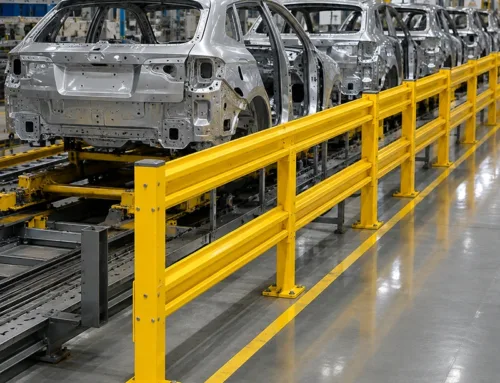
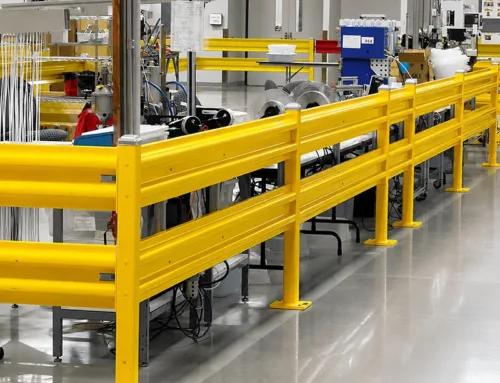
When four workshop zones re-zone on different business cycles, welded steel tube guard rails become sunk cost on the next aisle redraw. Hsafety modular corrugated steel warehouse guard rails — 1,500 mm standard W-beam panels plus 680–1,140 mm custom fillers, Q235 carbon steel, double-rail corrugation, 160×160×16 mm bolted base plates — give EHS, facilities and operations managers a bolted guard rail system that fits irregular zone lengths, drops onto a ≥150 mm concrete slab with no hot-work permit, and re-deploys intact when the next re-zone lands on the floor.

15176 Engineering Record: Four Zones, 72 Panels, 42 Posts, One Pallet Plan
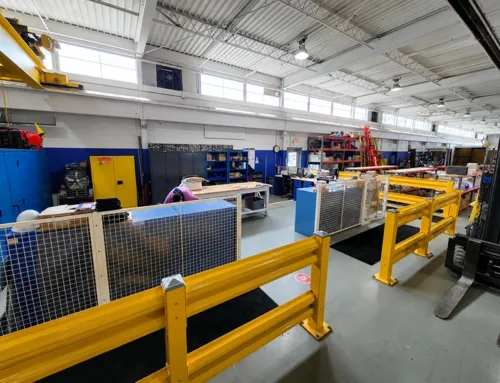
The 17,000 / 12,000 / 17,100 / 11,900 mm four-zone configuration is the kind of layout an EHS team hands to procurement when no two zones share the same length. Every standard 1,500 mm W-beam panel and every custom filler is the same Q235 corrugated steel, the same bolted base plate, the same yellow powder coated finish — the only thing that changes is the filler length and the post count.
| 15176 Workshop Zone | Standard Panels (1,500 mm) | Custom Filler Length | Posts 80×80×6 mm | Total Zone Length |
|---|---|---|---|---|
| Zone 1 | 20 | 2 × 1,040 mm | 12 | 17,000 mm |
| Zone 2 | 14 | 2 × 780 mm | 9 | 12,000 mm |
| Zone 3 | 20 | 2 × 1,140 mm | 12 | 17,100 mm |
| Zone 4 | 14 | 2 × 680 mm | 9 | 11,900 mm |
| 4-Zone Total | 64 | 8 (1,040 / 1,140 / 780 / 680 mm) | 42 | 58,000 mm |
Project total: 72 corrugated steel panels, 42 square posts, ~2,243 kg ±5% on 2 pallets (1,500×1,000×1,500 mm and 1,000×800×750 mm). Double-rail at 1,000 mm height; lower rail 100 + 6 mm off the slab. Packing: individual paper wrap + strapping for paint-film protection; stretch wrap is a project-line alternative.
Three Engineering Decisions That Make Hsafety Modular Guard Rails Re-Zoneable
1. 1,500 mm Standard Modules + 680–1,140 mm Custom Fillers Replace Site-Welded Tube
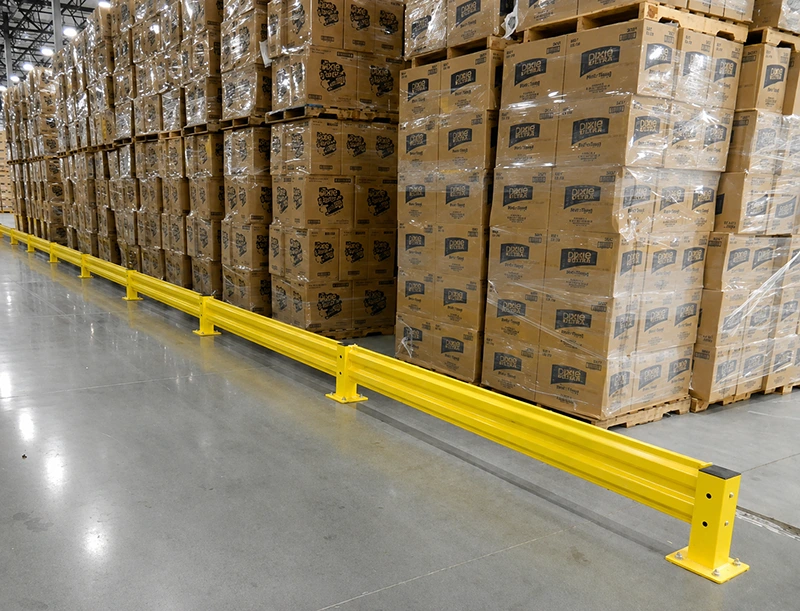
Most “non-standard” warehouse zones are non-standard only because the old supplier sold fixed 6 m or 12 m welded tube and refused to trim. Hsafety treats every zone length as the sum of standard 1,500 mm W-beam panels and 680–1,140 mm custom fillers pressed in the same Q235 production line. The 15176 four-zone record (64 standard + 8 fillers = 72 panels) covers 58,000 mm of zone edge with a single drawing pack — no cutting torch, no welder, no post-cure paint cycle on site, only a torque wrench on the 4 × M-class anchor bolts per 160×160×16 mm base plate. The same approach is what allows a distribution-center staging buffer to expand by 3,000 mm in a peak and contract by 4,000 mm in a lean without re-pouring a slab.
2. Q235 W-Beam Double Rail + Bolted Base Plate: Re-Deployable End-to-End
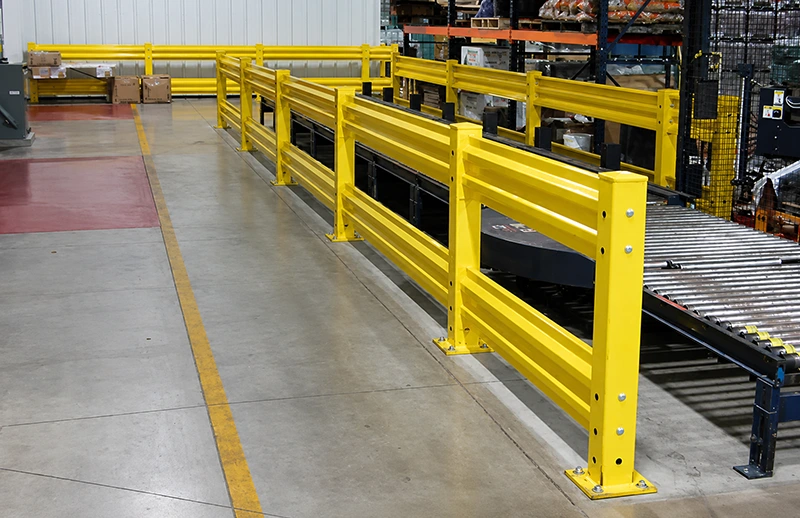
The double-rail W-beam corrugation (310 mm panel width, 85 mm wave height, 40 mm wave amplitude, 3 or 4 mm thickness) is what absorbs the forklift strike; the re-deployability is what sits in the base. Each panel is bolted to 80×80×6 mm square posts on 160×160×16 mm base plates, anchored with 4 × M-class expansion bolts into a ≥150 mm concrete slab. When the next re-zone lands, the same posts, panels and base plates unbolt in reverse order, move to the new zone, and re-bolt into the new anchor pattern — no slab re-pour, no hot-work permit, no repaint cure. Yellow powder coated is the default warehouse guard rail finish; hot-dip galvanized is selected for damp docks, cold storage, and outdoor loading aprons.
3. Project-Condition Load Statement, Not a Generic Marketing Joule
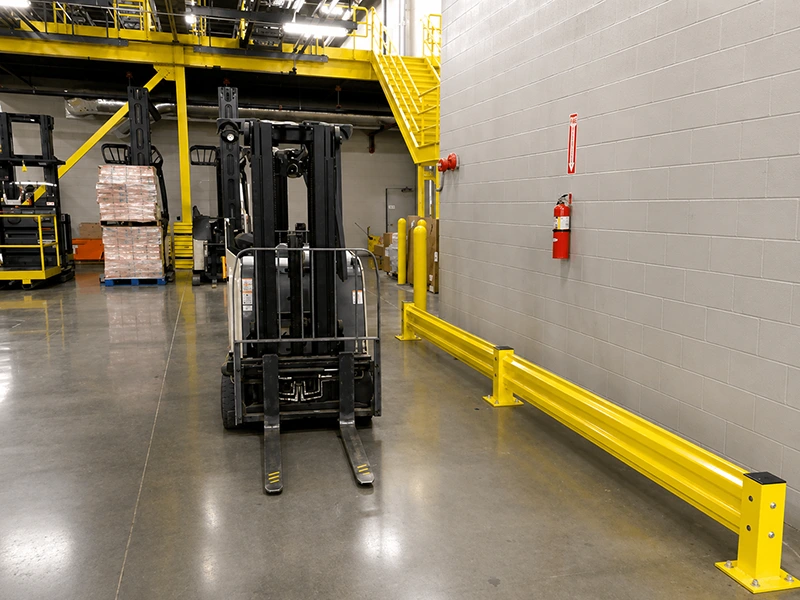
15176 is a real design condition, not a marketing number: 3-ton forklift at 10 km/h ≈ 16,680 N strike load distributed across the corrugated W-beam, applied uniformly to the 1,000 mm height and 1,500 mm post spacing, with the lower rail held 100 + 6 mm off the slab. The same calculation chain covers a 2-ton pallet jack at 6 km/h in a narrow pick aisle and a heavier 5-ton counterbalance at 12 km/h on a receiving apron. EHS teams should request the per-configuration impact test report for their actual forklift class and aisle speed before signing the drawing pack — never assume a generic Joule rating carries across a re-zone. End-cap bollards, reflective tape, hot-dip galvanized vs. powder coated surface, and lift-out segments are project-line items, not default scope.
Where Hsafety Modular Corrugated Guard Rails Re-Track the Traffic Flow
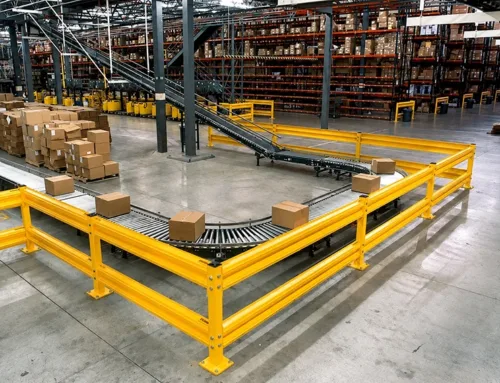
- Distribution-center staging buffers that expand for peak and contract for lean
- Manufacturing plant zone boundaries that re-balance per NPI cycle
- Loading dock apron and dock door post protection
- Pallet rack end frames in narrow-aisle pick modules
- Conveyor line side guarding that extends with each new infeed
- Electrical cabinet, control panel and utility room enclosures
- Pedestrian-vehicle separation along mixed-traffic aisles
Each Hsafety corrugated steel rail segment is bolted, not welded. When the next re-zone hits, the same modules, posts and base plates redeploy to the new zone — no scrap, no slab re-pour, no re-paint cycle, and no second capital purchase for the same protection line.
Drawing Pack Reference
Per-zone panel schedules, base-plate anchor patterns and the four-zone pallet plan (1,500×1,000×1,500 mm + 1,000×800×750 mm, total ~2,243 kg ±5%) are available on request. Send the four zone lengths and the forklift class / aisle speed; we return a 1,500 mm standard + custom filler layout, the anchor bolt call-out, and the per-zone project-condition load statement for HSE review.
Re-Zoning Four or More Warehouse Zones? Get the Modular Corrugated Guard Rail Drawing Pack
Send the four zone lengths (or any non-standard length) and the forklift / traffic flow brief. We return a 1,500 mm standard + custom filler layout, the 160×160×16 mm base plate and M-class anchor bolt call-out, and a project-condition load statement that EHS and procurement can both sign.