EN
EN  DE
DE  RU
RU  PT
PT  JA
JA  ES
ES  IT
IT PICK-LANE & AISLE PROTECTION
Peak-Season Aisle Re-Layouts: Lift-Out Warehouse Guard Rails That Move With the Forklift Route
When a 3PL or e-commerce DC reshuffles pick aisles every two weeks to chase a new peak, welded perimeter steel becomes scrap on the next re-layout. This is the working note on how bolted, lift-out warehouse guard rails absorb the same 3-ton forklift impact as fixed barriers, then unbolt in minutes when the next route redraw lands on the floor.
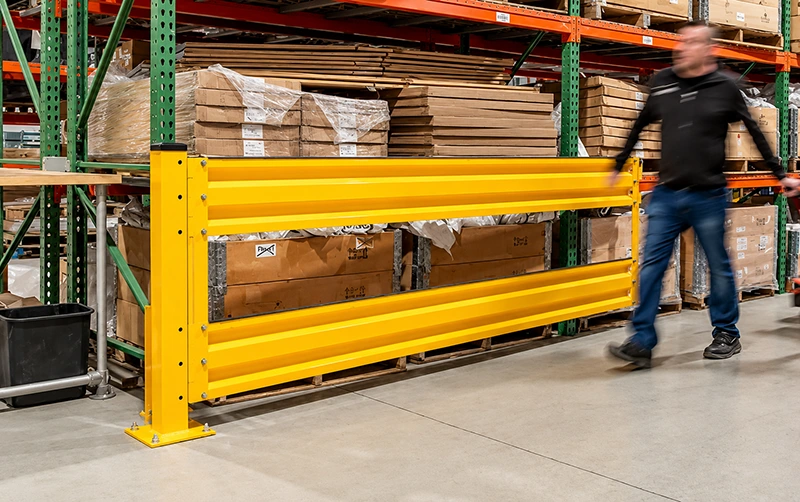
Modular Specs, Verified for a 3-Ton Forklift at 10 km/h
Every value below comes from a documented installation or the design record for opportunity 15176, not a marketing catalogue. Custom lengths and post counts are project-specific and have to be re-checked against the actual aisle width, the forklift class on site, and the slab condition before a purchase order is cut.
| Spec | Value |
|---|---|
| Material | Q235 carbon steel (S235JR equivalent) — panel and post |
| Panel thickness | 3 mm standard / 4 mm heavy option |
| Wave geometry | 85 mm wave height, 40 mm amplitude, 310 mm panel width |
| Panel length | 1,500 mm standard; custom cuts from 680 mm to 1,140 mm |
| Post section | 80 x 80 x 6 mm square tube, 1,000 mm tall |
| Base plate | 160 x 160 x 16 mm, 4 x M12 to M16 expansion bolts into at least 150 mm concrete |
| Post spacing | 1,500 mm centre-to-centre |
| Surface treatment | Hot-dip galvanized or yellow powder coat (RAL 1023); reflective tape optional |
| Impact rating | 3-ton forklift at 10 km/h equals 16,680 N on the 1,000 mm module |
| Hardware | Bolted guard rail system; every panel a separable lift-out segment |
Three Engineering Reasons Lift-Out Stays Ahead of Fixed Steel
Lift-Out Panels Unbolt in Under Two Minutes
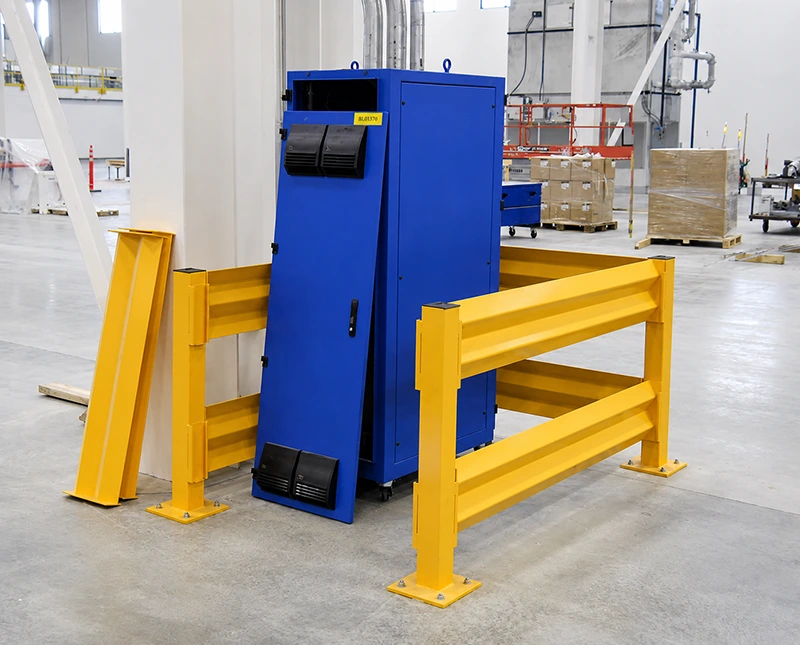
A single panel separates from its two neighbouring posts on four M16 through-bolts. The whole segment lifts out by hand, leans against a wall, and goes back into the same hardware. No torch, no angle grinder, no drill swarf on the floor. When the next peak lands, the same posts receive a new panel layout without re-drilling the slab. The lift-out feature also means a battery charger, a roll-up door, or a new dock leveler can be moved into the bay without cutting the rail with a reciprocating saw.
Bolted, Reusable Modules Spread Capex Across Every Re-Layout
Every rail, every post, and every base plate is an inventory item with a part number. A layout that used 1,500 mm rails in aisle A this month can move them to aisle D next month, piece by piece. The same hardware is reused across peak season, off-season, and any NPI cycle the floor team runs. Procurement no longer has to write off a welded perimeter every time the route map changes, because the asset walks from one aisle to the next with the aisle, not against it.
Custom-Length Panels Replace the Welder on Site
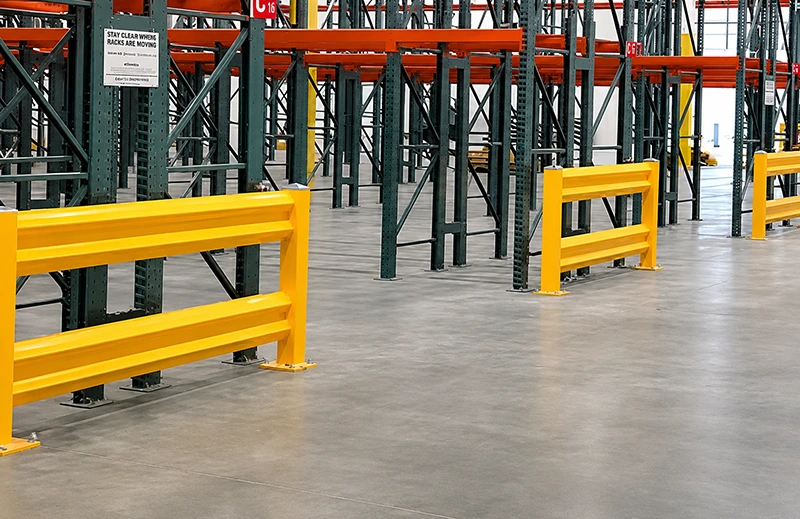
The line is sized in 1,500 mm modules plus a custom cut (e.g. 1,140 mm, 1,040 mm, 780 mm, 680 mm). The factory ships the cut; the installer does no site welding, no core drilling, and no on-site powder touch-up. A 17,100 mm run, a 17,000 mm run, and two 12,000-ish runs ship on two pallets, not four. The hot-dip galvanized or yellow powder coat is finished in the factory, so there is no spark, no fire watch, and no repaint cycle once the bolts are down. Re-purposing the same hardware for the next peak is then a half-shift job, not a multi-day shutdown.
Where Lift-Out Beats Fixed on a Re-Layout Floor
- Peak-season buffer expansion: 2 to 3 weeks of overflow pick-face expansion when order volume spikes past the base pick module.
- Off-season aisle contraction: 20 to 30 percent of pick faces handed back to pallet reserve for Q1, with the rails stored on standard racking until the next peak.
- End-of-aisle rack end protection: uprights stay intact through peak forklift traffic, and the same panel can be re-cut if a new beam level is added.
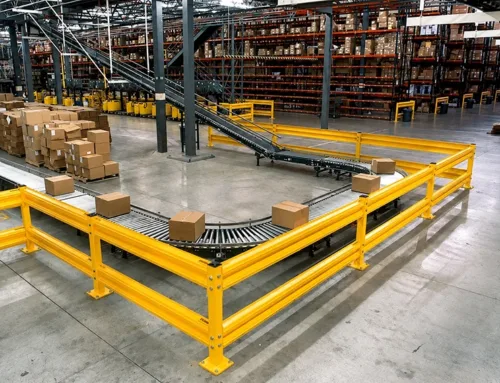
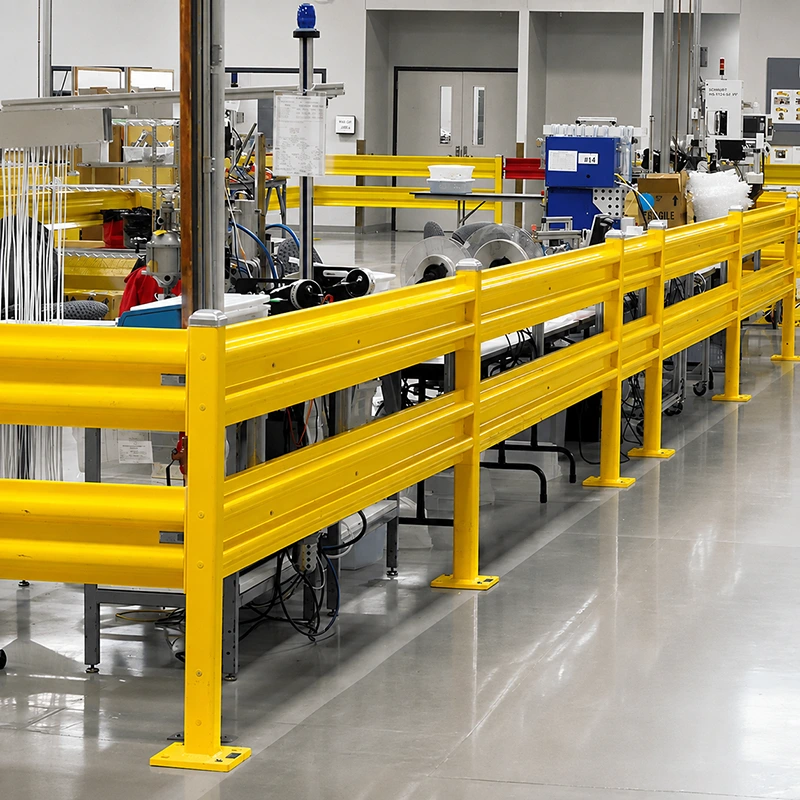
- Conveyor line crossover: temporary removal for maintenance or route redraws, then re-installed in the same base plate holes.
- Dock door approach: re-route a barrier when a new dock leveler, a new seal, or a wider trailer is introduced.
- Equipment cabinet enclosure: keep electrical cabinets shielded without welding the post into the slab, so the cabinet can be swapped without burning the rail.
- Charging station demarcation: relocate as the AMR or forklift fleet grows, with the lift-out hardware moving to the new charging island.
- Loading bay wall protection: same hardware moves when a wall is relocated for a new inbound lane.
In a floor that redraws routes every 14 to 30 days, the deciding factor between fixed and lift-out is no longer impact strength — both stop the same 3-ton forklift at 10 km/h — but what happens the next time the layout needs to change. A bolted, lift-out warehouse guard rail is the asset that comes along for the next peak, not the asset that has to be cut up and scrapped.
Get the Lift-Out Layout Worksheet
A one-page worksheet covers panel length, post spacing, base plate drilling, and lift-out hardware SKUs. Email us your peak-season aisle list — pick face widths, rack depth, forklift class — and we will return a bill of materials in two working days, including a per-aisle re-layout plan for the next two peak cycles.
Send Your Aisle Redraw, Get a Lift-Out BOM
Every lift-out project starts with the new aisle widths, the forklift class, and the impact direction. We return a panel cut list, a post list, and a hardware kit that the floor team can install over a weekend. The next layout change reuses the same hardware, so the second and third peak seasons ride on hardware that has already been paid for.