EN
EN  DE
DE  RU
RU  PT
PT  JA
JA  ES
ES  IT
IT ESG Disclosure & Multi-Site Safety
The No-Fatality Baseline Beneath Training, PPE and Telematics
For a multi-site distribution or e-commerce network, a Q235 corrugated steel warehouse guard rail is the visible passive layer that catches the strike training, PPE and telematics miss — and the consistent one-spec industrial guard rail that lowers ESG disclosure risk across plants.
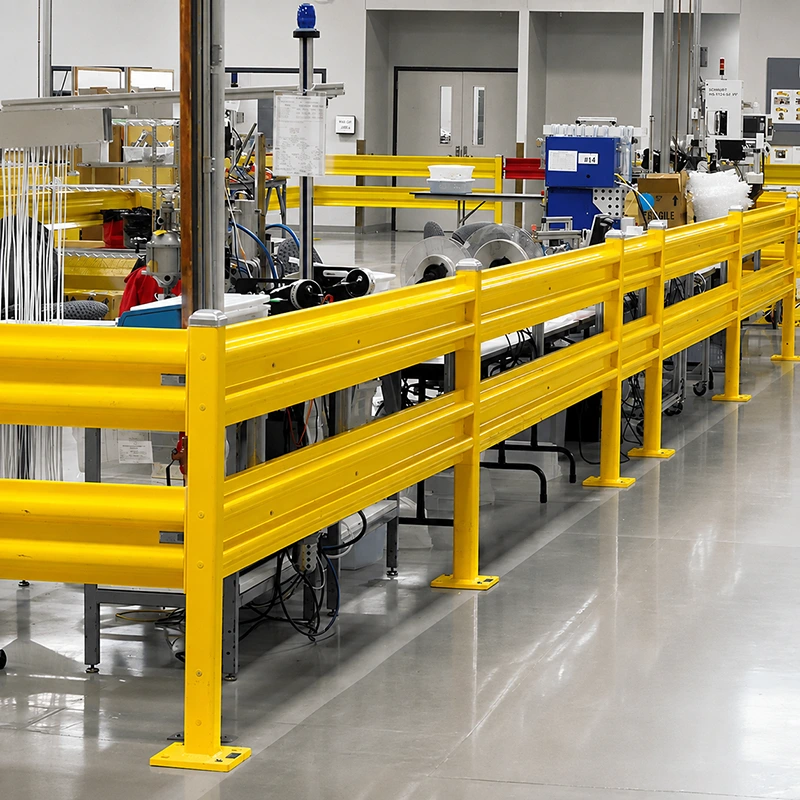
One Spec, Locked Once, Deployed at Every Plant
A corrugated steel guard rail scales across plants because the engineering is finished before the order ships. Network procurement does not re-engineer the panel at every site; it specifies the same Q235 module, the same anchors, the same inspection cycle, and lets the factory floor prove it on day one.
| Spec | Value |
|---|---|
| Profile | Q235 carbon steel, corrugated W-beam (2-rib or 3-rib) |
| Panel width | 310 mm |
| Wave pitch / wave height | 194 mm / 85 mm |
| Panel thickness | 3 mm or 4 mm |
| Post spacing (inside) | 1,500 mm |
| System height | 1,000 mm |
| Post section / base plate | 80×80×6 mm square tube / 160×160×16 mm base plate |
| Connection | Bolted panel-to-post; 4 expansion bolts per post into ≥150 mm concrete |
| Configuration | Single-rail or double-rail; modular bolted guard rail system |
| Surface | Powder-coated safety yellow (custom colors) or hot-dip galvanized |
| Options | Reflective tape, post caps, blockouts, end caps, lift-out bracket, custom length |
Why Network Procurement Buys Corrugated Steel, Not a Marketing Line
The No-Fatality Baseline Beneath Active Controls
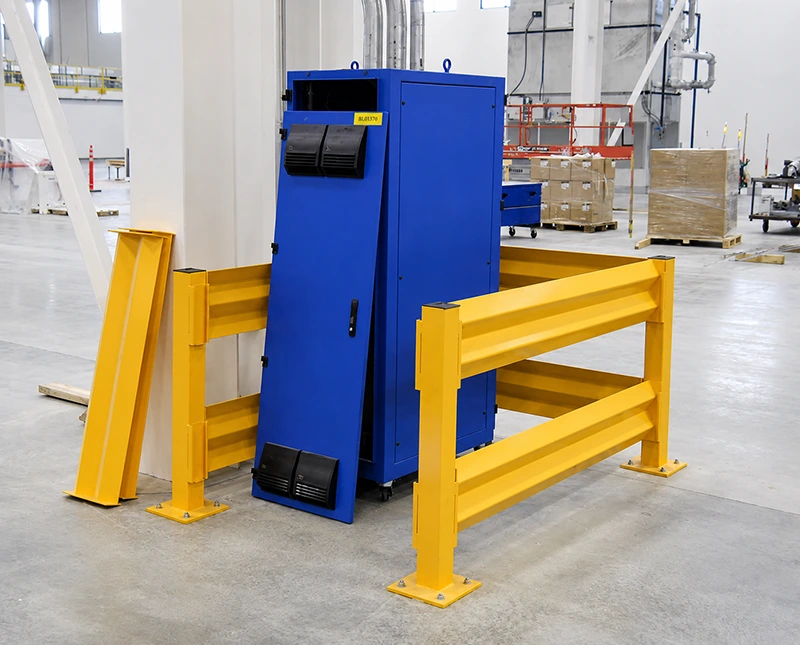
An OSHA hierarchy-of-controls map puts the passive physical barrier at the bottom of the stack — but “bottom” does not mean optional. When forklift telematics misses the second of operator inattention, when PPE cannot transfer impact away from the operator, the warehouse guard rail is what stops the fatal outcome. A double-rail corrugated steel panel at 1,000 mm height, bolted through a 160×160×16 mm base plate into ≥150 mm concrete, holds the floor when every other control has been used up. For an ESG-disclosure network, that is the line item that converts an “active safety programme” into an evidence file the auditor will accept.
One Spec That Re-Deploys Across Plants Without Re-Engineering
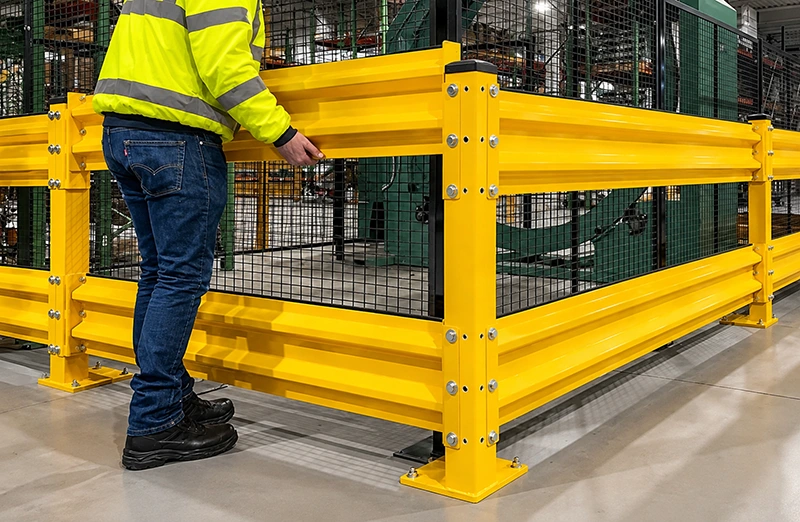
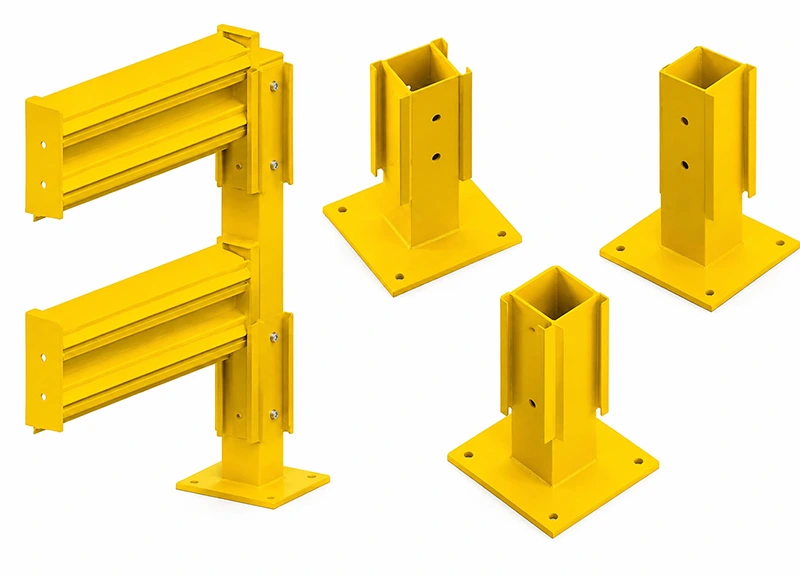
A 4-zone plant of 17,000 mm / 12,000 mm / 17,100 mm / 11,900 mm at uniform 1,000 mm height was delivered from one modular bolted guard rail system: 1,500 mm standard panels plus 1,140 mm / 1,040 mm / 780 mm / 680 mm custom fillers — 64 standard panels and 8 special panels, 42 posts, ~2,243 kg total, two pallets. The board-level review for a network rollout is whether the same 1,500 mm post spacing, the same 80×80×6 mm post and the same base plate can be re-specified at plant #2, #3 and #4 with no fresh structural calculation. With corrugated steel warehouse guard rails, the answer is yes — the panel geometry, the post spacing and the anchor pattern stay constant, only the total running length changes.
Maintenance-Free Steel vs. Annual Rebound-Tested Polymer
Polymer crash barriers rebound and look clean after a strike — but every plant that runs them pays for an annual rebound test to confirm the polymer cell has not fatigued. Across a 12-country network that re-test line item is a recurring brand-risk exposure that an internal auditor will find. A Q235 steel corrugated guard rail, hot-dip galvanized at the substrate, takes the strike, may dent locally, and is then inspected against the same engineering drawing used at the other 11 plants. There is no annual polymer-rebound verification line in the ESG workbook, and the procurement board signs off one spec, not twelve.
Where the One-Spec Warehouse Guard Rail Earns Its Place on the ESG Page
- Warehouse rack end protection and pallet-rack upright lines
- Loading dock and truck apron (forklift impact protection)
- Conveyor and sortation corridors (collision protection)
- Robotic cell external defense (asset protection guardrail)
- Electrical cabinet and equipment room boundaries
- Cold storage aisle and outdoor yard (hot-dip galvanized option)
- Pedestrian-vehicle separation at every pick face and QC station
The result, network-wide and across plants, is a consistent accident prevention barrier that supports the same documentation pack in every ESG disclosure — written once, deployed at every site, audited against the same drawings.
What to Ask Before You Lock the One-Spec Network
Before procurement signs off a multi-plant rollout, three checks keep the spec honest: confirm the 1,000 mm height and 1,500 mm post spacing match every site survey; confirm the 160×160×16 mm base plate and the 4-bolt anchor pattern can be re-used on each plant’s ≥150 mm slab; confirm the 3 mm or 4 mm panel thickness is paired with the documented forklift envelope in the engineering file — not inferred from a brochure. Hsafety addresses all three checks with a per-plant bill of materials on the same Q235 module, and a layout drawing keyed to the same post and base-plate schedule used by the other plants in the network.
Lock the Document Risk in One Q235 Steel Spec
Send us your site plan and we will return a per-plant bill of materials on the same warehouse guard rail module — for ESG disclosure consistency across plants, not for one-off installations.