EN
EN  DE
DE  RU
RU  PT
PT  JA
JA  ES
ES  IT
IT Hsafety · Multi-Site EHS Compliance
The Visible Hardware Layer: Building an OSHA Hierarchy-of-Controls Audit Pack from One Q235 Steel Warehouse Guard Rail Spec for Multi-Site EHS Rollouts
For multi-site distribution, e-commerce and network-level retailers, the auditor no longer accepts a yellow barrier as evidence. PAS 13 in the UK, the OSHA NEP on powered industrial trucks, and UNI TS 11886 for warehouse zonal logic all push the visible hardware layer up the hierarchy of controls. A Q235 steel warehouse guard rail with bolted base plates, custom project lengths, and site-specific color already supplies most of that audit pack. The remaining gap is honest: a tier-1 e-commerce procurement board reads an independently tested PAS 13 / EN 1317 impact certificate, and Hsafety currently publishes manufacturer-rated figures (2-Rib ≈ 4.5 t, 3-Rib ≈ 5.4 t @ 6.5 km/h as project / design conditions) without a public third-party PAS 13 test — the certification workstream that has to close before an Amazon-class BWU6-style polymer spec is fully matched.
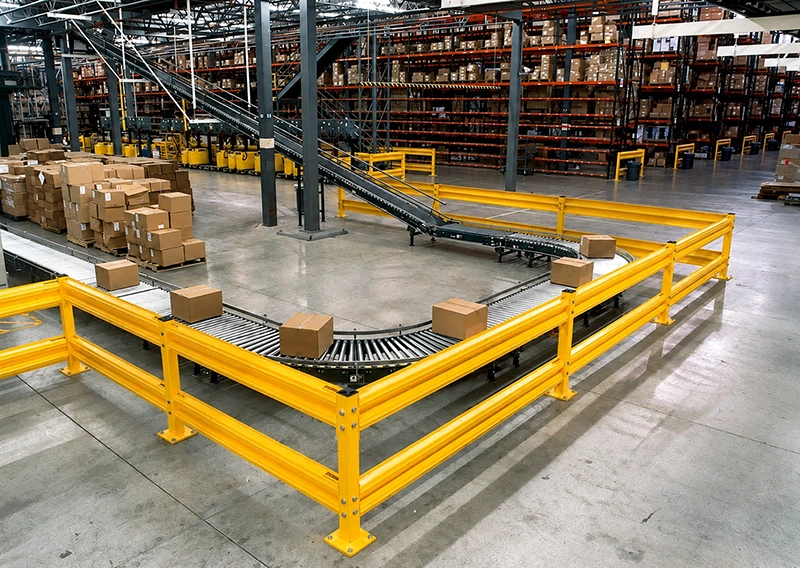
Standard Q235 Steel Guard Rail Hardware Documented in the Audit Pack
Most plant managers can hand an inspector a generic catalogue — few can hand them a per-site hardware register that explicitly maps the asset boundary to the OSHA hierarchy of controls and to PAS 13 / UNI TS 11886 zonal logic. A Q235 steel warehouse guard rail with bolted base plates, project filler panels and a site-specific RAL or hot-dip galvanized finish already covers the visible-hardware layer. This is what sits in the audit pack when the specification goes out to procurement.
| Audit-Pack Item | Hsafety Q235 Steel Warehouse Guard Rail Specification |
|---|---|
| Material and traceability | Q235 carbon steel, mill certificate traceable per lot; surface treatment recorded per project (powder coat batch or ISO 1461 hot-dip galvanize call-out) |
| Rib profile | 2-rib / W-beam or 3-rib / thrie-beam; both wave profiles kept under the same drawing revision so the audit register reads one format across plants |
| Module and filler lengths | 1,500 mm standard panel as the network baseline; custom fillers 680 / 780 / 1,040 / 1,140 mm documented per warehouse segment so non-standard aisles close cleanly without field cutting |
| Panel width and thickness | Approximately 300–310 mm wide; 3 mm thickness for light MHE corridors and 4 mm for higher-class impact routes per project call-out |
| Post and base plate | 80 × 80 × 6 mm square steel tube, 1,000 mm high, lower rail offset 100 + 6 mm above floor; 160 × 160 × 16 mm base plate; 4-bolt corner anchor pattern documented in the drawing revision |
| Anchoring | M16 expansion bolts into a ≥ 150 mm concrete slab; bolt count and torque logged in the asset register so replacement after a strike can be audited segment by segment |
| Surface, color and marking | Powder-coated yellow (default safety coat) or hot-dip galvanized; custom RAL per site standard; reflective tape or LED sign boards optional on low-light aisles |
| Documented accessories | End caps, joint hardware, bollards, lift-out sections for temporary vehicle access, reflective tape, project-branded kick plates |
| Asset register fields | Post count, panel count, segment lengths, drawing revision, install date, segment-level replacement-cycle plan — the data the corporate EHS manager hands the auditor on a single sheet |
Three Hardware Anchors That Show Up on Every OSHA Walkthrough
Custom-Color Site Marking for Multi-Plant Standardization
Network-level retailers and e-commerce 3PLs have a recurring audit headache: every DC installs whatever the local contractor happened to stock, so the asset register reads yellow at one site, painted blue at the next, and a custom red at a third. The Q235 steel warehouse guard rail ships in any RAL color, with optional reflective tape in the same project batch, so the asset register at every site points at the same drawing revision, the same rib profile, and the same anchoring detail. One spec, twenty plants, one audit pack — at a Q235 China manufacturing cost that keeps European-channel pricing off the project sheet.
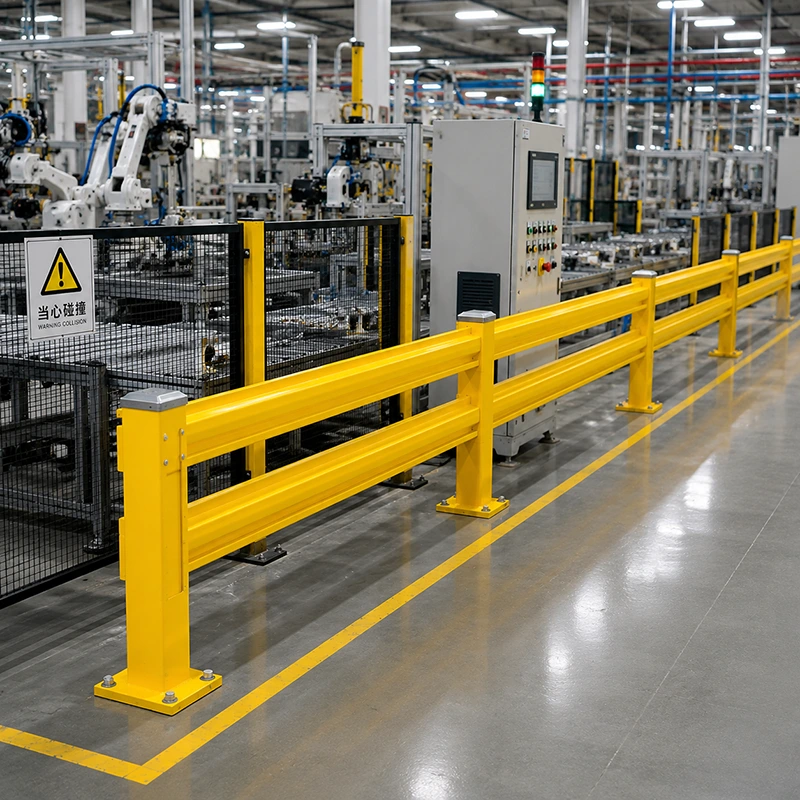
Q235 Anchor and Base-Plate Detail That Maps to the OSHA Hierarchy
The Hierarchy of Controls ranks engineered barriers after elimination and substitution and well above administrative controls; PAS 13 treats that engineered layer as the impact-rated physical barrier, and the OSHA NEP on powered industrial trucks inspects the same boundary as a visible MHE perimeter. The 80 × 80 × 6 mm Q235 post, the 160 × 160 × 16 mm base plate and the M16 anchor-bolt pattern are the hardware evidence that ties the steel warehouse guard rail into that hierarchy. Because the connection is bolted, a damaged section unbolts for replacement instead of rebuilding the perimeter — the asset register can log segment-by-segment repair cycles rather than writing the full run off after one impact event.
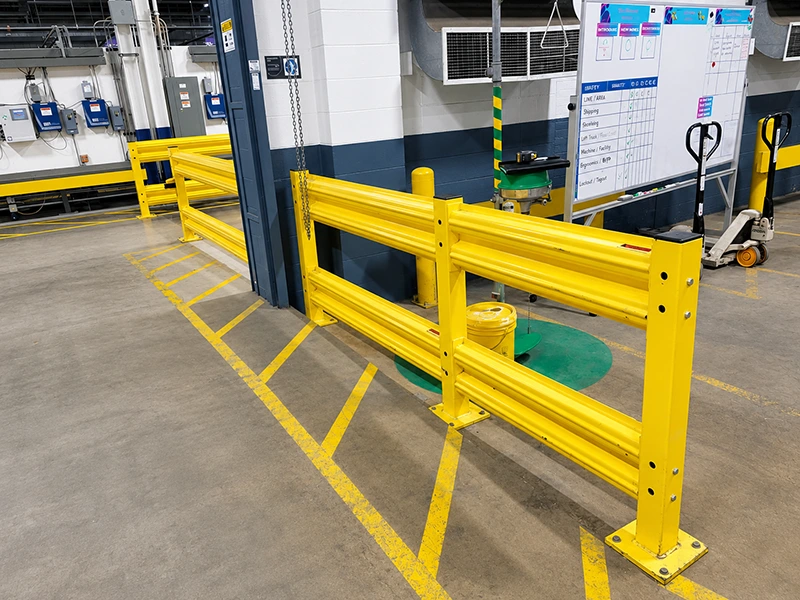
Visible Boundary in a Robot Cell and Electrical Room — the Asset-Protection Use Class
Most PAS 13 implementations frame the steel guard rail as a forklift-traffic perimeter. The same Q235 hardware extends to asset-protection use classes around robot cells, automated conveyor lines and electrical equipment rooms, where OSHA 1910.212 expects a visible boundary for maintenance access and ISO 10218 references a physical segregation layer around robot work envelopes. The yellow bolt-on steel boundary is the asset the auditor can follow from the floor plan to the maintenance log without losing the hardware identity — and the same custom-color project batch keeps a European plant, an Asian DC and a North American fulfillment center reading from one drawing revision.
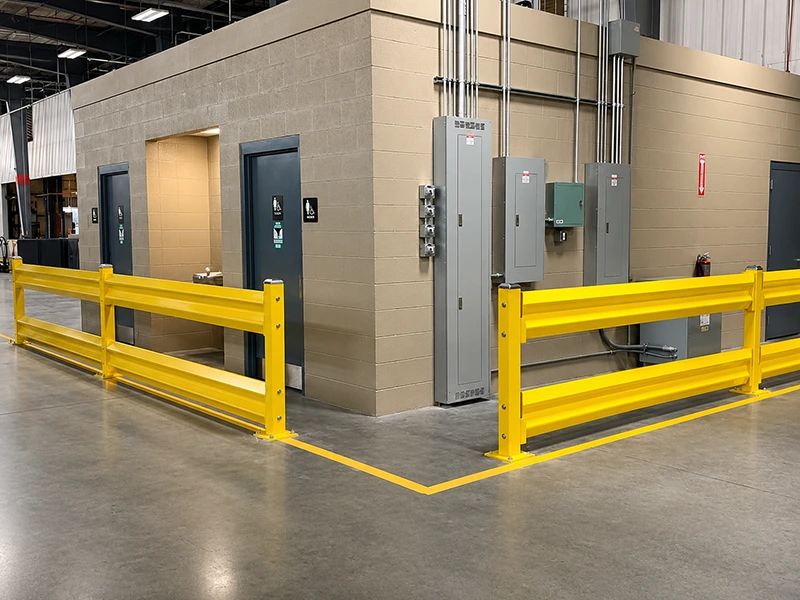
Applications Documented in the Multi-Site Audit Pack
- E-commerce fulfillment center rack ends, conveyor lines, parcel sortation and pick aisles
- Distribution center loading dock aprons and dock-door columns
- Automated warehouse robot cells, AMR pickup lanes and palletizing workcells
- Electrical equipment rooms, IT cabinets and utility corridors inside the building envelope
- Warehouse wall sides and corner zones beside forklift and pallet-truck traffic
- Outdoor or coastal loading zones where hot-dip galvanized Q235 + reflective tape is the documented corrosion and low-visibility package
Each site-specific line item sits against the same drawing revision, the same Q235 grade, and the same base-plate anchor pattern — the documentation a regional EHS manager needs when a procurement board asks for a complete audit pack for the network, and the evidence the on-site inspector can match against the asset register before signing the walk-through sheet.
What to Send with the Initial Procurement Spec
Before quoting, lock the four records the audit pack will live or die on: a per-line segment length table (1,500 mm standard + custom 680–1,140 mm filler panels, drawn against the warehouse floor plan), the post-and-base-plate anchor drawing with the M16 expansion bolt pattern, the surface finish reference (powder-coat RAL number or ISO 1461 hot-dip galvanize call-out per project), and a placeholder row in the document register for the independent PAS 13 / EN 1317 impact test certificate. The first three records ship with every Q235 steel warehouse guard rail quotation; the fourth is the open workstream — it is the largest gap against Amazon-class BWU6 polymer procurement boards, and our current priority is to close it before any tier-1 e-commerce network rollout goes to signature.
Plan the Network Rollout Before the Audit Window Opens
If your team is mapping a 10-, 20- or 100-plant rollout against the OSHA Hierarchy of Controls — and against the PAS 13 / OSHA NEP / UNI TS 11886 auditor’s checklist — a Q235 steel warehouse guard rail already supplies the visible-hardware layer. What is still missing is a single audit-pack map tying every site to the same drawing revision, the same anchoring detail, the same custom-color standard, and the same independent PAS 13 / EN 1317 test certificate workstream. We will run that scoping with you against the corporate EHS standard, the procurement calendar, and the honest disclosure on the certification gap that has to close before the network sign-off.