EN
 DE
 RU
 PT
 JA
 ES
 IT
RISK ASSESSMENT GUARDING / MACHINE PERIMETER GUARDING
A fence that only marks a zone will not pass a robot cell guarding audit
Plant managers, EHS leads and B2B industrial catalogue buyers tend to make one of two expensive mistakes. A low-cost pedestrian divider is placed around a robot cell and fails the machine guarding audit. Or a full high impact resistance fencing system is specified for a walkway with no hazard source, and the budget pays for capacity nobody needs. Machine guarding vs safety fencing is a risk assessment guarding decision that fixes height, wire diameter, gate and anchorage before a panel is ordered.
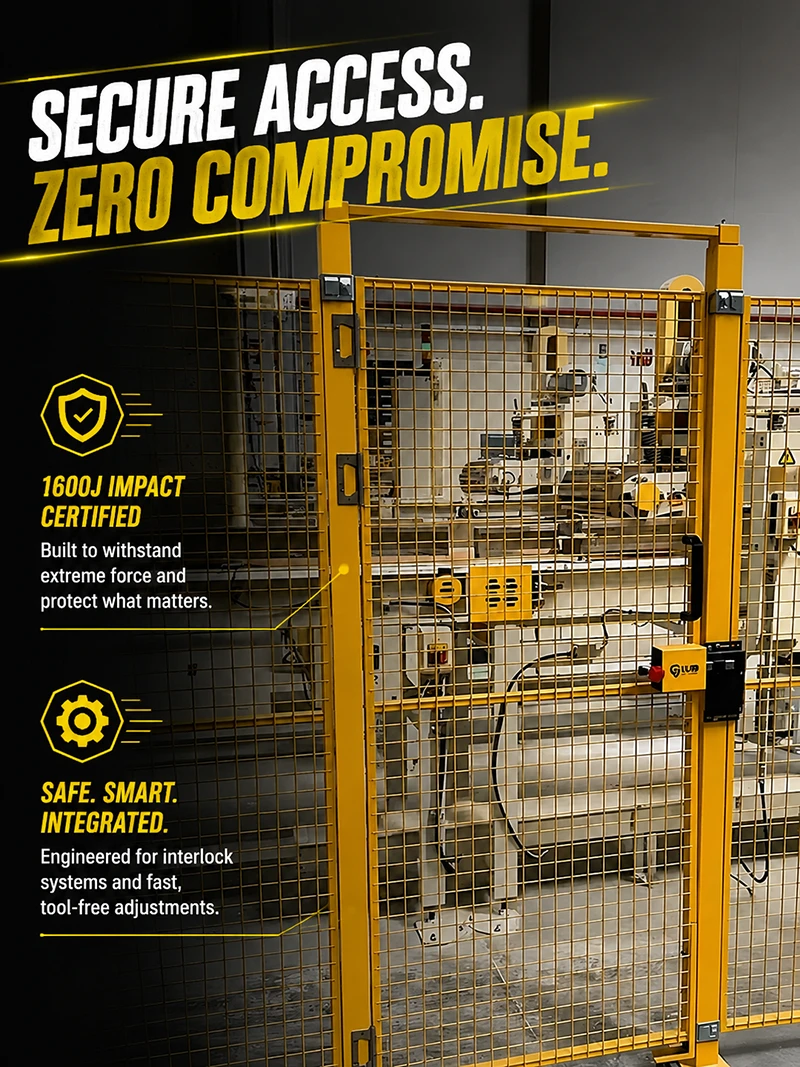
Three questions that separate a guard from a zone divider
Before comparing prices per running metre, answer three questions at the machine. Is there a hazard source: a moving axis, a press stroke, an ejected part? Is there impact energy from a forklift, an AGV or a thrown component? Must a gate be interlocked to stop the machine? If all three are no, the need is area demarcation; if any is yes, it is machine guarding.
| Risk level on the floor | Configuration to specify |
|---|---|
| No hazard source, no impact energy, no interlock | Area demarcation: lower posts and panels, 3.0 mm wire, no interlock carrier, no impact-rated anchorage. One documented project used 1200 mm posts with 1050 mm panels across roughly 56 m of zoning. |
| Mechanical motion, ejection or vehicle impact present | Full machine guarding system: framed mesh panels, interlocked access door, anchored posts. Standard builds use 2000 mm or 2200 mm height, 3.0 mm or 4.0 mm wire and 20 x 100 mm mesh openings. |
| Robot cell, palletizer or conveyor transfer with controlled service access | Guarded perimeter plus a hinge, sliding or folding gate carrying a safety lock mounting carrier for Omron D4NL or Pizzato FS series switches, with safety distance calculated to the applicable standard. |
What the hardware has to prove at each risk level
Anchorage turns a panel into a physical guarding solution
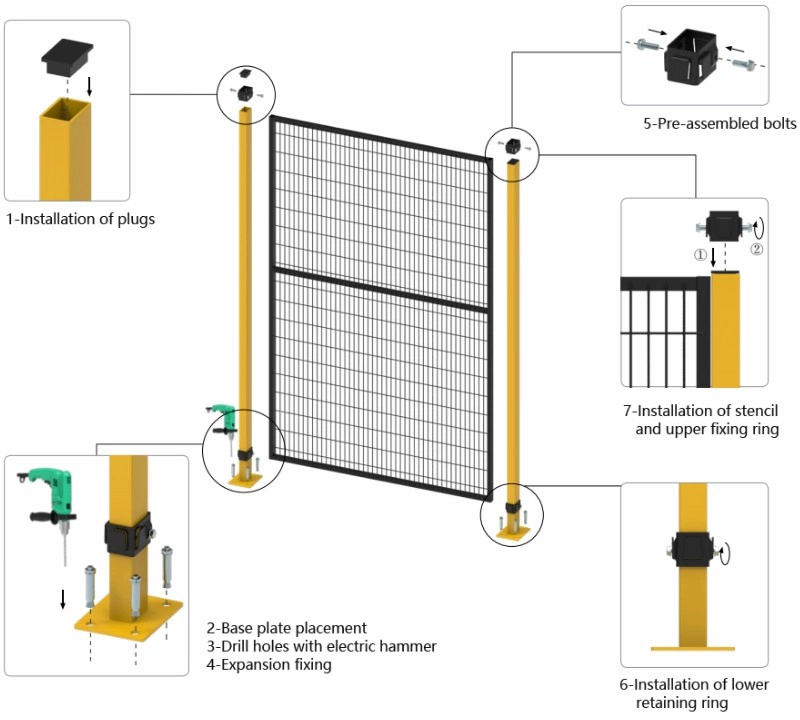
A mesh panel on a footplate is a visual boundary. A guarding system transfers load through panel, fixing rings, post and base plate into the floor. Q235 carbon steel posts are commonly 40 x 60 mm or 60 x 60 mm tube in 1.5 mm or 2.0 mm wall thickness, fixed with four M10 expansion anchors per base plate. Frames use 20 x 30 x 1.5 mm seamless steel tube with full welded, burr-free joints behind 3.0 mm or 4.0 mm wire. Any impact rating belongs to a tested standard configuration; custom sizes and door widths are confirmed per project, not assumed from a brochure.
The gate decides whether the audit passes
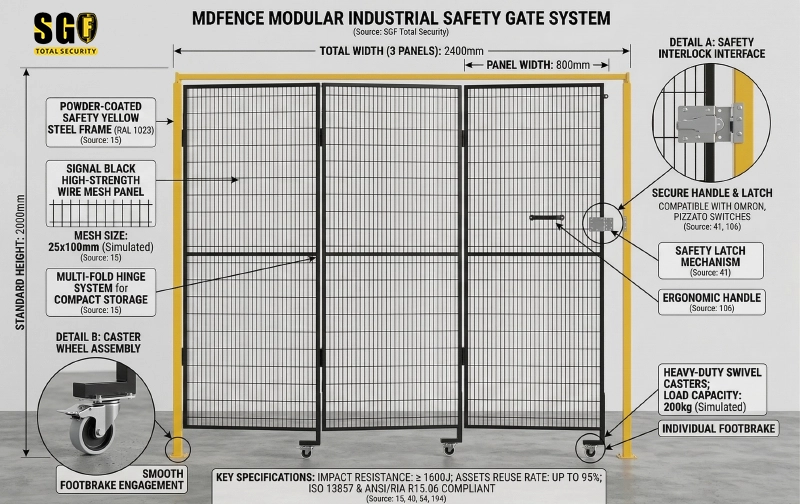
Most failed handovers are gate problems. A sagging leaf puts the actuator out of alignment with the switch. Gate modules carry a lock mounting carrier prepared for third-party safety interlock devices, plus a stiffened frame, door stop and support wheel so the latch stays aligned. Single hinged leaves are commonly specified to 1500 mm, double sets to 3000 mm, folding sets to 4800 mm and sliding sets to 4300 mm, subject to the drawing. The fence supplies the mechanical interface; the switch, wiring and safety circuit logic stay in the electrical scope, which belongs in the LOTO specification.
Lower-risk zones do not need the heavy specification
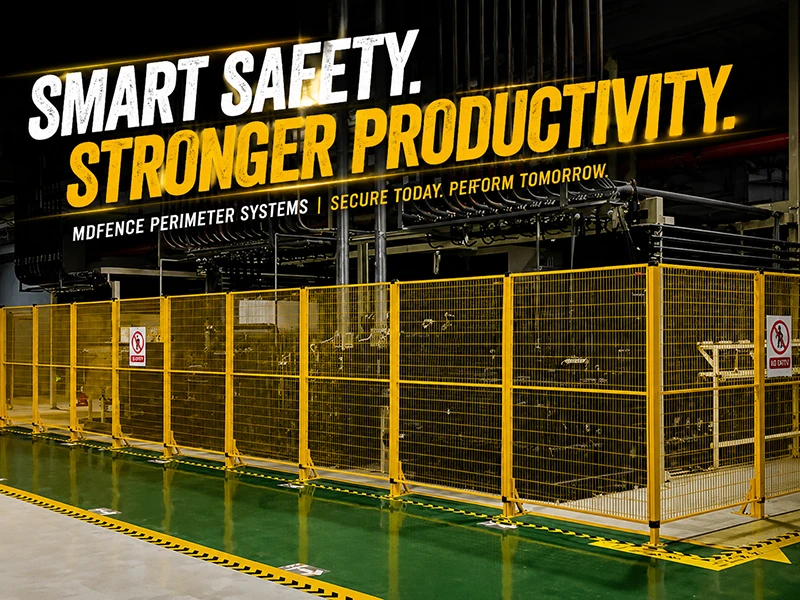
For smart warehouse zoning, equipment-free walkways and quarantine areas, a lower height with 3.0 mm wire and a simple hinged access point is often the correct purchase. The 1200 mm post and 1050 mm panel arrangement used across roughly 56 m shows a deliberately light configuration: it separates stock, people and routes without paying for an impact-rated assembly. Against welded safety fencing, modular panels unbolt, move and reuse when a layout changes, shortening automation project cycles and avoiding hot work. RAL1023 yellow posts and RAL9005 black panels keep the boundary readable in a mixed fleet aisle.
Selection conclusion: match the risk, then match the budget
- Robot cell guarding and palletizer cells: specify framed mesh, interlocked gate and anchored posts as one system, with safety distance verified against ISO 13857 and guard design reviewed against ISO 14120.
- Conveyor line safety guarding: define the transfer opening first, then choose tunnel guarding or a light-curtain interface so material passes and people do not.
- Automated material handling safety, forklift and pedestrian safety: confirm whether vehicle impact is credible. If it is, zone dividers are not enough.
- Smart warehouse zoning and equipment-free walkways: use the lighter height and 3.0 mm wire, and keep the saving visible in the BOM.
One boundary belongs at the end of any selection: this system is not intended for pure pedestrian guidance, queue management or office partitioning. Where there is no hazard, a people-flow product is the correct buy. Where there is a hazard, a configurable safety fence with a defined frame, gate and anchorage is the physical guarding solution that prevents unexpected production line downtime, achieves factory safety zoning and reduces the risk of workplace accidents. Buying by risk level avoids both an audit failure and a specification mismatch.
What to send before the specification is fixed
Bring the layout drawing, the hazard list for each zone, machine envelope and any ejection or vehicle risk, access points and door swing direction, floor condition and anchor positions, and the safety switch model chosen by the electrical team. From those inputs the configuration is drawn per project, with panel quantities, post heights, wire diameter, gate type, lock carrier and fastener BOM listed separately. Custom sizes, RAL colours and corrosive environments are confirmed on the drawing, so the result is a specification that can be audited and a budget that matches the actual risk.
Specify once, audit once
Grade each zone by its three hazard questions, then order the height, wire, gate and anchorage that grade calls for. Procurement avoids paying twice, commissioning passes the first time, and equipment uptime is maximized.