
 EN
 DE
 RU
 PT
 JA
 ES
 IT
LIGHT CURTAIN INTEGRATION POST / LIGHT CURTAIN VS PHYSICAL GATE
A high-frequency infeed opening needs a column, not a cable tie
An integrator replaces a solid door at a busy loading point because opening it slows the cycle, then discovers that the light curtain emitter and receiver have nowhere rigid to mount and the cables hang where a workpiece can catch them. Temporary ties and surface-mounted trunking are the usual result. A dedicated 80×80 mm light curtain integration post solves the mechanical half: the emitter and receiver mount to the guarding structure and the cable runs inside the column, so the detection device and the machine guarding fence become one assembly. The physical gate stays on the maintenance aisle, where occasional access belongs. Deciding light curtain vs physical gate is still a risk assessment question, not a throughput question, and the safety circuit stays with the controls integrator.
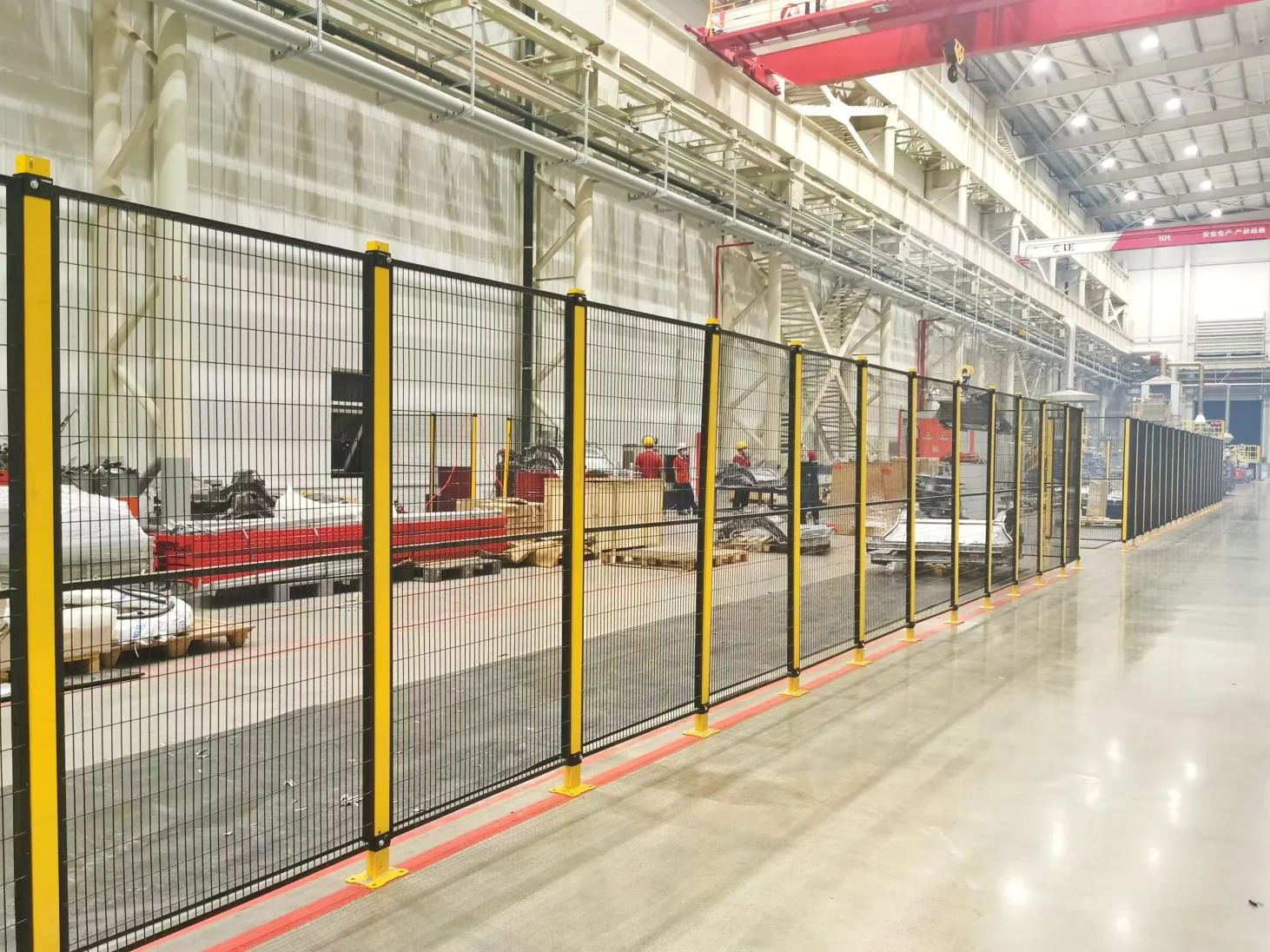
Send your infeed opening and light curtain model for a column layout
What each device is responsible for
A light curtain detects presence; a physical gate prevents access by geometry. They are not interchangeable, and mixing them without writing down the boundary is how an opening ends up with neither function properly documented.
| Element | Scope on the drawing |
|---|---|
| Physical gate | Closes the maintenance route with a framed mesh leaf, heavy-duty hinges, a door header beam and a safety lock mounting carrier. Access is infrequent and deliberate. |
| Light curtain | Detects entry at the high-frequency material opening. Muting or blanking logic lets product pass without stopping the line; that logic, the device selection and the safety rating belong to the integrator. |
| 80×80 mm column | Carries the emitter and receiver on a rigid face and routes the cable inside the post. The column is part of the perimeter structure, not a cable management accessory added after commissioning. |
| When only a light curtain is acceptable | Only where the risk assessment confirms that no one can remain in the danger zone undetected, that stopping time and approach distance are satisfied, and that local EHS accepts detection instead of a physical barrier. We do not make that determination. |
How the column and the fence are drawn as one assembly
Hidden cabling needs a service opening, not a hole
The general arrangement marks the column position, the cable entry and exit points and the inspection opening that lets a technician reach the terminations without dismantling a panel. Framed mesh panels on either side are dimensioned from the column centre line, and any narrow infill is listed in the fence layout BOM with its own part code. Q235 60×60 mm posts and four M10 expansion anchors per base plate keep the adjacent bays aligned, so the emitter and receiver stay on the same optical plane over a long run. Cable type, device model and safety circuit design remain with the electrical team.
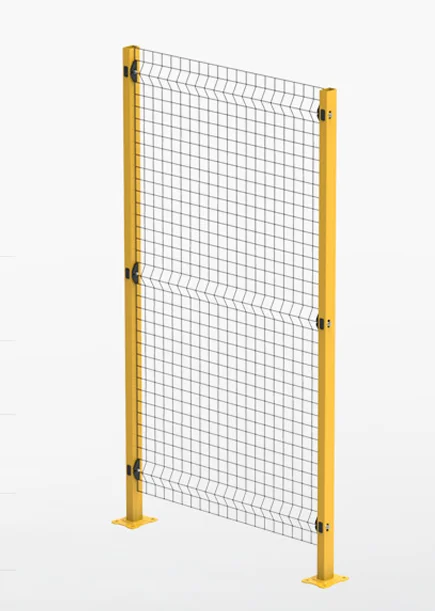
Keep the gate where access is rare
Conveyor line safety guarding normally has both kinds of opening: a transfer point used every cycle and a maintenance door used once a shift. Putting a hinged gate at the transfer point slows production; putting a light curtain at the maintenance door leaves a technician without a lockable, physically closed boundary. The drawing therefore lists gate positions, leaf widths and swing arcs separately from the detection openings, with the safety lock mounting carrier prepared for Omron D4NL or Pizzato FS series switches supplied and wired by the integrator.

Where coexistence still fails
A column does not fix an opening that is too short for the required safety distance, a product envelope that forces permanent blanking, or a cell where a person can step past the detection field. Those are ISO 13857 and ISO 14120 questions answered in the risk assessment with stopping time and approach distance recorded. The 1600 J impact figure quoted for the standard guarding configuration applies only to that tested build and does not cover the light curtain device. Aperture, hazard height and reach distance are re-checked on site. This system is not intended for pure pedestrian guidance.
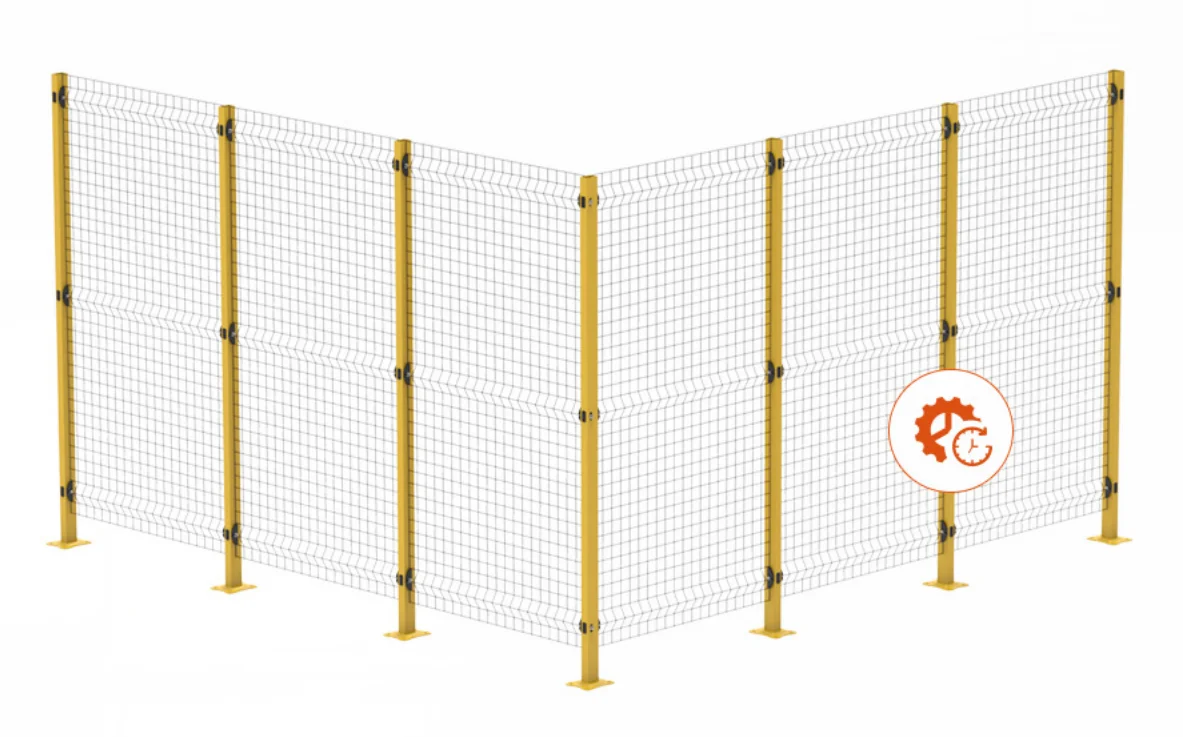
Openings that benefit from a drawn column
- Conveyor line safety guarding and sortation infeed: product passes continuously while people must stay out.
- Palletizer safety guarding and automated material handling safety: a physical door at the outfeed would dominate the cycle time.
- Robot cell guarding with a shared load point: the detection field and the lockable maintenance door have different owners.
- Warehouse automation safety and AGV handover: exposed cabling at a vehicle route is a repeat failure point.
Drawn this way, light curtain vs physical gate becomes two line items on one general arrangement instead of a field modification.
The inputs for a combined column and gate drawing
Send the transfer opening width and height, product envelope and cycle rate, the light curtain model chosen by the integrator, stopping time and approach distance, gate position and swing, hazard heights, floor and anchor conditions and the required service access. The returned pack carries the general arrangement with the column and cable path, the panel and post BOM including narrow infills, the gate and lock carrier schedule and the acceptance checklist. Detection logic, safety rating, electrical schematics and validation stay with the controls integrator and the local risk assessment.
Mount the detection on the structure
An 80×80 mm column with an internal cable route keeps the emitter aligned and the wiring out of the workpiece path, while the physical gate stays where a person actually needs to enter.

