
 EN
 DE
 RU
 PT
 JA
 ES
 IT
FRAMED MESH PANELS / PANEL STIFFNESS MACHINE GUARDING
Two panels can look identical in a price list and behave nothing alike when someone leans on them
Procurement teams and racking suppliers comparing a guarding quotation usually see one number: cost per square metre. An unframed screen gets its shape from bent wire and tension, so a worker leaning against it produces a bulge, and an impact can pull the whole sheet out of its clips. Framed mesh panels put 3.0 or 4.0 mm resistance-welded wire into a complete 20x30x1.5 mm rectangular tube border, so the frame works as a beam and carries out-of-plane load. Product documentation states more than four times the bending stiffness of an unframed screen for this framed construction. Panel stiffness machine guarding is not an abstract property: it decides what happens at a gate, a corner and a high-risk bay, and where a lighter configuration is still acceptable.
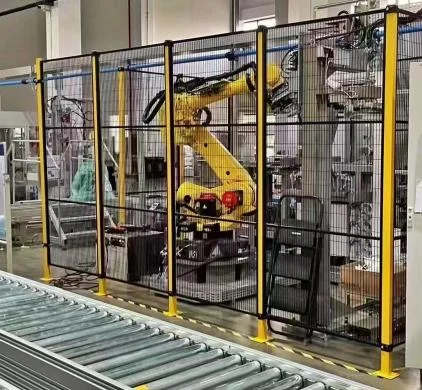
What out-of-plane stiffness means on a drawing
Out-of-plane load is any force pushing perpendicular to the mesh: a lean, a pallet nudge, a forklift scrape, a gate leaf closing. The wire alone resists by bending; a closed tube border resists by beam action and transfers that force into the posts and anchors.
| Construction | Behaviour under out-of-plane load |
|---|---|
| Unframed screen | Bent wire and sheet tension carry the load. Local bulging is common, and a strong contact can release the whole panel from its fixings. |
| Framed mesh panel | A 20x30x1.5 mm tube border with 3.0 or 4.0 mm wire welded into it takes the load as a beam. Product documentation states more than four times the bending stiffness of an unframed screen for the framed construction. |
| Connection to the structure | M8 fixing rings hold the panel to a Q235 60×60 mm post, and four M10 expansion anchors hold each base plate. Stiffness only helps if the load has a continuous path into the slab. |
| Where the figure stops | The stiffness comparison is a stated product value for the framed construction, not a third-party certificate for every width, height or door configuration. Custom sizes are re-drawn and re-specified per project. |
Where the framed panel earns its place first
Gates, corners and high-risk bays
A gate leaf is opened every shift and carries the actuator key, so flatness is what keeps the interlock aligned. A corner takes loads from two directions. A bay beside a forklift route takes repeated contact. These are the positions where framed mesh panels are specified first: flat full welds, burr-free joints, a complete tube border and electrostatic powder coating in RAL1023 posts and RAL9005 panels. A door header beam then keeps both gate posts parallel, so the leaf does not sag out of line with its safety lock mounting carrier.

Low-risk runs can be specified differently, but visibly
Not every metre of a long perimeter needs the same build. A straight run behind a quiet conveyor, with no vehicle route and no access point, can use a more economical configuration to control cost. The important part is that the drawing says so: the framed and economy sections are listed as separate line items in the fence layout BOM with their own part codes, so goods-in, installation and the acceptance checklist all see the same distinction. Mixing them without a marked schedule is how a low-risk panel ends up in a gate bay.

Stiffness supports the safety argument, it does not replace it
Rigidity keeps the geometry that the risk assessment was written against. It does not set guard height, aperture or reach distance under ISO 13857, does not replace an ISO 14120 design review, and does not validate a safety circuit. The 1600 J impact figure quoted for the standard configuration applies only to that tested build. Guard height, opening size, floor condition, anchor positions and vehicle routes are re-checked on site, and local EHS owns the sign-off. This system is not intended for pure pedestrian guidance or office partitioning.
Layouts where a per-square-metre comparison misleads
- Robot cell guarding and palletizer safety guarding: frequent access and interlock alignment depend on a flat leaf.
- Press shop safety fence and vibrating equipment: slow datum drift shows up as intermittent false stops.
- Forklift routes and forklift impact protection: the load path from panel to post to anchor is the whole point.
- Long conveyor line safety guarding runs: a marked schedule lets cost be controlled without weakening the gate bays.
Once panel stiffness machine guarding is written into the BOM, the price per square metre stops hiding the parts that actually carry load.
What to send for a framed and economy schedule
Provide the general arrangement with run lengths and corner angles, gate positions and leaf widths, vehicle routes, vibration sources, hazard heights and opening sizes, floor and anchor conditions and the sections where cost reduction is required. The returned pack carries the panel-by-panel width schedule with framed and economy sections marked, the post and corner quantities, the gate and lock carrier schedule, the coded fastener list and the acceptance checklist covering dimensions, welds, coating finish, panel flatness and gate cycling.
Price the frame, not just the area
Specify framed mesh panels where the load and the interlock are, mark the lighter sections on the drawing, and let procurement reconcile both against the crate.

