EN
 DE
 RU
 PT
 JA
 ES
 IT
MACHINE CONTAINMENT GUARDING / INTERNAL PROJECTILES / PANEL SELECTION
A fence that keeps people out can still let a broken tool leave the cell
Most perimeter guarding is specified to stop a person reaching a hazard. A bearing race, a broken insert or a workpiece ejected from a chuck is a different problem: the energy comes from inside, it travels outward, and an open mesh that satisfies a reach-distance table may not stop it. Machine containment guarding starts by classifying the projectile and its energy, then choosing between narrow-aperture framed mesh, a solid steel sheet and polycarbonate machine guard panels. The result is an enclosure designed around what the machine can throw, not a line drawn around its footprint.
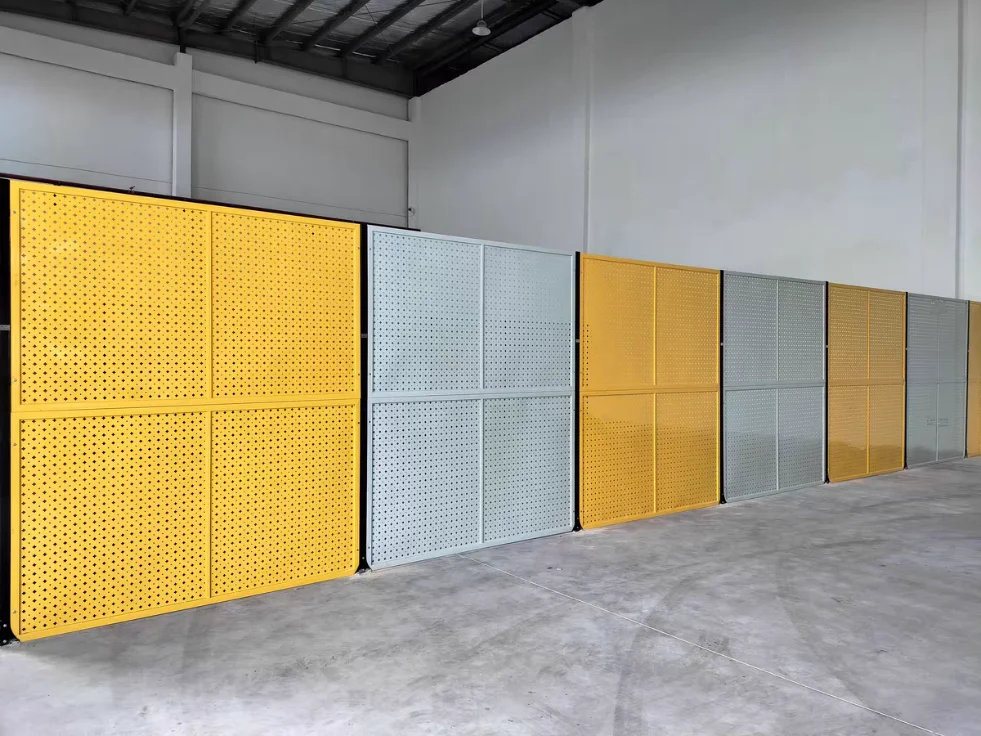
Two load cases that are not interchangeable
External vehicle impact pushes into the cell; an internal projectile pushes out. The first is checked as a cantilever down to the anchors. The second is checked as local penetration and panel retention, including what happens at the frame, the fixings and the seams.
| Load case | What governs the panel choice |
|---|---|
| Forklift or AGV contact from outside | Post bending, base plate and anchor pull-out; framed mesh and the Q235 skeleton carry it. |
| Workpiece, tool fragment or grinding wheel from inside | Aperture size, wire diameter, panel retention and whether a closed infill is required. |
| Combined risk on one cell | Zone the enclosure: solid or polycarbonate panels opposite the spindle, framed mesh on low-risk sides. |
| Visibility and inspection | Solid sheet blocks sightlines; polycarbonate machine guard panels keep the process visible. |
| Heat and fire near the process | Plastic panels are rated to 60 °C and listed to UL94 V0 and EN 1598; above that, use steel. |
Choosing the surface that faces the hazard
Start with the aperture, not the wall thickness
A 20×100 mm mesh with 4.0 mm wire in a 20x30x1.5 mm tube frame is the standard starting point for internal interception: the narrow slot limits what can pass and the welded border keeps the sheet in its clamps. It is a real containment layer for chips and small fragments, not merely a boundary marker. Where the risk assessment names a heavier ejected part, the aperture alone is not enough evidence and the panel has to be upgraded.

When a solid infill is mandatory
High-energy ejection, grinding wheel failure, press tooling breakage and coolant jets at pressure call for a closed surface. Steel or aluminium sheet is the default where heat, sharp fragments or hot swarf are present. Polycarbonate machine guard panels are used where the process must stay visible or where a transparent barrier supports inspection. Both are fitted as module infills on the same frame system, so a cell can mix mesh and closed panels along one run instead of switching to a bespoke enclosure.

Where the plastic panel stops
Product documentation gives a 60 °C heat limit for plastic panels and lists UL94 V0 and EN 1598 fire behaviour. Those are boundaries, not a general-purpose rating: a welding station with hot spatter, a furnace cell or a wash-down line with aggressive cleaners belongs on steel or on a specified high-temperature glazing. We do not claim a plastic infill contains a workpiece from a failed fixture. The containment case has to be stated in the risk assessment and matched to a tested panel, with the acceptance evidence supplied for that configuration.

Cells that usually need a containment decision
- CNC turning and machining centres with chuck-mounted workpieces and indexed tooling.
- Precision bearing and grinding lines where wheel or race failure is a credible event.
- Press and stamping cells with ejected offcuts and die fragments.
- Robotic welding and cutting cells where spatter and arc flash reach adjacent stations.
- Test rigs and spin stands where a rotating assembly can shed a component.
Each of these asks the same question in a different form: what leaves the machine, at what energy, and which surface is directly opposite it. Machine containment guarding answers it panel by panel, with the mesh, the closed infill and the gate treated as one enclosure.
What the panel schedule should show
Ask for a zone drawing marking every solid or polycarbonate machine guard panel, the 60 °C limit note, the fixing method and the evidence supporting the containment case. A single line item called guarding cannot be checked against a risk assessment.
Put the ejection case on the drawing
Share the machine envelope, the failure modes from your risk assessment and the viewing requirements. We will return a panel-by-panel schedule with mesh, solid sheet and transparent infill assigned to the surfaces that need them.