EN
 DE
 RU
 PT
 JA
 ES
 IT
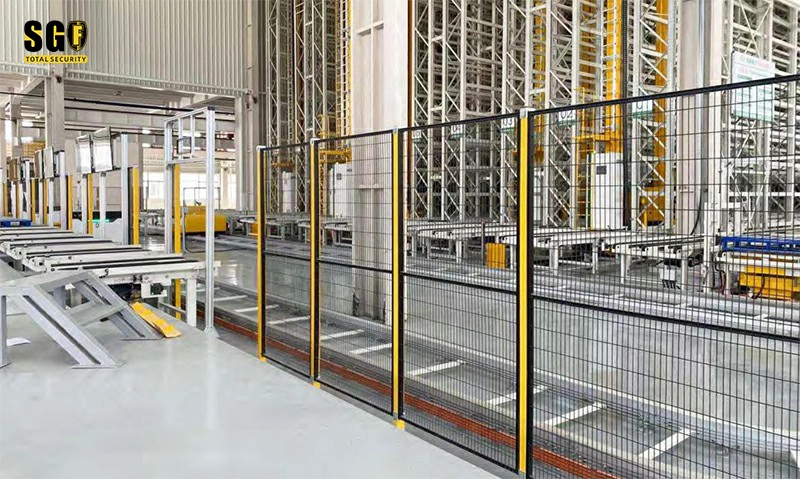
Stocking Fence Modules Instead of Ordering Each Run
Some customers do not buy a fence for a single layout. They want a repeatable set of posts, panels and fittings in stock, then assemble different perimeter runs as projects arrive. In one SGF Mdfence proposal, a customer asked for a standardized post-and-panel module that fits one 20 ft container, to be used for guarding palletizing robots, automatic sorting and conveyor systems on different projects.
That changes the technical problem. The question is no longer one finished fence, but whether a stocked set of parts can be combined into several valid layouts without the customer redesigning the connection logic each time.
Define the Module by Quantities and Roles
The referenced proposal listed a container load by part number and count. Panels appeared in several widths, posts were supplied as sets that include the anchor bolts and a cap, and fittings were grouped as sets for fixing clamps, hinges, handles, stops and support wheels. The logic behind the list is as important as the numbers:
- Panel widths: a small set of standard widths lets a run be closed with combinations rather than a unique panel for every gap.
- Post sets: a post set that already includes expansion bolts, a plug and a cap reduces the chance of a partial installation kit.
- Connection sets: fixing clamps and hinges should be counted from the number of panel joints and gates, not guessed as a flat percentage.
- Optional narrow panels: the proposal added 200 mm and 400 mm panels as options to make on-site combinations more flexible.
The proposal also states that pallet alignment height should not exceed 1.8 m and that no cargo should be stacked above, because pressure in transit can deform or dent mesh panels. It advises reserving the space above the pallets when booking container capacity. For a stocking customer, packing is a design constraint, not an afterthought.
A Checklist for the Three Project Roles
- Designer: fix the standard panel widths and the connection sets that go with each post-and-panel joint.
- Project manager: treat the container list as a stock bill of materials, with pallet stack height and no-stack-above rules carried into the shipping plan.
- Sales manager: describe the kit as a standardized module that supports multiple layouts, and be explicit about what each set contains.
Scope Note
The 20 ft container quantities and the 1.8 m pallet stacking guidance come from one Mdfence proposal for a specific customer and product mix. They are not a universal container-load table. The actual container count must be recalculated for the chosen panel widths, post heights and packing method. Confirm all quantities and packing dimensions against the released packing list.