EN
 DE
 RU
 PT
 JA
 ES
 IT
Mefence Frameless 3D Safety Fence — Area Demarcation & Traffic Control
SGF · Safety Fence Industrial
A visible boundary you can cut, move and install yourself
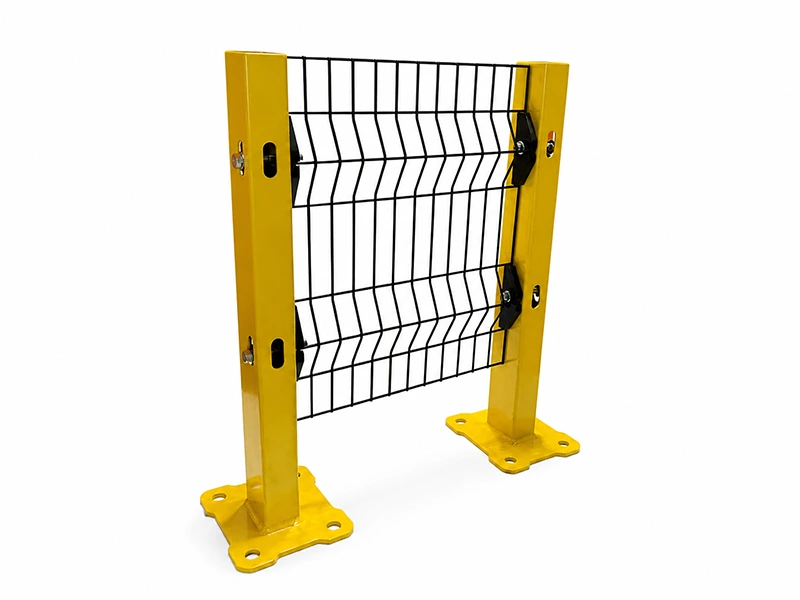
Mefence is a frameless 3D welded wire mesh fence for area demarcation, AGV and forklift lane control, and pedestrian–vehicle separation. The mesh panel has no square-tube border and is pressed with horizontal T-shaped ridges, so it can be cut to the space on site, carry cable runs, and accept wood slat inserts. Yellow posts against black mesh make the line readable from across the floor. This is a demarcation and guidance fence, not a certified anti-collision machine guard.
- Cut the panel to irregular widths, heights and shapes on site
- One person, three steps, no on-site welding
- T-shaped ridge works as a cable channel and a wood-slat slot
- Unbolt and reuse the sections when the layout changes
A frameless panel, pressed into a 3D profile
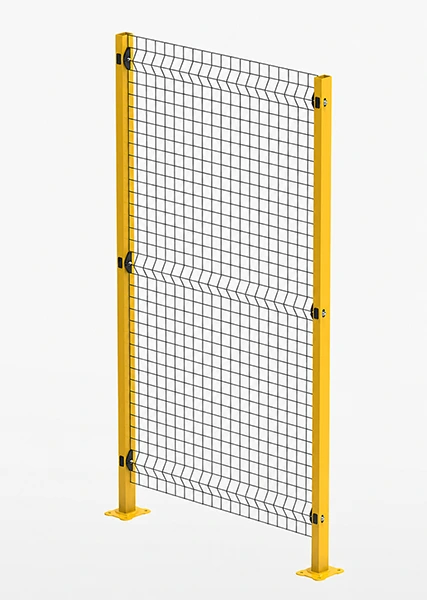
Unlike a conventional guard panel, the mesh sheet has no square-tube frame welded around its four edges. The panel is a bare sheet of welded wire with several horizontal ridges pressed into it — the bend that gives the 3D fence its name. With no frame to work around, an installer can trim the mesh to almost any width, height or outline on site, which is how it fits awkward bays, pipework and column grids without a custom fabrication.
That same ridge is functional: it forms a channel along the panel and a gap that accepts a wooden slat. The standard finish is a yellow powder-coated post with a black mesh panel; other colours, including high-visibility orange, can be made to order.
The important limit: Mefence is built for zoning and traffic guidance, not for stopping an impact. It carries no impact rating, load test or collision data. Where a robot, forklift or conveyor can strike the line directly, select a certified Machine Fence at that point and keep Mefence for the rest of the route.
Where this fence is used
AGV and AMR lane control
In a mixed-traffic warehouse, a painted line or tape does not stop someone stepping into a guided lane. A physical fence line leads people to planned crossing points instead of cutting across the route, reducing the stop-start losses that come from repeated emergency stops. The open mesh keeps LiDAR returns and overhead cameras usable.
Pedestrian–vehicle separation
Yellow posts and dark mesh read as a warning from a distance, giving forklift drivers and pedestrians an obvious, continuous boundary on shared floors — more reliable than cones, rope or floor markings that only work under ideal conditions.
Robot cells and equipment perimeters
Enclose a robotic workstation, CNC periphery or conveyor and transfer zone where the job is to define the zone and keep people out — not to absorb a direct machine strike. A single access gate can be fitted at the panel line.
Warehouse zoning and storage separation
Divide storage areas, tool cribs and aisles into clear zones. Because the panels unbolt from base-plate posts, a zone can be redrawn when stock or equipment moves rather than written off as a fixed installation.
Retrofits and temporary partitions
Short shutdown windows rule out on-floor welding. Clip fixing and expansion-bolt base plates make this a cold-work installation that can be laid out around existing aisles and equipment islands, then relocated for the next phase.
Cable and service runs
Where conveyors or machines sit behind the fence, the pressed ridge carries the cable run inside the panel instead of leaving conduit clipped to the outside of the line.
Why a frameless panel instead of framed fencing or floor tape
Cut to fit on site
Panel widths run from 200 to 1400 mm and heights from 200 to 3000 mm, and the frameless mesh can be trimmed further on site to the width, height or shape the bay actually needs. Awkward spans are cut rather than ordered as custom panels, and the offcut is not billed back.
One person, three steps, no welding
Step 1 align the post's hole pattern with the mesh ridge; step 2 fix the panel to the post with the plastic clip; step 3 drive the self-tapping screw through to lock it. No square-tube welding and no hot-work permit. This reduces installation time by more than 50% compared with framed fencing — a figure reported by the manufacturer, not an independently tested result.
One ridge, two jobs
The pressed T-shaped bend is both a cable trough and a slot for wood slats. It keeps wiring off the floor and out of sight, and accepts charred or oiled timber for visual screening — without bolting a separate tray to the fence line.
Move it when the layout moves
Base-plate posts fix with expansion bolts through slotted holes, so the run can be unbolted, shifted and re-used when a line expands or equipment is relocated. It is a reconfigurable partition rather than a one-time build.

How one bend does two jobs
The horizontal T-shaped ridges are the reason this product is called a 3D fence. The bend is not decorative. Pressing the flat wire into a raised channel creates a space along the panel with two practical uses.
First, cable. The channel takes the line bundle for cameras, interlocks or access readers running along the fence, so wiring does not hang outside the boundary or need a separate conduit fixed to the posts. This matters most where conveyors or machines sit behind the mesh.
Second, screening. A wooden slat dropped into the same ridge gives visual privacy where it is needed. The slats are charred and brushed clean — a treatment used to resist insect damage — then finished and inserted from the top. A self-tapping screw driven above a horizontal wire acts as a stop so the slat cannot slide down, and a horizontal batten can tie the slats together.
One panel therefore covers three needs at the same boundary: a visible division, tidy cable management, and optional sight screening. Wood-slat inserts are supplied to suit the run, and the slats are fixed from the top with a self-tapping screw above a horizontal wire.
Technical specifications
- Material
- Q235 carbon steel with a small number of plastic fittings
- Surface treatment
- Electrostatic powder coating (spray coating)
- Wire diameter
- 3 mm or 4 mm
- Mesh opening
- 20 × 100 mm or 50 × 50 mm
- Panel width
- 200–1400 mm (the span between two posts); trimmable on site
- Panel height
- 200–3000 mm, measured along the post
- Post size
- 40 × 60 mm or 60 × 60 mm
- Ground clearance
- 140 mm, keeping the mesh clear of washdown water and truck traffic
- Standard colour
- Yellow post + black mesh; custom colours available, including orange
- Structure
- Frameless welded wire mesh with multiple horizontal T-shaped ridges; no square-tube border
- Panel-to-post fixing
- Plastic clip plus self-tapping screw; no site welding
- Floor fixing
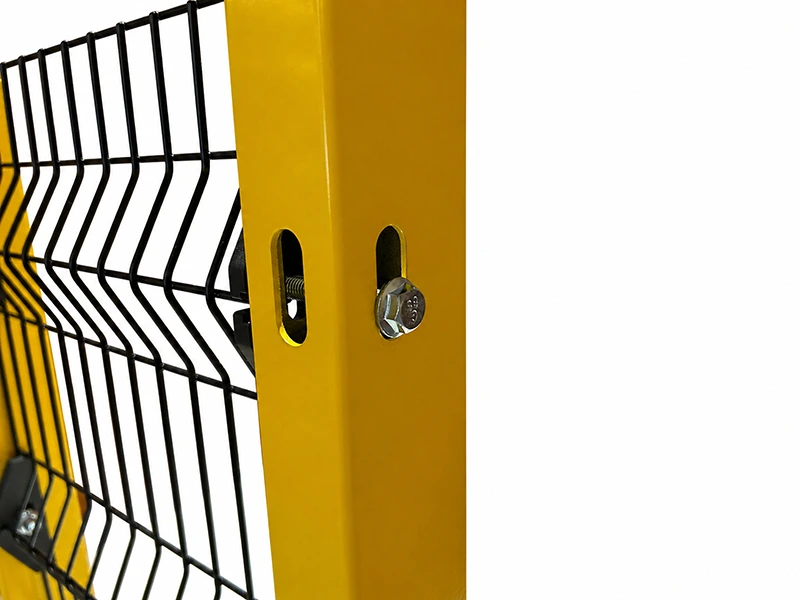
- Base-plate post with expansion bolt; slotted holes for alignment, shims for vertical adjustment
- Functional features
- Ridge carries cable runs and accepts wood slat inserts
- Positioning
- Area demarcation, traffic guidance, modular separation and cable management — not a certified anti-collision guard
The fence in use

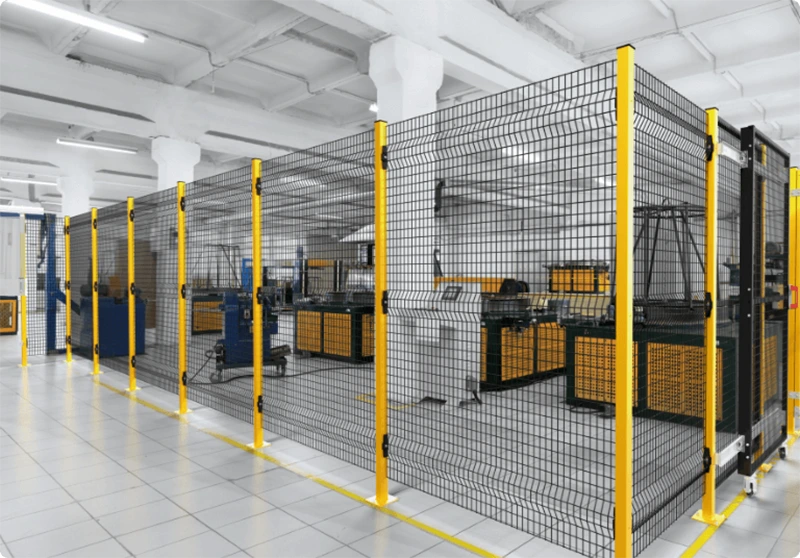
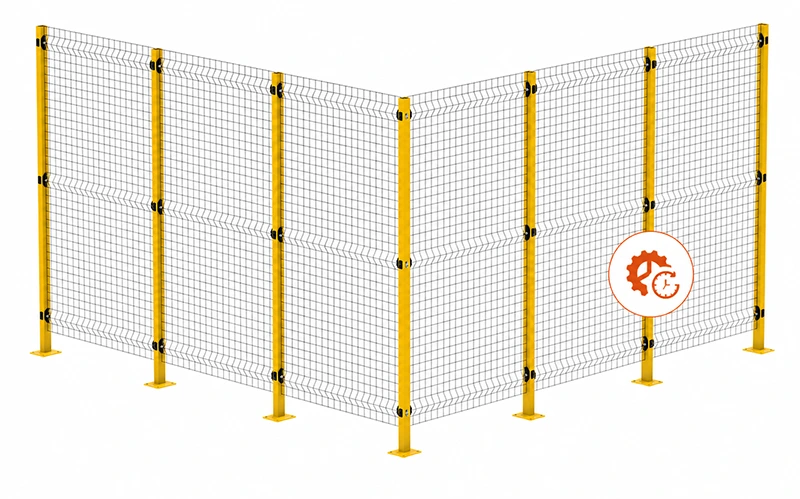
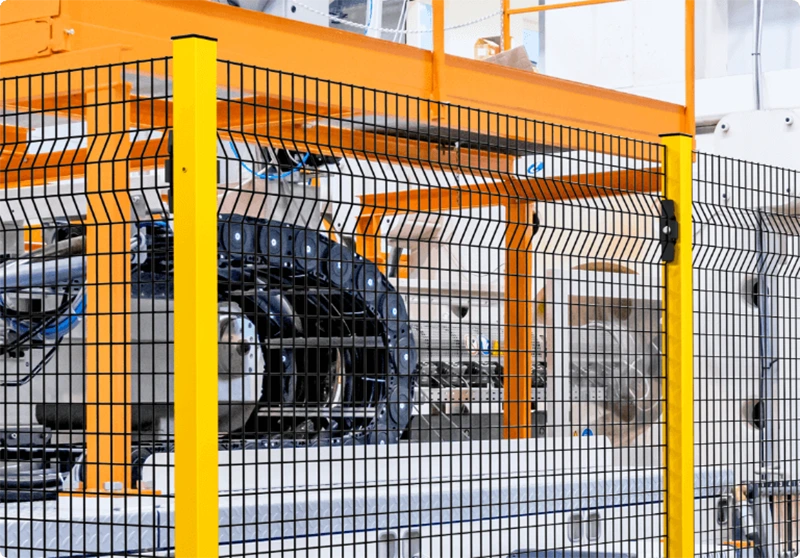
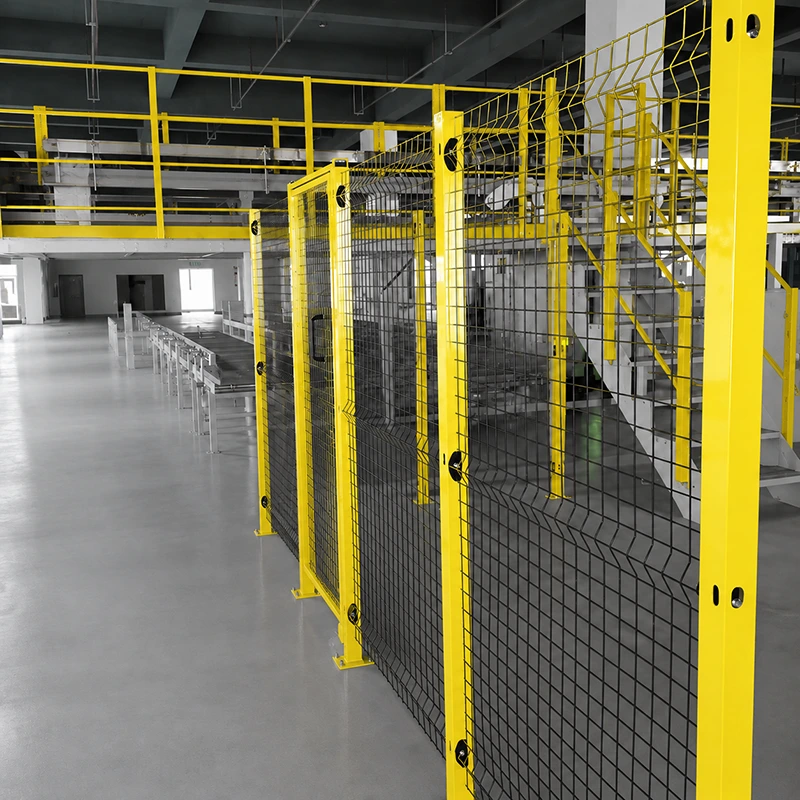
Equipment perimeters stay visible through the open mesh while the line defines the zone. A controlled access point can be built into the panel line. Modular sections form straight runs and corners around a storage zone. Mesh keeps machinery in view while marking the boundary close to the equipment. Base feet and corner layouts let a run follow the floor plan. The system is made of three parts: mesh panel, post and connector.


Choosing the right fence for the risk
| Your situation | Mefence | Certified Machine Fence |
|---|---|---|
| Large-area zoning, traffic guidance, pedestrian–vehicle separation | Intended use | Not needed for the open floor area |
| Direct strike point from a robot, forklift or conveyor | Not rated for impact — do not specify at the strike point | Select a certified guard at that point |
| Layout changes, short retrofit window, need to re-use panels | Clip fixing and bolt-down posts: cut, move, re-use | Heavier fixed systems suit permanent cells |
| Cable routing or visual screening on the boundary | T-shaped ridge carries cable and accepts wood slats | Accessories available, but zoning layer is usually Mefence |
Standards your specification will refer to
When planning a guard for a machine area, your safety or facilities team will usually work to OSHA 29 CFR 1910.212, ANSI B11.19, and ISO 14120, 14119, 13857 and 13855. These set out machine-guarding duties, guard design, interlocking, and the safety distances that decide how close a barrier may sit to a hazard.
These are the standards your specification will refer to. They are not certifications held by Mefence. Mefence is supplied for demarcation and guidance. Where a risk assessment calls for a certified, impact-tested guard or an interlocked door, that requirement belongs to the Machine Fence line rather than to this demarcation fence. We can help separate the two layers of a layout so the boundary stays practical and the strike points stay protected.
How installation works
1. Step 1 — Set and fix the end posts
Mark the base-plate holes on hardened floor or a wall footing, drill with the bit matched to the expansion anchor, and drive the anchors. Seat the post with the nut only lightly tightened, check verticality with a level, and correct with shims under the plate before tightening. Fix both end posts first.
Slotted base plates and expansion bolts allow alignment without a new foundation. 2. Step 2 — Line up the intermediate posts
Snap a chalk line between the two end posts to set the intermediate positions, then place each post by measuring a panel length or offering the panel up directly. This keeps the run straight before any panel is fixed.
A chalk line keeps intermediate posts aligned along the run. 3. Step 3 — Clip and lock the panels
With the frameless mesh, any horizontal wire can act as the fixing point. Align a post's hole pattern with the mesh ridge, press the plastic clip over the wire against the post, and drive a self-tapping screw through to lock it. One operator completes the sequence; no welding or cutting is required on the line itself.
The clip and self-tapping screw are the only panel-to-post fixing.

Questions buyers ask
Can I get a colour other than yellow and black?
Yes. Yellow post with black mesh is the standard pairing, but other colours can be made to order, including high-visibility orange for temporary construction zones.
Will it stop a runaway forklift or a robot striking it?
No. Mefence is a demarcation and guidance fence with no impact rating. At any point where a moving vehicle or machine can strike the line directly, use a certified Machine Fence guard there and keep Mefence for the surrounding route.
Can I run cable along the fence?
Yes. The pressed T-shaped ridge forms a channel that carries cable along the panel, so wiring for cameras or access control does not hang outside the line.
Can I add visual screening?
Yes. Wood slats insert into the same ridge for privacy or to screen a work area. They are held in place with a self-tapping screw above a horizontal wire.
Does installation need welding?
No. Panels fix to posts with plastic clips and self-tapping screws, and posts bolt to base plates with expansion bolts. It is a cold-work installation that suits short retrofit windows.
How long does installation take?
One person completes the three-step panel assembly, and the manufacturer reports a saving of more than 50% in installation time against conventional framed fencing. That figure is the manufacturer's own result rather than an independently tested guarantee.
What if my bay is an odd width or has a pipe in the way?
The frameless mesh can be trimmed on site to the needed width, height or shape, so irregular spans and obstacles are handled by cutting rather than by ordering a custom panel.
Can I reuse it after a layout change?
Yes. Panels unclip from the posts and posts unbolt from their base plates, so the sections can be relocated and re-used when aisles or cells move.
Plan your fence line
Tell us the length and height you need to separate, the area or lane type, whether you want cable routing or wood-slat screening, your colour preference, and the number of runs. We will review the layout and separate the demarcation sections from any points that need a certified guard.