EN
 DE
 RU
 PT
 JA
 ES
 IT
Who is responsible for the maintenance of roof guardrails

Roof guardrails are a crucial safety feature for any building with elevated work areas or rooftop access. They provide a protective barrier that helps prevent falls and accidents, safeguarding workers and visitors. To ensure the continued effectiveness of roof guardrails, regular maintenance is essential. In this article, we will explore the importance of maintaining roof guardrails and how often this maintenance should be carried out.
The Importance of Roof Guardrails Maintenance
Roof guardrails act as a primary line of defense against falls from heights, making their maintenance a critical aspect of ensuring workplace safety. Over time, exposure to various weather conditions and environmental factors can lead to wear and tear, compromising the structural integrity of the guardrails. Additionally, regular use can result in the loosening of bolts and fittings, further highlighting the need for routine maintenance.
By conducting regular inspections and maintenance, potential issues can be identified and addressed promptly, preventing accidents and injuries. Well-maintained roof guardrails not only protect workers but also demonstrate a commitment to safety, promoting a positive safety culture within the organization.
Recommended Frequency of Roof Guardrails Maintenance
The frequency of roof guardrail maintenance depends on several factors, including the type of guardrail system, the environmental conditions, and the level of usage. As a general guideline, roof guardrails should undergo maintenance at least twice a year. However, in some situations, more frequent inspections and maintenance may be necessary.
a. Heavy Usage and Harsh Environments
For buildings where the rooftop is frequently accessed by workers or equipment, or in areas with harsh weather conditions such as coastal regions with salt exposure, quarterly maintenance may be advisable. The increased usage and environmental stress can accelerate wear and tear, necessitating more frequent checks and repairs.
b. Annual Inspection by Professionals
Apart from regular maintenance conducted by on-site personnel, it is recommended to have a professional inspection by a qualified engineer or safety expert at least once a year. These experts can perform a detailed assessment of the roof guardrails, identifying any underlying issues that may not be apparent during routine inspections.
Conclusion
Roof guardrails are an indispensable safety measure to prevent falls and accidents in elevated work areas. To ensure their continued effectiveness, regular maintenance is crucial. By conducting routine inspections and addressing any identified issues promptly, businesses can uphold workplace safety standards and protect their workforce. Remember, safety should always remain a top priority, and investing in roof guardrails maintenance is a proactive step towards maintaining a safe working environment.
Money Welded to the Floor: Mefence Frameless Industrial Safety Fence Re-Zones a Packaging Plant in One Weekend
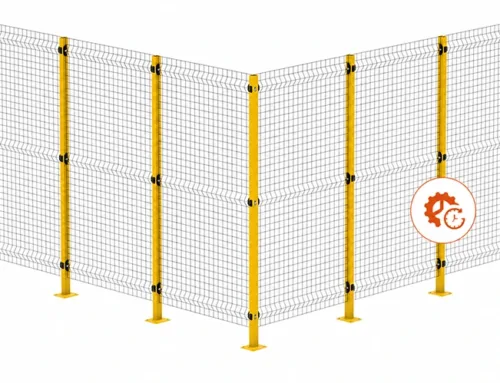
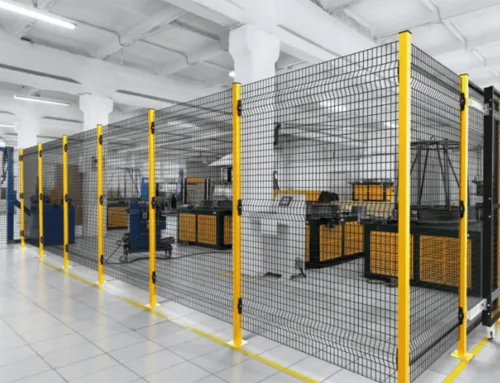
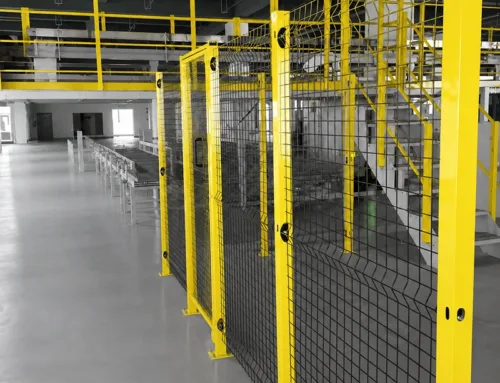
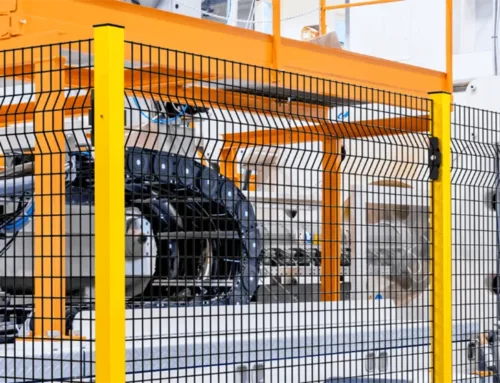
A packaging plant on a 14-day order book redraws its zones faster than a welded perimeter can be justified. Mefence frameless industrial safety fence is a Q235 welded mesh boundary with 3-4 mm wire, 20x100 or 50x50 mm mesh openings and clip-and-screw fixing on base plate posts with slotted mounting holes - unclip the panels, cut the last bay on site, re-bolt them into the new layout. Built for warehouse zoning, storage area separation, pedestrian vehicle separation, forklift path barrier and AGV lane control, with strike points routed to the impact-rated Machine Fence line.
Mesh Opening Over Panel Thickness: Frameless 3D Industrial Safety Fence for Robot Palletizer Cells
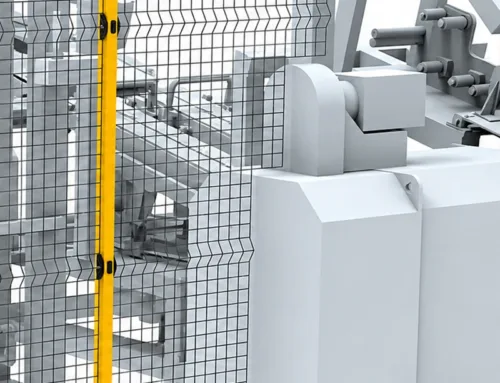
An end-of-line palletizer needs a boundary that keeps people out without taking the sightline with it. Mefence frameless 3D industrial safety fence is a Q235 welded mesh boundary with 20 x 100 mm or 50 x 50 mm openings, clip and self-tapping screw fixing on base plate posts, on-site cut panels and T-shaped ridges that carry interlock, sensor and camera cable — built for robotic workstation enclosure, AGV lane separation and warehouse zoning, with impact-rated strike points on the Machine Fence line.
Open-Mesh Frameless Safety Fencing for Robot Palletizing Cells: Sightline, Camera and AGV LiDAR Without a Solid Panel Wall
Solid panel walls around an end-of-line palletizer keep people out and blind everyone else: the operator cannot see the cycle, the camera sees a grey rectangle, and the AGV map has a new hard surface in it. Mefence frameless 3D safety fencing is a Q235 welded mesh boundary with 20x100 or 50x50 mm openings, clip and self-tapping screw fixing on base plate posts, on-site cut panels and a T-shaped ridge that carries interlock and camera cable — built for robotic workstation enclosure, AGV lane separation and warehouse zoning, with strike points routed to the impact-rated Machine Fence line.