EN
 DE
 RU
 PT
 JA
 ES
 IT
OMRON D4NL INSTALLATION / PIZZATO FS SERIES INTEGRATION
The switch is chosen, and the project still stops at the last bracket
Controls engineers often finish the electrical design, fix the safety switch model, and then discover that no one has specified the part that joins that switch to the gate and the post. Search results return generic industrial safety fencing; nothing answers the interface question. The way out is a three-part text check written down in order: switch body model, actuator key model, then gate type. Omron D4NL installation and Pizzato FS series integration each need their own carrier hole pattern, and a single or double leaf hinged gate needs a different fixing face from a sliding one. Mechanical locks and electronic safety locks can be configured on the same gate. The switch and key are specified by the customer; we do not make the electrical selection for them.
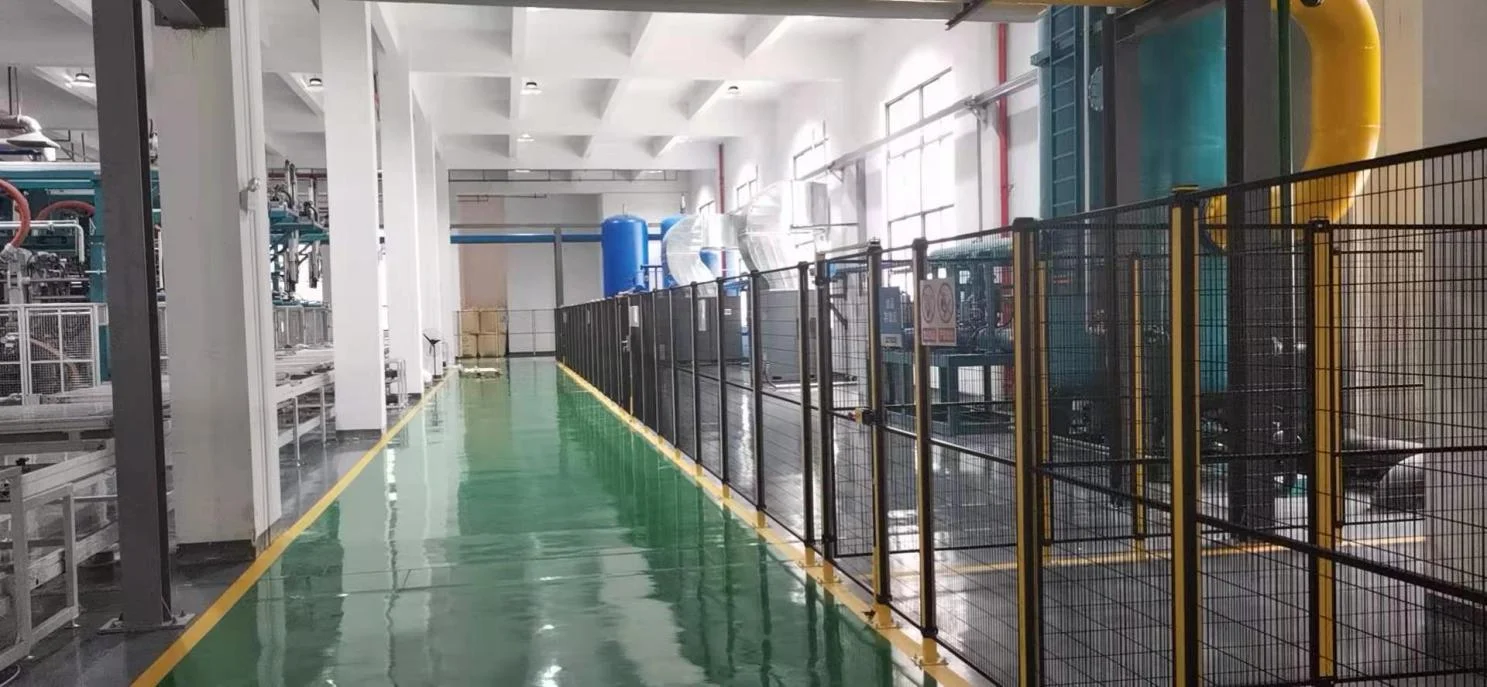
Send your switch model, key model and gate type for a matching check
The three-part matching check, written out step by step
Each step narrows the parts list. Skipping one means the carrier is drawn against an assumption, and the assumption is discovered at commissioning when the actuator no longer meets the switch head.
- Step one, the switch body model. State the exact series and variant, for example an Omron D4NL device or a Pizzato FS series device. The body sets the carrier hole centres, the fixing face and the clearance needed behind the plate. It also fixes which actuator family can be used.
- Step two, the actuator key model. Name the matching key separately. Different keys have different insertion angles and reach, so the key determines where the carrier sits relative to the gate leaf and how much travel the closed position allows. The switch body and key are supplied by the customer or the controls integrator.
- Step three, the gate type. Record single or double leaf, hinged or sliding, handing and swing direction, and clear opening width. A hinged leaf puts the actuator on a rotating arc; a sliding leaf moves it in a straight line. The carrier and the door header beam are then drawn around that movement.
- Step four, the combined configuration. Where a mechanical lock and an electronic safety lock are required on the same gate, list both on one drawing so the hole positions do not compete. The carrier is prepared for the mechanical interface; the safety circuit, rating and validation stay with the electrical team.
- Step five, the mounting face. Confirm flatness of the post face, hole centre tolerance and the available clearance behind the plate. A carrier bolted to a distorted face reproduces that distortion as an alignment fault.
One recorded project supplied five sets of customer CAD drawings; carriers were then manufactured separately for Omron D4NL and Pizzato FS series devices. That is a single project record for a specific machine perimeter guarding configuration, not a statement that all variants are covered or stocked. Custom plates are re-drawn per order.
What the mechanical pack actually contains
A carrier plate with approved hole centres
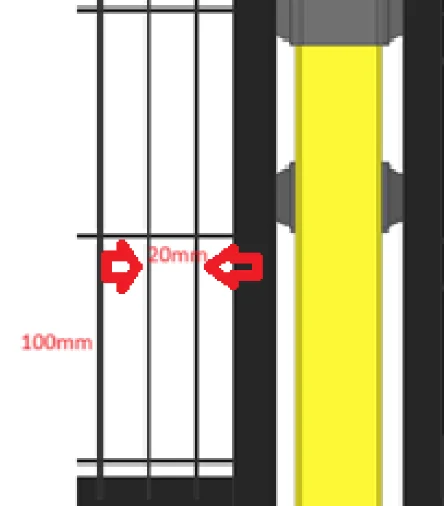
The safety interlock mounting carrier is cut and drilled in the factory to the approved hole pattern, with a universal mounting plate where the post needs a flat datum. Because the holes are made before powder coating, the finished surface stays continuous. Framed mesh panels with a 20x30x1.5 mm tube border and flat full welds give the gate leaf its rigidity, and Q235 60×60 mm posts with M8 fixing rings and four M10 expansion anchors per base plate hold the switch body at a repeatable position.
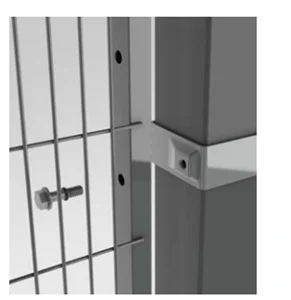
Gate type decides the header and the leaf count
Door width limits are checked before the carrier is drawn: hinged single and double leaves are listed at 1500 and 3000 mm, push-pull at 1200 and 2400 mm, sliding at 2150 and 4300 mm, and folding at 2400 and 4800 mm. A 2.5 m opening is therefore not a single oversized hinged leaf; it moves to a double leaf or a sliding arrangement. The door header beam keeps both gate posts parallel so the actuator stays on its intended line. These are configuration ranges for the framed system, and custom door widths are re-drawn per project.
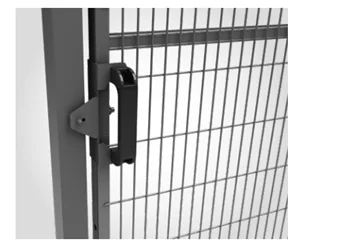
The line we do not cross
We supply the mechanical interface, the prepared hole positions and the installation datum. We do not choose the switch, select the actuator key, set the safety rating, write the PLC logic or validate the circuit under ISO 14120 and ISO 13849-1. Guard design remains subject to the local risk assessment. A 1600 J impact figure quoted for the standard configuration applies only to that tested build and must be confirmed against the actual gate, carrier and door width. This system is not intended for pure pedestrian guidance.
When a written matching check is worth running
- Robot cell guarding and palletizer safety guarding: access is frequent and the actuator alignment becomes a maintenance setting.
- Conveyor line safety guarding: gate interlocks and transfer light curtains share one circuit with separate owners.
- Multi-site machine guarding fence rollouts: the same model-to-carrier-to-gate list repeats for every plant.
- Retrofits on an existing perimeter: the switch is already installed, so the carrier is drawn to the as-built post face.
Written down in this order, the last bracket stops being the reason a commissioned cell is delayed.
The information list for a matched quotation
Send the switch body model, the actuator key model, the gate type and leaf width, handing and swing, the clear opening, the target safety rating, the CAD drawing of the interface, the mounting face condition, the number of access points and the name of the controls integrator. The returned pack carries the model-to-carrier-to-gate list, the carrier hole-position drawing, the general arrangement with the header beam, the panel and post BOM and the acceptance checklist. Electrical selection, schematics and circuit validation remain with the customer’s team.
Write the interface down before you order the panel
Model, key, gate. Three lines of text turn an unspecified bracket into a manufactured part with a part code and a hole pattern that can be checked at goods-in.