
 EN
EN  DE
DE  RU
RU  PT
PT  JA
JA  ES
ES  IT
IT 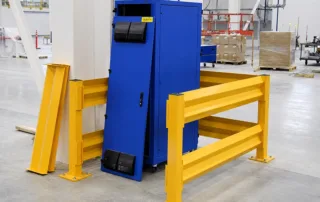
Changing Warehouse Layouts Need Corrugated Guard Rail That Moves with the Operation
When warehouse layouts change with contracts, Hsafety corrugated guard rail uses bolted modular sections, custom lengths, and optional lift-out access to keep forklift impact protection aligned with moving aisles, equipment, and pedestrian routes.
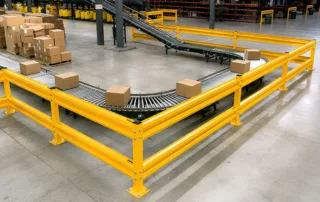
Steel Guard Rail for Warehouse Pedestrian-Vehicle Separation: Preventing Forklift Injury at the Source
A steel guard rail adds a permanent passive safety layer to warehouse pedestrian-vehicle separation, complementing IoT alerts with physical forklift impact protection for people, racks, conveyors, and equipment.
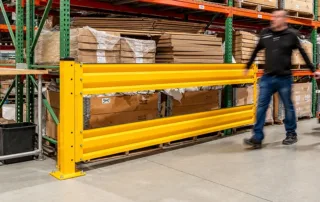
Industrial Guard Rail for Warehouse Pedestrian Separation at Forklift Zones
When people and forklifts share aisles, an industrial guard rail creates a visible physical boundary that does not depend on memory, attention, or perfect training. Hsafety warehouse guard rails add a passive safety layer alongside IoT alerts to protect people, racks, equipment, and walls.
20x100mm Robot Safety Fencing for Compact Automation Cells
Learn how a calculated 20x100mm narrow-opening machine safety fence can help automation integrators reduce unnecessary perimeter setback, preserve forklift and pedestrian routes, and deliver more compact robot cells.
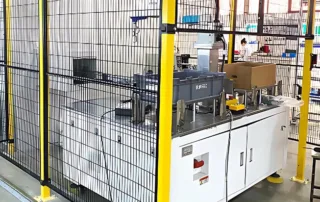
20x100mm Mesh for Compact Robot Cell Guarding Without Sacrificing Safety Distance
A 20x100mm narrow-aperture machine guarding fence can help large automation cells preserve forklift routes and usable factory floor. This GBIM layout reference compares 850mm and 120mm positions while keeping ISO/GB risk assessment at the center.
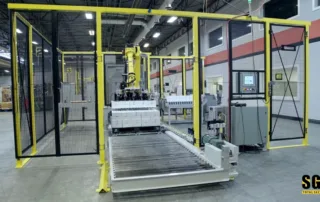
How a 20×100 mm Mesh Pattern Changes the Layout Calculation
A 20×100 mm narrow-slit mesh can help automation integrators evaluate a much tighter robot safety fence position than conventional 50×50 mm mesh, preserving forklift routes and valuable factory floor space when the complete risk assessment supports it.
Industrial Safety Fencing for OSHA and ISO Audit-Ready Machine Guarding
A practical framework for multinational manufacturers that need consistent OSHA and ISO machine guarding across robot cells, automated lines, conveyors, and international plants.
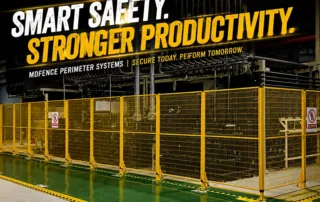
North American Multisite Compliance Audits: Industrial Safety Fencing That Standardizes Machine Guarding
For multinational manufacturers, machine guarding must withstand OSHA and ISO 14120 scrutiny across every site. This guide shows how modular industrial safety fencing, documented steel construction, anchored posts, and interlocked access points create a repeatable, auditable physical guarding baseline.
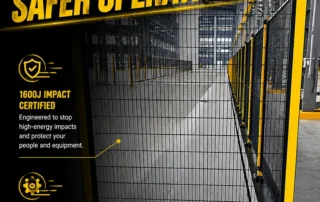
Fire-Sensitive Auto Recycling: Modular Industrial Safety Fencing for Faster Line Rebuilds
In fire-sensitive vehicle recycling and metal-processing areas, hot-work modifications can add both safety exposure and costly downtime. This guide explains how modular industrial safety fencing supports cold-work assembly, machine perimeter guarding and reusable line upgrades.
Fire-Sensitive Auto Dismantling Lines: Modular Industrial Safety Fencing for Lower Retrofit Downtime
For vehicle dismantling plants handling residual fuel, engine oil and metal dust, machine guarding must create a physical boundary without introducing hot-work risk. A modular industrial safety fencing system assembled with mechanical connections helps the line adapt, reuse assets and protect production time.

