EN
 DE
 RU
 PT
 JA
 ES
 IT
Machine Guarding vs Safety Fencing: Three Hazard Questions That Prevent Specification Mismatch
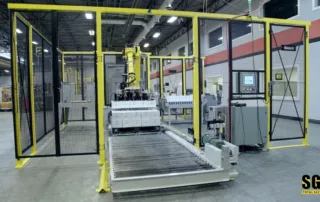
Plant managers and B2B industrial catalogue buyers make two expensive mistakes: a low-cost pedestrian divider around a robot cell fails the machine guarding audit, or a full high impact resistance fencing system is bought for a walkway with no hazard source. Machine guarding vs safety fencing is a risk assessment guarding decision that fixes height, wire diameter, gate and anchorage before a panel is ordered.
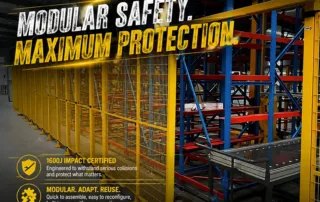
Robot Cell Guarding: What a 1600 Joules Impact Rating Proves, and What It Leaves Untested
A 1600 Joules rating is a tested system result, not a panel property. This note follows the load path a guarding fence needs before the number means anything on your cell.
Machine Guarding Audit Checklist: Five Checks That Decide ISO 14120 Sign-Off
A five-stop walk of the guarding fence before an EHS audit: perimeter integrity, gates and interlock carriers, opening dimensions, anchoring state and the records an auditor asks for at sign-off.
Limited Space Machine Guarding: Cutting the Safety Distance from 850 mm to 120 mm
In a tight plant the fence panel is thin but the safety distance in front of it is not. Switching 50 x 50 mm mesh for 20 x 100 mm narrow slit mesh cut the set-back from ~850 mm to ~120 mm, returned ~3 m² per machine and restored forklift passage on a laser cutting cell retrofit.

ISO 13857 Safety Distance: How a 20 x 100 mm Finger-Safe Mesh Sets the Fence Line
The derivation order that turns a 20 x 100 mm finger safe mesh into a 120 mm ISO 13857 safety distance - and the height and reach-over checks that decide whether that 120 mm floor holds on your layout.

One Cage, Three Sites: Redeploying a Modular Wire Mesh Storage Cage Through a Rolling Programme
A temporary project needs a lockable tool room for the length of the programme, and the next site needs it again weeks later. A modular wire mesh storage cage is bought as parts — galvanised welded mesh panels, posts, hinged mesh doors, base plinths and shelves — bolted with 90-degree angle screws and back-to-back through-bolts, anchored with expansion bolts after squaring. Two people, a hand drill and a wrench, no welding: and the same parts leave on the truck.

Stop Writing Off the Zone: Wire Mesh Storage Cages as a Movable 3PL Asset
A masonry partition is priced once and stranded in the layout it was built for; removing it is a second bill. A modular wire mesh storage cage is a count of galvanised welded mesh panels, steel posts and hinged doors fixed with 90-degree angle screws, back-to-back through-bolts and expansion bolts — so a 3PL zone is unbolted and re-laid when the client mix changes, and the same panels carry into the next bay set.

Custom Sizes Without a One-Off Build: A Wire Mesh Storage Cage Configured From Stock Panels
A catalogue storage cage fixes one width, one height and one door leaf, so the buyer either wastes the air above the load or pays for a fabricated one-off. A custom wire mesh storage cage is quoted as a count of galvanised welded mesh panels, posts, base plinths, shelves and hinged doors, sized bay by bay to the pallet, the forklift and the column you actually have — hinged, sliding or fork-width openings chosen per bay, expansion bolts after squaring, two people and no welding.

Pallet-Wide or Nothing: Sizing a Wire Mesh Storage Cage Door to the Load
A warehouse storage cage quoted off a catalogue page assumes one pallet size, one door leaf and one direction of access. A custom wire mesh storage cage is specified bay by bay — height, widened and deepened bays, base plinth, shelves, mesh fill and door type — so the opening is drawn around the forklift and the load, then bolted together from galvanised steel welded mesh panels and posts.

Sightline, Air and Spray: A Wire Mesh Storage Cage Boundary You Can Re-Lay Instead of Demolish
A solid partition blocks the aisle view, the air path and the sprinkler spray path at the same time. A modular wire mesh storage cage keeps the lock and gives up the surface — galvanised welded mesh panels bolted to steel posts with 90-degree angle screws, back-to-back through-bolts, one hinged mesh door per bay with its lock position scribed on the door bar, ceiling mesh only where a run stops below the pipework, and expansion bolts driven after the run is squared. Two people, a hand drill and a wrench, no welding — and the same parts come down when the zone moves.