EN
 DE
 RU
 PT
 JA
 ES
 IT
01Why a Farm Fence Post Has to Come Out as Fast as It Goes In
On a farm or ranch, a fence line is rarely permanent. Paddocks get re-cut, stock moves between fields, and a temporary boundary may only be needed for one season. That is the context behind the Spfence Y post: a steel star picket designed to be set and pulled without an excavation, a form or a curing wait.
The technical proposal puts it plainly. The post is best suited to farm and livestock fencing where the line has to be built quickly and moved quickly, and it is designed to be sold alongside barbed wire. The recommended weight is a moderate 1.86 kg per metre, chosen because the client had not specified a weight and needed a middle option.
02The Pointed End Replaces the Post Hole
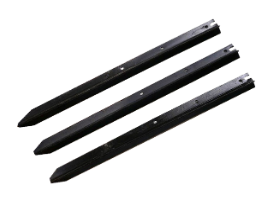
The profile is a Y section, or star section, formed from low-carbon steel. Its lower end is cut to a point. In use, the post is driven into the ground by hammering at intervals along the line, which turns each star picket into a fence post with no digging involved.
- A pointed tip goes straight into the soil, so there is no hole to excavate and no concrete to pour.
- The Y profile gives the post stiffness in more than one direction once it is driven in.
- Because nothing is cast in place, the same post can be pulled and re-set when the paddock layout changes.
- Setting out is a spacing decision, not a civil works programme.
This is the practical reason a Y post farm fence suits rotational grazing and temporary pens: the fence follows the stock plan rather than fixing it.
03The Face Holes Carry the Barbed Wire
The long wing of the Y section is punched with round holes. Their job is to take the horizontal barbed wire, which is tied through the openings as the run is built. The installation view shows strands of barbed wire fixed through these face holes on a post set in pasture.
- Holes let the wire be tied at the height the stock and the terrain require.
- Wire height can be changed later by re-tying, without replacing the post.
- Hole positions vary with post length, so pick the length before laying out the wire lines.

04An Outdoor Finish to Specify Up Front
The proposal lists two surface treatments: paint and hot-dip galvanising, with black as the listed colour, and notes that both the treatment and the colour can be customised. For a fence that stays outdoors, finish is a specification decision to make at order time, not something to leave open.
- Hot-dip galvanising is the option to discuss where the line will see long-term outdoor exposure.
- Painted black is the finish shown in the product images and can be specified where appearance matters.
- Confirm which finish and colour apply to the delivered posts before the order is released.
05Scope Note
The Y profile, Q235 low-carbon steel, pointed lower end, round face holes for barbed wire, paint and hot-dip galvanising options, black colour, 1.86 kg/m recommended weight and the fast-build, fast-move application all come from the Spfence technical proposal. The proposal does not give a driving depth, a post-spacing rule, a finished fence height, a service life by finish, a total weight or a price. The 1.86 kg/m figure is a recommendation made because the client did not state a weight. Confirm spacing, embedment and finish against the actual soil and stock type before ordering.
Planning a paddock or temporary livestock fence?
Ask for the star picket lengths, finish options and hole positions before you set the post spacing.