EN
EN  DE
DE  RU
RU  PT
PT  JA
JA  ES
ES  IT
IT Warehouse zoning, AGV lanes, and forklift path separation
Construction Fence for AGV and Forklift Separation: Mefence Industrial Safety Fencing
When people cross AGV lanes, the line stops. When a forklift meets a pedestrian, the risk is worse. A construction fence style layout built with Mefence industrial safety fencing gives you physical demarcation, high visibility, and a cold-work install path that fits active warehouses and automated production areas.
Why mixed-traffic areas need more than warning tape
In a warehouse with AGV or AMR traffic, a single pedestrian crossing can trigger an unnecessary stop. That is not a safety system failure; it is a planning failure. The same is true when forklifts and people share the same aisle. Warning tape, painted lines, and floor signs can help with awareness, but they do not physically hold a lane. Mefence industrial safety fencing is used for area demarcation, pedestrian separation, warehouse zoning, and forklift path barrier layouts because it turns a rule into a boundary.
| What the site needs | How Mefence answers it |
|---|---|
| AGV / AMR lane control | Physical separation keeps pedestrians out of travel paths and cuts ghost-stop losses caused by surprise crossings. |
| Forklift and pedestrian risk reduction | Mesh fencing creates a visible, fixed boundary for warehouse zoning and traffic flow planning. |
| Fast retrofit in live operations | Cold-work installation with clamp fixing, self-tapping screw, expansion bolt, and base plate post avoids welding downtime. |
| Visible boundary without blocking supervision | Yellow-black safety fence color is easy to spot, while the wire mesh keeps the area visible from outside. |
| Flexible layout for changing lines | Modular reconfigurable system supports relocatable reusable fence planning when aisle layouts change. |
| Match the right product to the risk | Use Mefence for large-area division; use higher-impact Machine Fence where certification and crash resistance are required. |
Three reasons this construction fence style layout fits automation zones
1) Physical separation stops the stop-start cycle
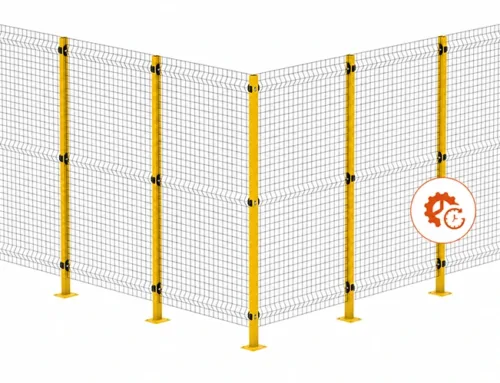
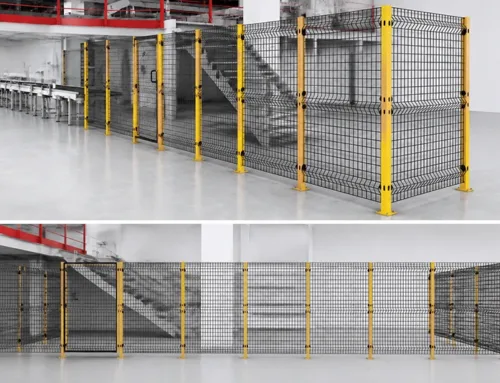
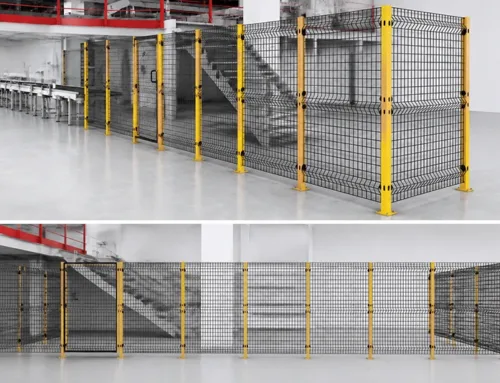
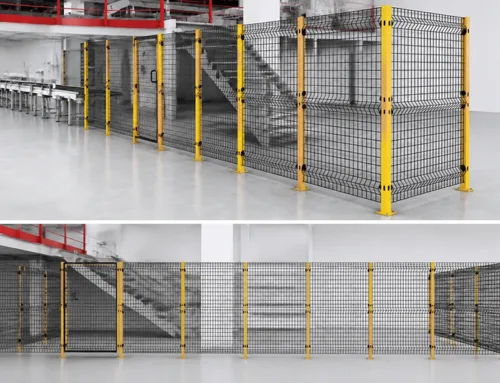
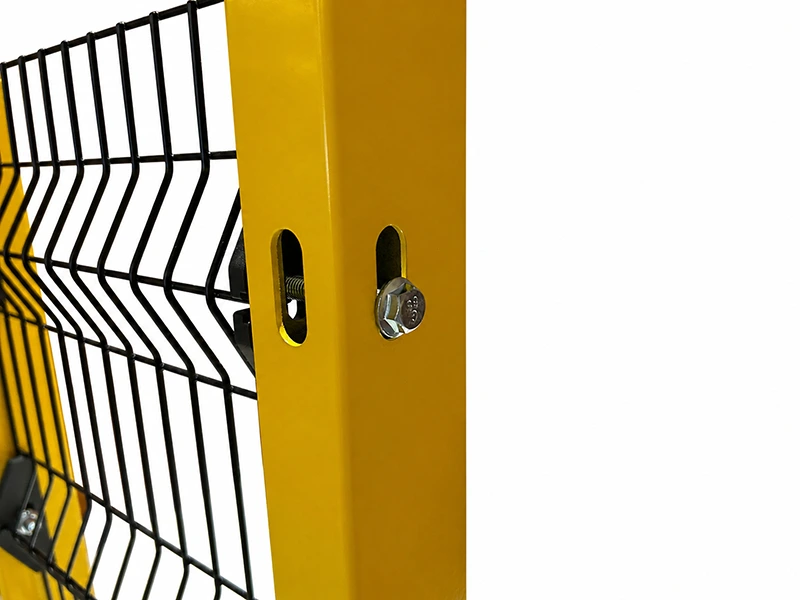
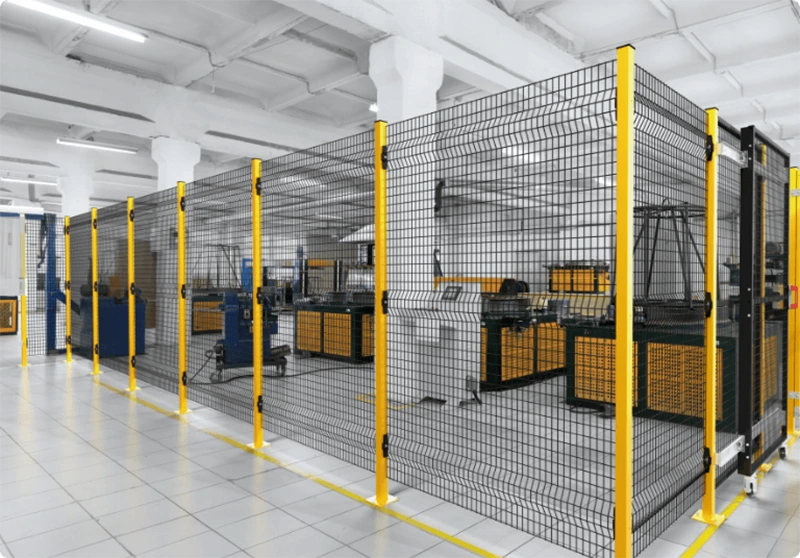
The first job is simple: stop people from casually crossing an AGV or forklift path. Mefence is not a painted reminder or a soft barrier. It is a frameless safety fence that creates a real route for people and a separate route for vehicles. That is why it works for warehouse partition, storage area separation, and robotic cell safety planning. The panel detail in the image shows how the mesh panel clamps to the yellow steel post with a bolt-mounted connector, which is exactly the kind of fixed, repeatable connection a live site needs.
2) High visibility without losing supervision
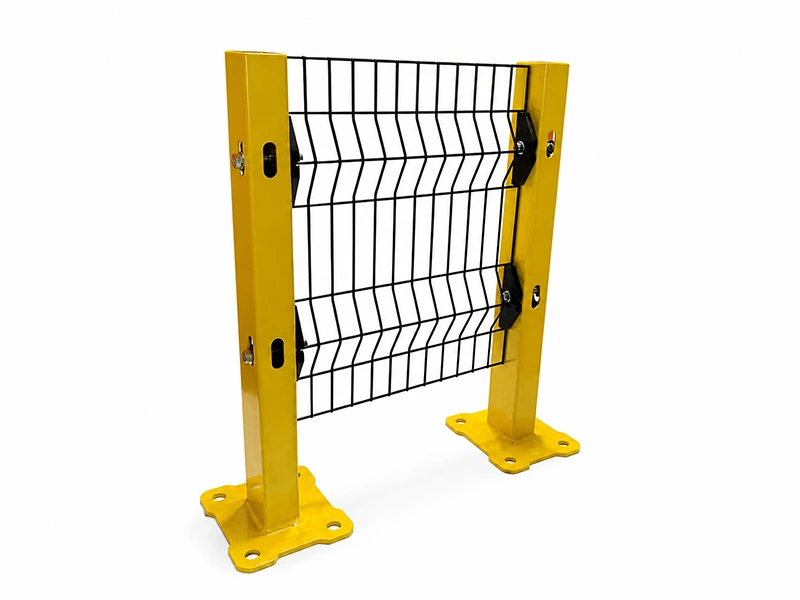
The second job is visibility. Yellow-black safety fence colors are easy to identify from distance, so the boundary is obvious before a worker reaches it. At the same time, a wire mesh machine guard keeps sightlines open, which matters when supervisors need to monitor equipment state, conveyor movement, or loading activity. Compared with a solid wall, the mesh panel gives better visibility and less visual bulk. Compared with barrier tape, it actually defines the route.
3) Cold-work installation keeps the site moving
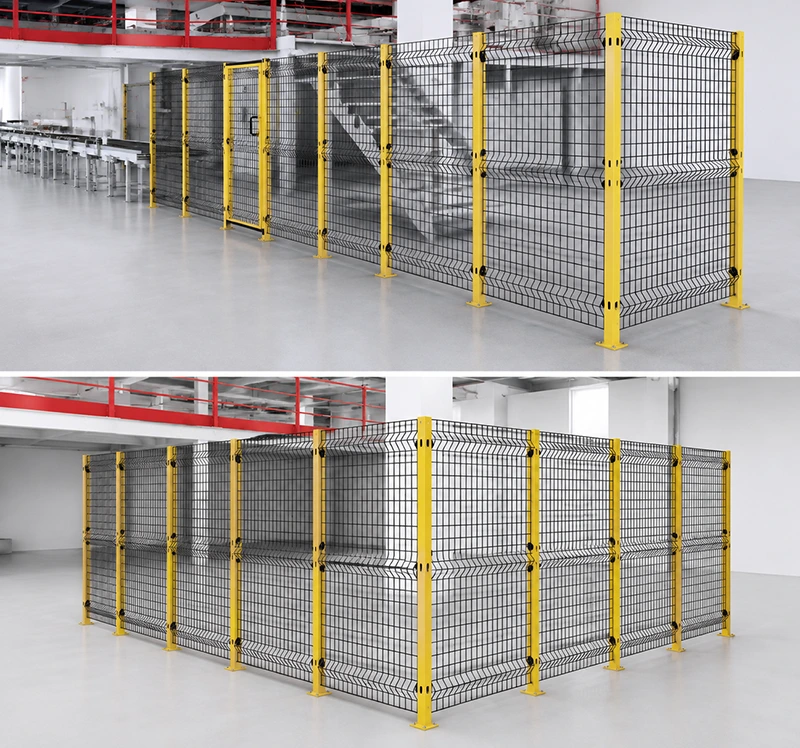
The third job is installation speed. A warehouse does not stop just because the fence is being upgraded. Mefence supports quick install safety fence planning with powder coated steel posts, base plate post options, slotted holes, and modular panel widths from 200 to 1400 mm, with heights from 200 to 3000 mm. Typical structure options include wire diameter 3 mm or 4 mm, mesh opening 20×100 or 50×50, and post sizes 40×60 or 60×60. That gives enough range for aisle edges, equipment zones, and temporary partition layouts without forcing a custom rebuild every time.
Where this works best
- Warehouse zoning around AGV and AMR travel lanes
- Pedestrian vehicle separation at forklift intersections
- Robotic workstation enclosure and automated equipment guarding
- Storage area separation for material segregation
- Workshop isolation and site demarcation during retrofit work
For mixed-traffic facilities, the result is not just “more safety.” It is fewer accidental lane intrusions, fewer unnecessary AGV stops, clearer pedestrian routing, and less wasted time on low-value interruptions. If your site has a few high-impact collision points, use certified impact protection there. For the broader lane network, Mefence gives you the right layer: physical guidance, modular layout, and a cleaner traffic plan.
What to specify before you order
Start with lane width, access points, post spacing, and the required boundary height. Then decide whether each zone needs simple area demarcation or a higher-impact barrier. Mefence is built for the routing layer: industrial safety fencing that helps separate people, vehicles, and automation without blocking supervision or slowing down the whole site.
Build the lane plan before the next ghost stop
If your warehouse or automation floor has people cutting across AGV routes, forklift aisles, or machine cells, we can help map the fence line, access points, and module sizes around the actual traffic flow.