DE
DE  EN
EN  RU
RU  PT
PT  JA
JA  ES
ES  IT
IT 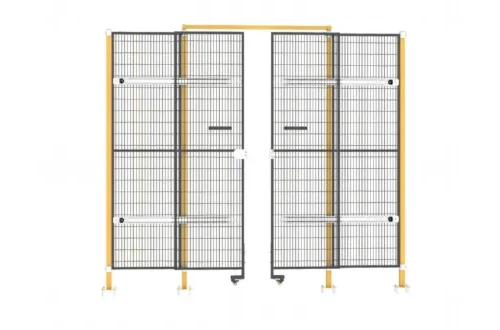

|
For system integrators, the “hardware” is the easy part. The nightmare begins when standard fencing doesn’t handshake with your PLC logic, or when mounting a Pizzato switch requires custom fabrication on the shop floor. We don’t just sell steel; we deliver a modular Sicherheitszaun Industrie ecosystem designed to integrate seamlessly with KUKA, ABB, and Fanuc cells without delaying your FAT (Factory Acceptance Test). |
Beyond the Mesh: Analyzing the Anatomy of a Robot Cell Perimeter
In the world of automotive automation and Tier 1 supply chains, a safety fence is not just a barrier; it is a critical component of the machine safety circuit. When you are designing a turnkey solution for a welding station or a material handling line, you cannot afford components that fail ISO 14120 impact tests or require hours of retrofitting during installation.
Below, we deconstruct the standard components of our Mdfence system, specifically engineered to solve the integration headaches common in high-speed automated environments.
1. The Structural Backbone: High-Tensile Posts
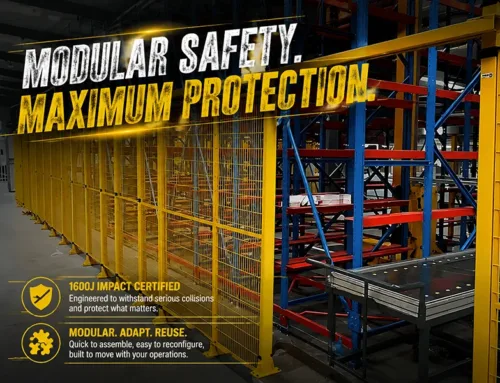
The integrity of any Roboter-Schutzzäune system relies entirely on the rigidity of its vertical supports. In automotive assembly lines, vibration from stamping presses or the kinetic energy of a rogue AGV can compromise weaker structures.
Our standard posts are engineered from **Q235 Cold Rolled Seamless Steel** with a 60x60mm profile. Unlike generic hollow tubes, these posts feature a heavy-duty wall thickness (up to 2.0mm) designed to absorb kinetic energy rather than buckling.

Figure 1: Standard 60x60mm post profile with welded base plate for heavy-duty anchoring.
* **Integration Advantage:** The base plates are pre-welded with “ear” extensions for stability and secured using M10 x 70mm expansion bolts. This ensures the fence remains static even if a forklift nudges the perimeter, preventing false trips of optical sensors aligned with the fence line.
2. The Impact Shield: Framed Mesh Panels
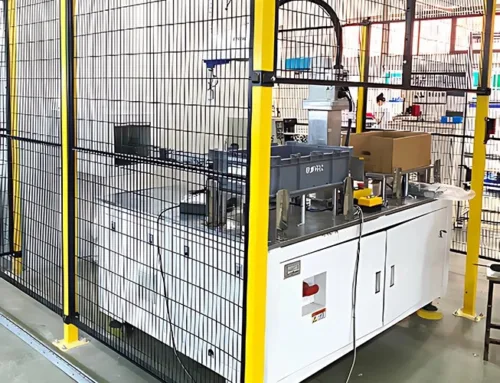
In “Build to Print” projects, rigidity is non-negotiable. We utilize **Framed Panels** rather than loose mesh. The 20x30mm steel tube frame acts as a skeleton, preventing the “wobble” effect often seen in cheaper fencing when doors are slammed shut.
The wire mesh (3mm or 4mm diameter) is flat-welded to the frame. This “flat weld” technique is crucial for automotive interiors or textile handling zones where a snagged glove or scratched component equals a quality rejection.

Figure 2: Framed panel construction ensures rigidity and eliminates sharp edges that could injure operators.
* **Safety Compliance:** These Maschinenschutzzaunfelder are TUV certified for impact resistance, ensuring that ejected parts from a CNC lathe or a shattered grinding wheel are contained within the cell.
3. The Logic Gate: Integrated Door Systems
For a System Integrator, the door is where the mechanical meets the electrical. It is the most complex part of the Industrielle Perimetersicherungen.
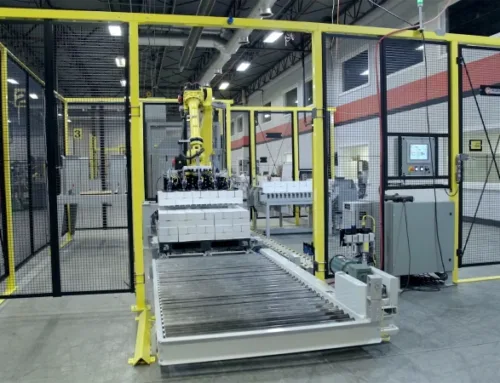
We offer modular door systems (Hinged, Sliding, Folding) that are pre-engineered to accept safety interlocks. Instead of your technicians drilling holes on-site to mount an Omron D4NL or Pizzato switch, we provide **Specialized Lock Carriers**. These carriers are interface-ready, meaning you can mount the interlock and wire it to the safety PLC in minutes, not hours.

Figure 3: Double hinged door system equipped with caster wheels for smooth operation, ready for interlock integration.
* **Operational Efficiency:** For high-traffic maintenance access, our hinged doors utilize heavy-duty casters to prevent hinge sag over time—a common failure point in high-cycle robotics cells.
4. Layout Adaptability: Solving the “Odd Angle” Problem
Automotive production floors rarely offer perfect square footage. You often need to route fencing around existing pillars, conveyors, or cable trays.
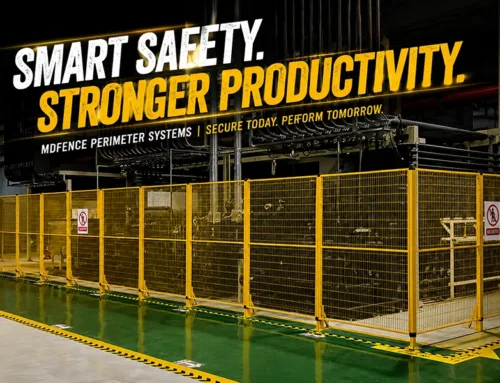
Unser Sicherheitszäune Maschinenschutz system includes adjustable mounting clips and variable-width panels. This allows for on-site adjustments to handle non-90-degree corners or tight clearances between the robot reach and the aisle.

Figure 4: Complex layouts with multiple entry points and angles are standard configurations for our modular system.
By standardizing these components—Posts, Framed Panels, Smart Doors, and Adjustable Fixings—we allow you to focus on the automation logic, knowing the physical barrier is compliant, robust, and ready for inspection.
Häufig gestellte Fragen
Q: Can your fence posts accommodate mounting brackets for light curtains or E-stops?
A: Yes. Our 60x60mm posts are structurally sufficient to support ancillary safety equipment. We can also provide pre-drilled or tapped holes based on your CAD drawings to mount light curtain emitters/receivers or E-stop control boxes directly.
Q: We use specific safety interlocks (Euchner/Schmersal). Are your doors compatible?
A: Absolutely. We offer “Lock Carrier” kits specifically designed for major brands like Omron, Pizzato, Euchner, and Schmersal. This ensures the actuator aligns perfectly with the switch head without makeshift shimming.
Q: What is the standard lead time for a custom layout for a 5-robot welding cell?
A: For projects utilizing standard modular components (even with custom layouts), we can typically ship within 10-14 days. Our modular stock allows us to “pick and pack” based on your CAD design rather than fabricating from scratch.
Q: How does the powder coating hold up to cutting fluids or oils common in CNC machining centers?
A: Our panels undergo ISO9227 salt spray testing and adhere to GB/T9286-1998 standards. The powder coating is highly resistant to industrial oils, coolants, and mild solvents, preventing corrosion even in wet machining environments.
Q: Do you provide CAD/STEP files for us to drop into our SolidWorks assembly?
A: Yes. We provide full 3D models of our posts, panels, and door assemblies. This allows your engineering team to validate safety distances (ISO 13857) and check for interferences in the digital twin before ordering.