ES
ES  EN
EN  DE
DE  RU
RU  PT
PT  JA
JA  IT
IT 

For EHS Managers and Safety Officers, passing an OSHA Machine Guarding audit is just the baseline. The real challenge is fighting the “bypass culture”—where frustrated operators disable safety devices to maintain production speed. We provide a human-centric Valla de Seguridad Industrial system designed to work with your operators, not against them. From high-visibility mesh to ergonomic door systems, our solution reinforces your Workplace Injury Prevention strategy while satisfying the strictest Industrial Safety Standards.
The Visibility Paradox: Why “Black” is Safer than “Yellow”
Many facilities default to bright yellow mesh for high visibility, but this can actually hinder safety. High-gloss yellow reflects light, creating “visual noise” that makes it hard to see the Automated Production Line inside. If operators can’t see the process clearly, they are tempted to open the gate or bypass the interlock to check on the machine.
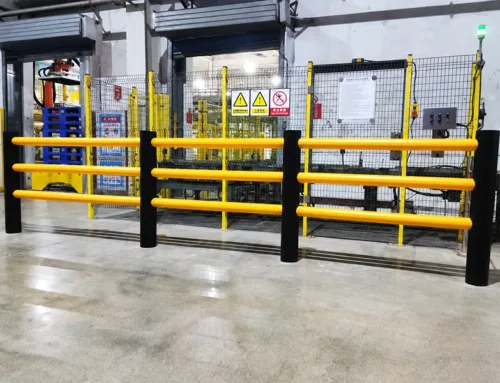
Our system uses a scientifically proven color combination: RAL 1023 Safety Yellow for the posts (to define the hazard boundary) and RAL 9005 Black for the Steel Mesh Panel. The black powder coating absorbs light, rendering the mesh almost invisible to the human eye. This allows for superior monitoring of Industrial Robots and gauges without breaching the safety perimeter, reducing the frequency of unnecessary entries and keeping your safety circuit intact.
Eliminating Trip Hazards and Promoting 5S
Safety isn’t just about stopping a robot; it’s about the entire environment. Exposed floor anchors on traditional fencing are notorious trip hazards and debris traps, complicating your 5S Management efforts. A cluttered, dirty safety line signals a lack of discipline.
We address this with our specialized two-piece Post Base Protective Cover. These durable covers fully encapsulate the anchor bolts and base plates, creating a smooth, sloped surface that prevents tripping and allows for easy cleaning. By eliminating these micro-hazards, you demonstrate a commitment to detail that permeates your entire safety culture.

Eliminating trip hazards with enclosed base covers for better 5S compliance.
Engineering Out the “Bypass” Incentive
Why do workers bypass safety gates? Often, it’s because the doors are heavy, misaligned, or difficult to latch. A sagging door that requires two hands to close is a production nuisance that invites tampering.
Our Modular Design features rigid framed doors with structural headers (Door Frame Beams) that maintain perfect alignment year after year. Combined with our Interlock Carriers, the safety switch key engages smoothly every time. When the safety system is effortless to use, compliance becomes automatic. Furthermore, our door systems easily integrate with Lockout Tagout (LOTO) hasps, ensuring that maintenance personnel can mechanically secure the area during service, compliant with OSHA 1910.147.
Preguntas Frecuentes
1. Does the black mesh meet safety color code standards?
Yes. Safety standards (like ANSI Z535) focus on marking physical hazards and boundaries. Using yellow posts clearly defines the “caution” zone, while black mesh is an industry best practice for visibility through the guard, widely adopted by automotive and aerospace leaders.
2. How does the system support Lockout/Tagout (LOTO)?
Our door handles and slide bolts are designed to accommodate multiple padlocks. Additionally, our “Jimmy Proof” lock options provide robust mechanical security that physically prevents the door from closing while maintenance is being performed.
3. Are there sharp edges that could injure workers?
No. Unlike cut-wire fencing, our “Framed Panels” use a flat-welding process where every wire end is fully welded to the tube frame. This creates a smooth, snag-free surface that protects operators from cuts and scrapes.
4. Can I retrofit this system to existing unsafe machinery?
Yes. Our modular system is ideal for brownfield upgrades. The adjustable fixing rings allow installation on uneven floors common in older factories, helping you bring legacy equipment up to modern safety standards quickly.
5. Is the system TUV certified for safety audits?
Yes. We provide full TUV certification documentation for impact resistance. Having third-party validated guarding simplifies your internal risk assessments and external insurance or OSHA audits.