ES
ES  EN
EN  DE
DE  RU
RU  PT
PT  JA
JA  IT
IT 

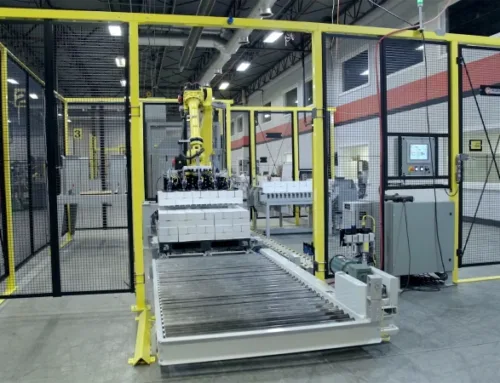
When a high-speed 6-axis robot drops a 50 lbs engine block, or an AGV veers off its programmed path in your material handling area, a flimsy wire barrier won’t save your equipment. You need a physical barrier engineered for precise kinetic energy dissipation to prevent catastrophic line downtime and EHS audit failures.
The Physics of Robot Collisions: What Does 1600 Joules Actually Mean?
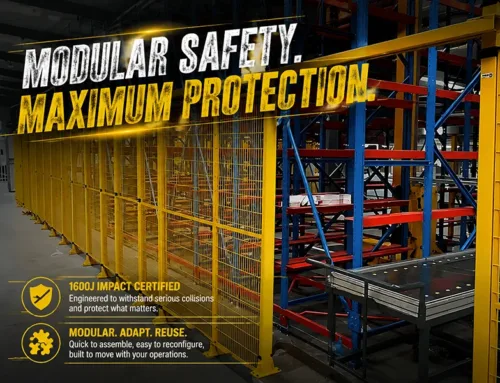
In the world of robotics integration and automated production lines, impact resistance cannot be a guessing game. When we specify that our Valla de Seguridad Industrial is certified to withstand an impact of 1600 Joules, we are translating structural mechanics into shop-floor reality.
To put this into perspective: 1600 Joules is the equivalent of a 220 lbs (100 kg) object crashing into the barrier at 12.4 mph (20 km/h). In a dedicated manufacturing line, this represents a worst-case scenario where a CNC machining center ejects a heavy metal workpiece, or a robotic arm experiences a critical failure and throws a payload outward.

Instead of using brittle cast iron or easily warped aluminum profiles, the system relies on high-tensile Q235 carbon steel. When subjected to an excessive load, the 60x60mm posts and heavy-duty base plates—anchored by M10x70mm expansion bolts—undergo plastic deformation. Like the crumple zone of an automobile, the steel bends to absorb the kinetic energy rather than shattering into dangerous shrapnel that could damage adjacent servo motors or injure operators.
Before vs. After: Surviving the High-Speed Assembly Line Hazards
The Pain (Before): System integrators often face nightmares with generic, frameless wire mesh. When an automated high-speed mechanical assembly machine generates heavy vibrations, or a worker accidentally leans on the enclosure, the frameless mesh sags like a hammock. A minor bump from a pallet jack causes the mesh to detach. Worse, this sagging misaligns the safety interlock switches on the doors. The PLC reads a broken circuit, triggering a Safe Torque Off (STO), resulting in phantom machine stops that kill your Overall Equipment Effectiveness (OEE).

The Logic (Why it works): Our Protección de Máquinas panels are engineered with a 20x30x1.5mm seamless tubular frame. The 3.0mm or 4.0mm wire mesh is attached using a flat welding process, ensuring zero burrs and maximum out-of-plane stiffness. When a point load strikes the mesh, the welded nodes immediately distribute the force across the rigid tubular frame, which then transfers the load to the posts via heavy-duty connection clips.
The Benefit (After): The structural integrity remains uncompromised. Your robot work cells stay online, the doors remain perfectly plumb, and the safety interlocks stay aligned. You eliminate costly unplanned downtime and breeze through rigorous EHS and OSHA compliance audits.
| Scenario | Standard Frameless Mesh | Mdfence Framed System (1600J) |
|---|---|---|
| Accidental Forklift Bump | Mesh detaches, requires cutting and re-welding. Line stops for hours. | Frame absorbs impact. Replace single panel in 10 mins using a wrench. |
| Door Operation & PLC | Hinges sag over time, causing interlock misalignment and phantom STO trips. | Rigid tubular frame keeps doors perfectly aligned; seamless PLC integration. |
| EHS Audit / ISO 14120 | Fails impact tests; requires excessive safety distance (850mm+). | Passes stringent TUV impact tests; allows installation as close as 120mm. |
Defending the Perimeter: AGVs and Material Handling Areas
In modern intelligent logistics setups, the danger isn’t just inside the cell; it’s on the floor. Autonomous Guided Vehicles (AGVs) and manual forklifts navigate tight paths around your automated production line. A collision at the base of your perimeter guarding can shear off standard posts.

To combat this, the system incorporates robust base plates anchored deep into the concrete. Furthermore, the two-piece plastic post base protective covers shield the expansion bolts from direct tire strikes and prevent operators from tripping, ensuring your material handling area remains both safe and compliant.
Integrating with Your PLC: Precision for Safety Interlocks
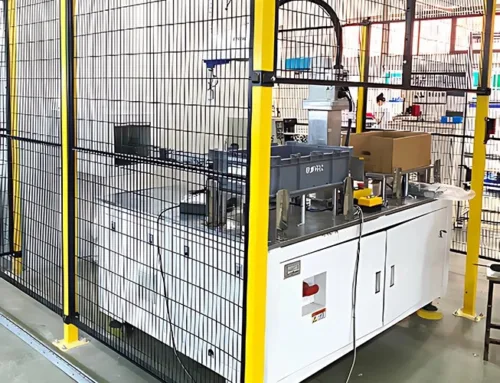
A physical barrier is only half the solution; it must communicate with your control equipment. System integrators despise fencing that requires on-site drilling to mount safety light curtains or interlock switches (like Omron D4NL or Pizzato). Drilling compromises the powder coating, introduces metal shavings into clean assembly environments, and often results in misaligned sensors.

Our Valla de Seguridad para Robots acts as a highly accurate lock carrier. We provide pre-engineered mounting brackets designed specifically for industry-standard safety switches. Because our framed panels do not flex, the actuator key on the door perfectly aligns with the switch body on the post every single time. When a worker opens the door, the mechanical separation instantly forces the electrical safety circuit open, signaling the PLC to cut servo power without delay or error.
The ISO 13857 Advantage: Reclaiming Shop Floor Real Estate
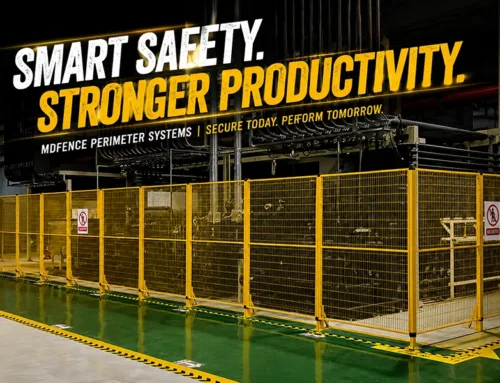
Floor space in an automotive manufacturing plant is premium real estate. Standard 50x50mm (2×2 inches) mesh allows fingers to pass through, forcing EHS engineers to mandate a safety distance of up to 850mm (33.5 inches) from the hazard. Our system utilizes a specialized 20x100mm “finger-safe” mesh design. By restricting access to just the fingertips, ISO 13857 standards allow this barrier to be installed a mere 120mm (4.7 inches) from the danger zone. For a 150-foot automated line, shrinking the perimeter by over two feet on all sides reclaims hundreds of square feet for additional CNC machinery or wider AGV paths.
Frequently Asked Questions (FAQs)
1. How do you calculate if 1600J is enough for our specific robotic cell?
1600 Joules covers the vast majority of industrial applications, equivalent to a 100kg mass hitting at 20 km/h. For highly specific payloads (e.g., a robot handling a heavy automotive chassis at maximum velocity), your EHS engineer will conduct a Risk Assessment based on ISO 14120 to calculate the exact kinetic energy. Our Q235 steel framed panels consistently exceed standard baseline requirements for these assessments.
2. If a forklift crashes into the post, do we need to replace the whole line?
No. The system features a 100% modular design. The kinetic energy is localized to the point of impact. You only need to unbolt the damaged post or panel and swap it with a replacement from inventory. This cold-assembly process takes minutes, requires no hot work permits, and keeps your assembly line running.
3. Does the structural rigidity complicate the installation of safety light curtains?
Actually, it simplifies it. The rigid 60x60mm posts provide a perfectly plumb surface for mounting electro-optical elements. We also offer specialized posts with internal wire routing, allowing safety light curtains to be seamlessly integrated without exposed cables that could snag on passing material handling equipment.
4. Are the framed panels heavy enough to cause sagging on wide sliding doors?
To prevent sagging on wide sliding doors (which can span up to 4300mm), we utilize heavy-duty bearing rails and overhead door frame beams that connect the structural posts. This ensures the weight is supported evenly and the sliding mechanism operates smoothly without stressing the PLC interlock alignments.
5. How does this system comply with OSHA and ANSI/RIA R15.06 for robotics integration?
The system is engineered specifically to meet the “State of the Art” requirements of ISO 14120 and ANSI/RIA R15.06. From the 20x100mm mesh size that dictates safe reach distances, to the pre-engineered lock carriers that enforce Lockout/Tagout (LOTO) and Safe Torque Off (STO) procedures, it provides the physical compliance necessary to pass stringent EHS audits.