ES
ES  EN
EN  DE
DE  RU
RU  PT
PT  JA
JA  IT
IT 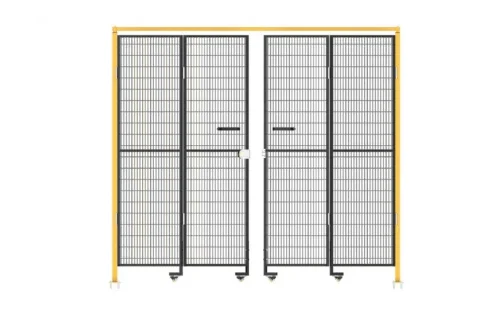

|
Designing a robotic welding cell isn’t just about stopping a runaway forklift; it’s about containing 3,000°F weld spatter and blinding arc flash. For automation integrators, choosing between standard wire mesh and solid welding shields dictates not only OSHA compliance but also the cycle time and maintenance overhead of your automated manufacturing lines. Let’s engineer the exact perimeter your welding robots need to keep production moving without melting adjacent pneumatic lines. |
The Reality of Automotive Welding Stations: Spatter, Flash, and Fumes
When engineering an automated production line, the welding station is often the most hostile environment on the floor. The Before Scenario: System integrators frequently default to standard, cheap wire fencing for the entire perimeter. The result? High-velocity weld spatter shoots through the large mesh openings, melting the sensor cables of adjacent CNC machining centers. Simultaneously, the intense UV arc flash triggers safety complaints from operators working on nearby assembly systems. Conversely, enclosing the entire cell in solid steel boxes traps toxic fumes, causing the robotic cell to constantly trigger the overhead HVAC extraction alarms.
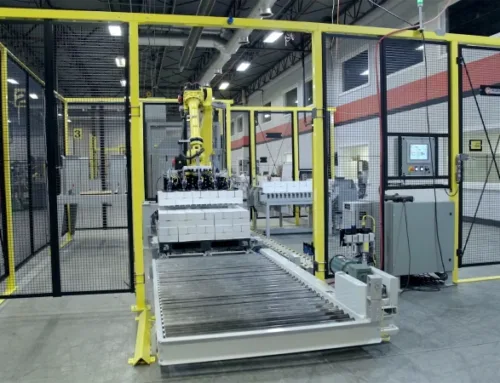
To solve this, Sistemas de Vallado de Seguridad para Robots must be engineered as a targeted physical barrier, balancing arc containment with necessary ventilation.
Option 1: The Framed Wire Mesh Panel

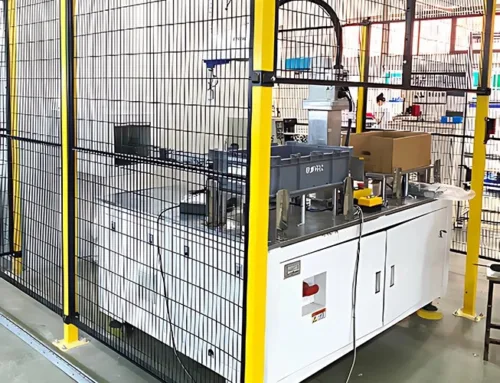
Why it works: Our standard framed mesh panel utilizes a robust 0.78″ x 1.18″ (20x30mm) tubular steel frame with 0.11″ or 0.15″ (3.0mm/4.0mm) wire flat-welded to the inside. The tight 0.78″ x 3.93″ (20x100mm) mesh spacing restricts finger access, allowing you to install the perimeter just 4.7 inches (120mm) away from moving robotic arms according to ISO 13857.
The After (Actual Benefit): While mesh provides excellent visibility for quality inspection cells and allows fume extraction systems to breathe, it is not suitable for direct line-of-sight to the welding arc. We deploy these Paneles de valla de protección para maquinaria at the rear of the welding cell or on the upper tiers (above 5 feet) where spatter cannot reach, saving you significant material costs while maintaining structural rigidity.
Option 2: The Solid Welding Shield (Steel or Polycarbonate)
Why it works: For the primary strike zones, the Mdfence modular system allows you to swap out wire mesh for solid Q235 carbon steel plates or UV-blocking polycarbonate (PC) panels, mounting them on the exact same 2.36″ x 2.36″ (60x60mm) posts. These plastic panels meet UL94V0 and EN1598 fire safety standards, easily shrugging off hot slag.
The After (Actual Benefit): By installing solid welding shields at the lower and middle tiers of the cell, you create an impenetrable barrier against arc flash and spatter. This completely eliminates the risk of adjacent pneumatic line damage and protects floor operators from eye injuries. Your layout passes OSHA inspections the first time, preventing costly rework before the line goes live.
The Hybrid Solution: Maximizing ROI and Floor Space
The most efficient turnkey solutions utilize a hybrid approach. We recommend a “Top-Open” configuration: solid panels from the floor to 5 feet high to block UV flash and slag, topped with framed wire mesh panels up to 8 feet. This contains the hazards while allowing overhead cranes to drop heavy fixtures directly into the cell without dismantling the perimeter.
| Panel Type | Arc Flash Blocking | Ventilation / Airflow | Best Application in Welding Cell |
|---|---|---|---|
| Framed Wire Mesh | Low | High (70% Open Area) | Upper tiers, rear perimeter, fume extraction zones |
| Solid Steel Shield | 100% | None | Direct spatter zones, heavy impact areas |
| Polycarbonate (PC) | High (UV Filtered) | None | Operator viewing windows, HMI interaction points |
Access Control in High-Speed Manufacturing Lines

In high-density automotive layouts, swinging a standard hinged door open can block critical AGV pathways. For these tight aisles, we deploy double sliding doors suspended on heavy-duty bearing rails. More importantly, these doors aren’t just physical barriers; they are active nodes in your safety circuit.
Our Valla de Seguridad Industrial system features pre-engineered lock carriers specifically designed for industry-standard PLC interlocks (like Omron D4NL or Pizzato). You no longer need your technicians wasting hours drilling and tapping painted posts on-site. The mechanical separation forces an immediate Safety Torque Off (STO) to the welding robot, ensuring zero risk to operators entering the cell for maintenance.
Frequently Asked Questions (FAQs)
1. Can we mount safety light curtains directly to the welding shield posts?
Yes. Our Q235 carbon steel posts (2.36″ x 2.36″) provide a rigid, vibration-free surface. We also offer dedicated 80x80mm light curtain posts with integrated internal cable routing to protect wiring from weld spatter.
2. How close can the 0.78″ x 3.93″ mesh panel be installed to the welding robot?
Based on ISO 13857 standards for preventing finger access, our 20x100mm mesh allows the fence to be installed as close as 4.7 inches (120mm) from the hazard zone, saving valuable floor space compared to standard 2″x2″ mesh.
3. Will your solid steel panels withstand a direct forklift impact?
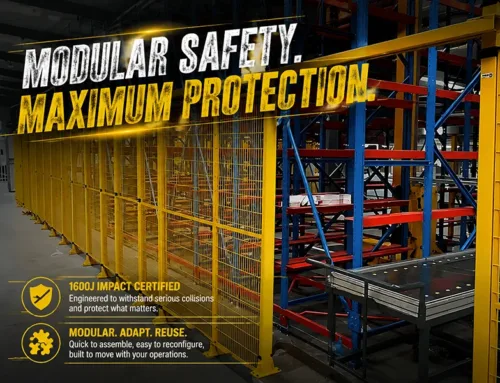
Our system is TUV certified to withstand up to 1600 Joules of impact energy. This is equivalent to intercepting a 220-lb (100kg) object moving at 12.4 mph (20 km/h), protecting your expensive robotic assets from material handling accidents.
4. How do we handle overhead crane access for loading heavy fixtures into the welding cell?
We utilize a “Top-Open” layout. Unlike fully enclosed cages, our rigid framed panels and robust floor anchoring do not require top cross-bracing, allowing unobstructed vertical access for overhead cranes.
5. Are the panel systems compatible with our specific PLC interlocks?
Absolutely. We provide pre-fabricated mounting plates for major safety switches (Omron, Pizzato, Schmersal). This “design for automation” approach eliminates on-site hot work and ensures perfect alignment for reliable machine safety integration.