ES
ES  EN
EN  DE
DE  RU
RU  PT
PT  JA
JA  IT
IT AGV PATH GUARDING | INDUSTRIAL SAFETY FENCE
The 20×100 mm answer to a crowded AGV lane
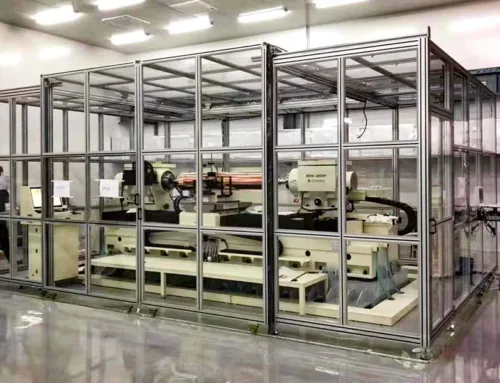
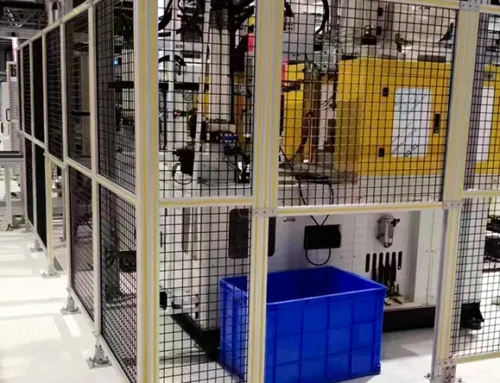
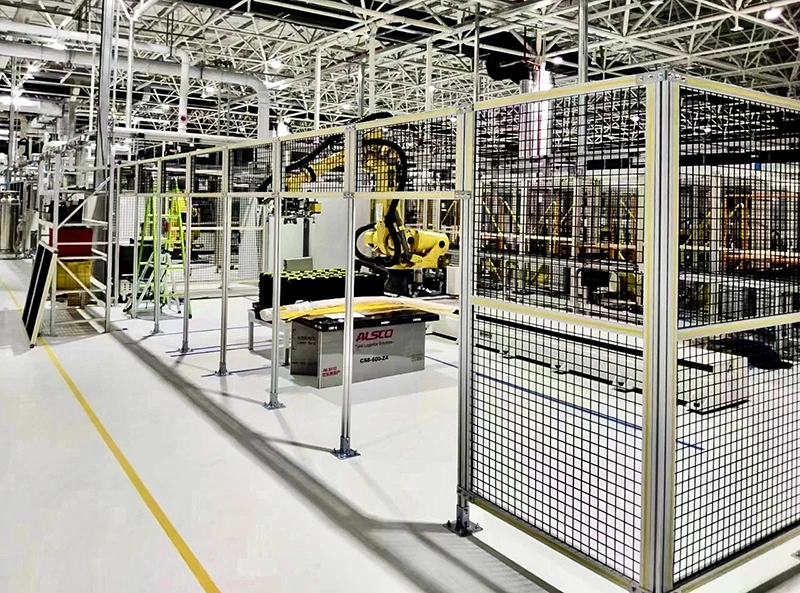
When forklifts, tugger trains and AGVs pass close to a robot cell, a conventional mesh fence can consume the very floor space the vehicles need. Alfence is a modular safety fence for indoor machine guarding that combines a 20×100 mm welded wire mesh, 40×40 or 45×45 mm aluminum profile posts, anchored foot connectors and controlled safety-door access. The layout can bring the perimeter close to the hazard—around 120 mm in the specified use case—while keeping the final EN ISO 13857 assessment project-specific.
What changes the AGV path guarding calculation?
The problem is not simply that a fence is too large. The fence, the reach distance, the vehicle envelope, the gate swing and the stopping logic all compete for the same aisle. A standard 50×50 mm mesh arrangement may require about 850 mm of separation in the project reference when assessed against ISO 13857. That can turn a usable mixed-traffic lane into a bottleneck. Alfence addresses the geometry first, then the anchoring and access controls.
| Mixed-traffic issue | Alfence detail to specify and verify |
|---|---|
| 50×50 mesh pushes the perimeter away from the hazard | Use the 20×100 mm grid where the risk assessment allows a closer-to-hazard layout, with approximately 120 mm as the specified design target for this use case. Do not treat that figure as a universal compliance distance. |
| Forklift or AGV contact can loosen an unplanned base | Use 40×40 or 45×45 mm aluminum posts with a foot connector and M8 expansion-bolt anchoring. This creates a defined floor-mounted boundary for incidental contact exposure; it is not a tested high-impact steel barrier rating. |
| One standard gate does not fit people, maintenance and logistics | Plan hinged, folding, telescopic, linear/sliding or project-configured safety-door arrangements. The supplied reference allows a double sliding/roller opening up to 6000 mm, subject to the final layout. |
| A gate must not become an uncontrolled shortcut into the robot cell | Integrate a safety interlock switch and, where required, a safety light curtain. The control sequence can be designed so a door-open signal stops hazardous motion; validation remains part of the machine risk assessment. |
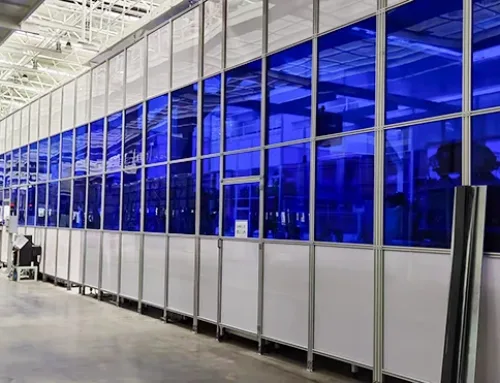
| Frequent line changes make welded steel guarding a sunk cost | Use connector-based, bolt-free panel assembly and removable panels so the perimeter can be reconfigured for a new robot cell, conveyor route or ASRS boundary without on-site welding. |
How the modular safety fence fits the real route
1. Bring the boundary closer without hiding the risk
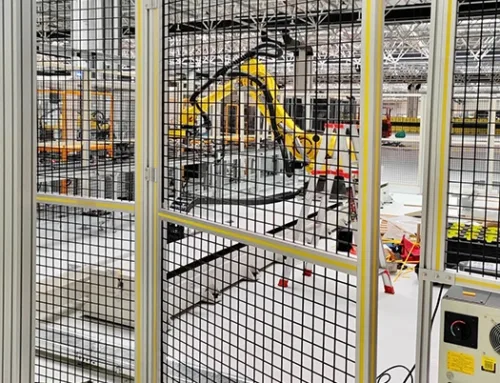
With a welded steel fence or a coarse wire partition, the required stand-off can steal the turning margin from an AGV path. Alfence uses a 20×100 mm welded wire mesh and a slim aluminum profile safety fence format to keep visibility into the robot cell while reducing unnecessary floor-space loss. The result is not a promise that every installation can sit at 120 mm: the hazard, opening, reach height and vehicle movement still have to be checked against EN ISO 13857. It is a more practical starting point for AGV path guarding than designing the aisle around a generic 50×50 panel.
2. Give incidental contact a defined anchored base
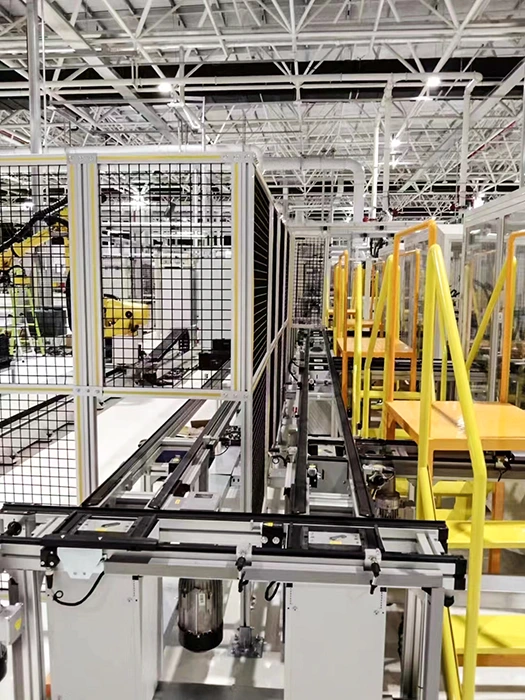
Where a forklift, tugger or AGV passes close to the perimeter, the base connection deserves the same attention as the panel. A 40×40 or 45×45 mm T-slot aluminum post sits in a post-and-panel system, while the foot connector and M8 expansion bolt transfer the installation into the floor. This is the right way to specify a corrosion-resistant, lightweight and reconfigurable indoor machine guarding fence for incidental contact exposure. It should not be sold as equivalent to a certified heavy-impact vehicle barrier; repeated collision risk needs a separately rated protection design.
3. Turn every personnel and logistics opening into a controlled event
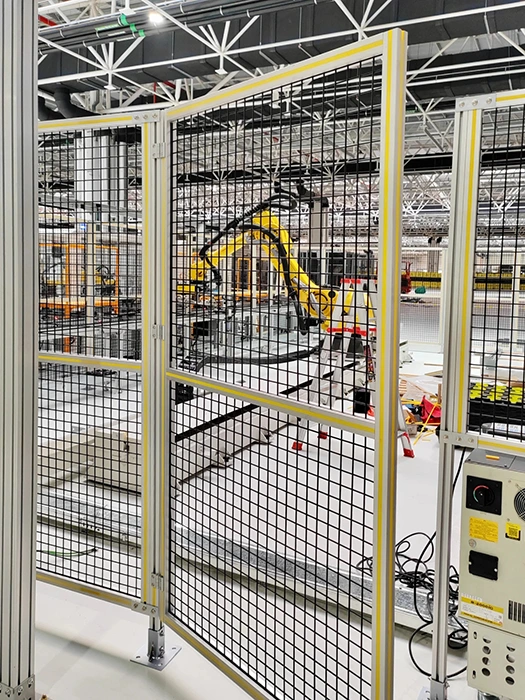
Mixed traffic needs more than a gap in the fence. Select the door around the actual movement: a hinged door for routine service, a folding or telescopic arrangement where swing space is limited, or a linear/sliding safety door where pallets, forklifts and AGVs need a wider crossing. A double sliding/roller door can be specified up to 6000 mm in the supplied reference. Add an interlock switch or safety light curtain so the opening is connected to the stop circuit rather than left as an informal route around the machine guarding.
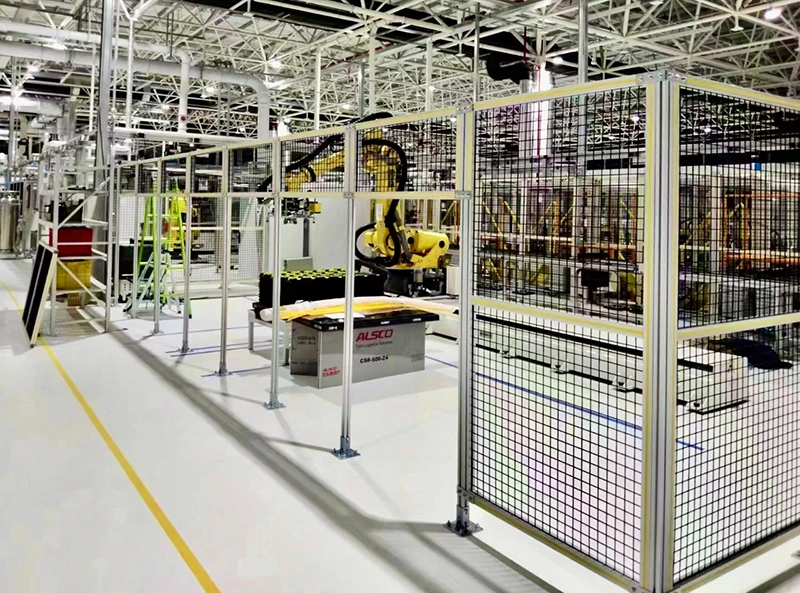
Where this industrial safety fence fits
- Protección de rutas AGV: keep robot cells, conveyor transfer points and pedestrian crossings visibly separated without expanding the perimeter unnecessarily.
- Forklift and tugger routes: define the boundary around automated production lines while reserving the aisle for turning and loading checks.
- Protección de celdas de robot: combine welded wire mesh, aluminum profile posts, access doors and interlock-ready hardware around an automation cell.
- Automated warehouse and ASRS guarding: create a modular perimeter around storage zones, shuttle-car interfaces and material-handling equipment.
- Retrofit and reconfigurable guarding: remove and reuse panels when a conveyor, CNC machine or robot layout changes, avoiding on-site welding labor.
Alfence is intended for indoor plant installation and light-corrosion environments where visibility, clean assembly and future changes matter. It is not a default outdoor security fence, fall-protection guardrail or high-impact steel barrier.
Plan from route geometry, not from a generic panel
Before ordering, map the hazard envelope, AGV or forklift turning path, pedestrian crossings and maintenance positions. Then confirm the required reach distance, select the 20×100 mm mesh or an appropriate panel, place the 40×40 or 45×45 mm posts, define the foot-connector and M8 anchor points, and specify each safety door and its stop signal. The project drawing should confirm heights, widths, gate clearances, interlock logic and any local standard before fabrication.
Need to reclaim an AGV lane around a live machine?
Send the robot-cell footprint, vehicle envelope, hazard distance and required access widths. SGF can use those inputs to develop an Alfence modular safety fence layout for machine guarding, perimeter guarding and controlled mixed-traffic access.