ES
ES  EN
EN  DE
DE  RU
RU  PT
PT  JA
JA  IT
IT Rack-End & Column Protection
Tight-Aisle Fulfilment Centers: Why a 28,950 J Self-Rebounding Polymer Barrier Beats Steel at Rack Ends and Columns
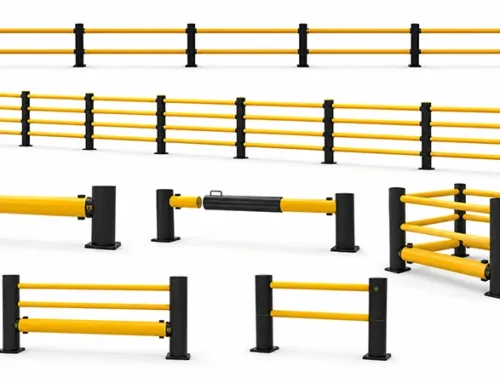
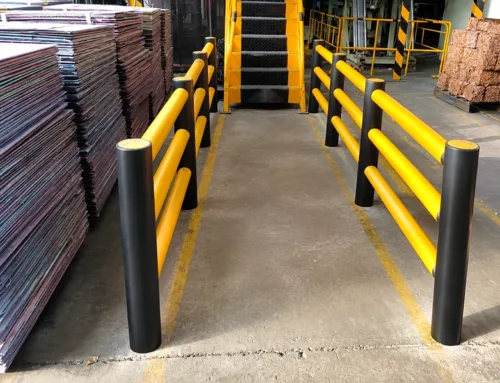
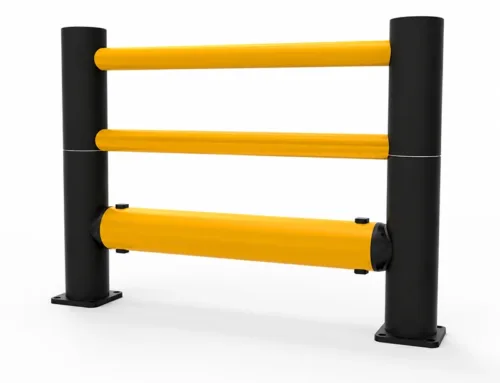
In a high-density fulfilment center, every rack-end frame and every building column sits inside the same forklift and AGV traffic envelope. A conventional powder-coated steel guard takes one hard hit, bends permanently, and pulls the next pallet reload into a maintenance order. FCBarrier CTR column protectors and DR double-rail guards are moulded from ARMORFLEX™ polymer, absorb roughly 80% of the strike energy, and rebound — so a hit on a rack-end upright or on a building corner no longer becomes a multi-day repair cycle.
Match the Joule Rating to the Forklift or AGV in the Lane
FCBarrier publishes four series — SR single-rail, DR double-rail, TR pedestrian-rail and CTR column protector — with a Joules-rating ladder that scales from 3,850 J at the lightest Class III truck envelope up to 28,950 J at an 8-tonne truck travelling 9.6 km/h. CTR (column protector) and TR (pedestrian rail) share the same Joule table because both are point-protection profiles, not zone fences. Specifying by vehicle mass and travel speed, not by panel count, is what keeps a tight-aisle fulfilment lane inside its design envelope.
| Series / Model | Rated Impact Energy (vehicle / speed equivalent) |
|---|---|
| SR100 | 3,850 J — 1.5 t @ 8 km/h |
| SR148 | 14,400 J — 4 t @ 9.6 km/h |
| SR190 | 21,350 J — 6 t @ 9.6 km/h |
| DR100 | 6,500 J — 3 t @ 7.5 km/h |
| DR148 | 19,000 J — 6 t @ 9 km/h |
| DR190 | 28,950 J — 8 t @ 9.6 km/h |
| TR100 / CTR100 | 8,200 J — 3 t @ 8.4 km/h |
| TR148+ / CTR148+ | 19,000 J — 6 t @ 9 km/h |
| TR190+ / CTR190+ | 28,950 J — 8 t @ 9.6 km/h |
Three Engineering Choices That Stop the Repeat-Hit Cycle
ARMORFLEX™ Polymer Absorbs ~80% of the Strike and Rebounds
A powder-coated steel guard transfers most of the impact energy into permanent bending of the rail, the post and the anchor bolts. The FCBarrier polymer column protector and double-rail guard convert that energy into elastic deformation inside the ARMORFLEX™ body and spring back toward the original geometry. In the official FCBarrier video evidence, the same impact that visibly bows a steel panel leaves the polymer profile with no permanent set — which is the practical difference between a one-hour inspection note and a replacement purchase order for an entire section of guard.
DR190 / TR190+ / CTR190+ Cover 28,950 J — 8 t at 9.6 km/h
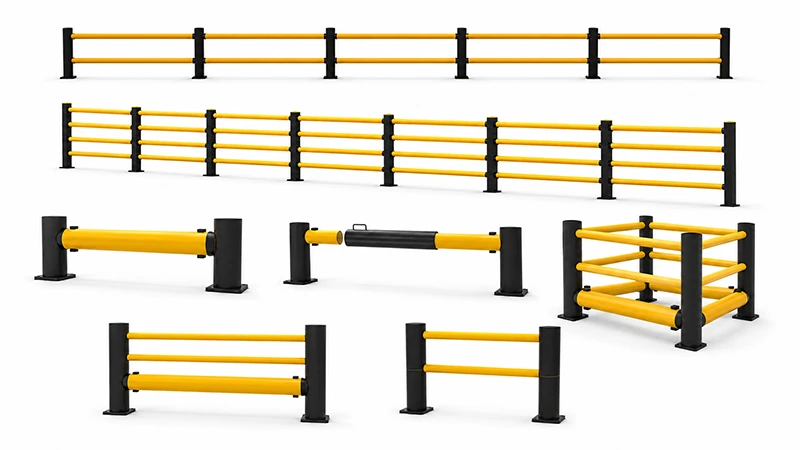
The highest-rated polymer barrier in the FCBarrier family is engineered for the heaviest lift-truck envelope still operating inside a fulfilment center — a Class I counterbalance or stand-up reach truck in the 8-tonne range travelling at 9.6 km/h. The DR190 double rail, TR190+ pedestrian rail and CTR190+ column protector are all rated at 28,950 J, so the same Joule envelope protects the rack-end frame, the aisle-side pedestrian rail and the structural column at the corner of the loading bay. That gives the EHS manager one ladder of impact data to point to in a procurement review, instead of three different steel-supplier ratings.
Modular Mortise-and-Tenon Joints Turn a Hit Into a 15-Minute Part Swap
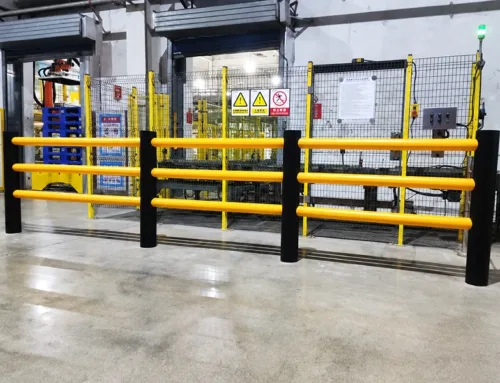
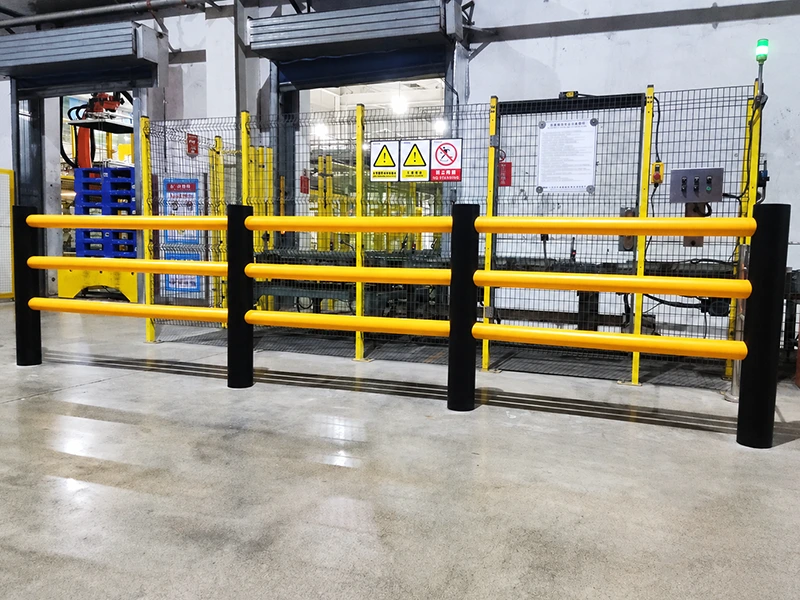
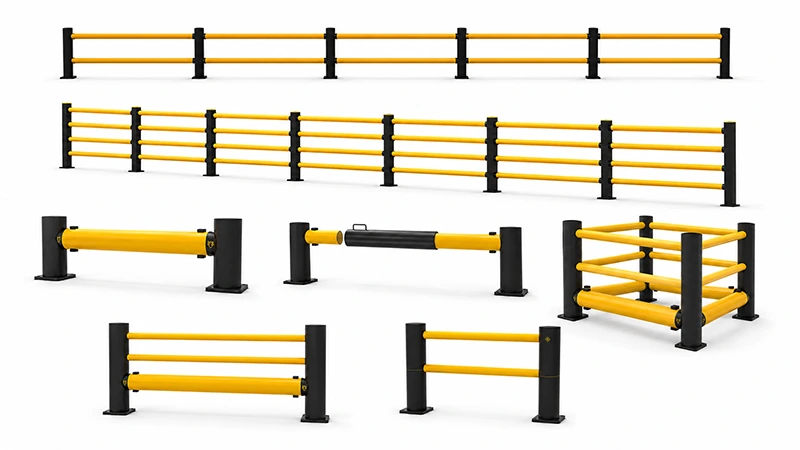
The standard FCBarrier assembly is a 3-rail × 2-post basic unit. Rails slide into the post mortise holes and lock with an internal long pin driven in by a rubber mallet — the same mortise-and-tenon geometry visible on the modular uprights used in the factory-aisle installation. A damaged rail or post comes out as a single part instead of being cut out of a welded run, and the spare-part inventory is one rail and one post, not a whole replacement section. On a tight-aisle fulfilment floor that means a single impact does not propagate into a weekend shutdown of the affected rack bay.
Where a Tight-Aisle Fulfilment Center Places FCBarrier
- Rack-end frames along pick-face and reserve-pallet aisles
- Building columns at aisle corners and dock-door posts
- Loading-bay edges and dock-level-processor perimeters
- Pedestrian walkway boundaries beside powered PIT traffic
- AGV / AMR charge-zone and intersection guards
- End-of-line palletizer in-feed and out-feed columns
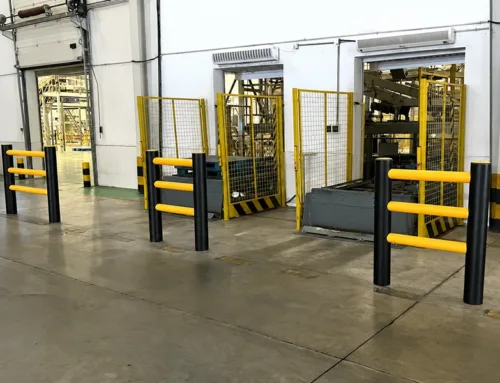
Each of these positions is a “hit the same spot twice” zone on a tight-aisle floor. Pairing CTR190+ on the column with DR190 on the rack-end gives the same 28,950 J envelope on both sides of the strike line, so the asset is not over-protected on one face and under-protected on the other.
Get the FCBarrier Joule-Rating Table and Series Datasheet
The Joules table above is the starting point. For a layout review, share the aisle width, the heaviest lift-truck class, the typical AGV speed envelope, and the rack-end or column coordinates to be protected. We will return a DR / CTR / TR / SR layout matched to your Joules envelope, with the rail-and-post count per zone.
Send Your Aisle Drawing for a Joule-Matched FCBarrier Layout
Tight-aisle fulfilment centers cannot afford to keep replacing steel rack-end guards after every forklift or AGV nudge. Send the layout and the lift-truck roster; we will return a CTR / DR / TR / SR layout with one Joule rating per strike line, sized to the ARMORFLEX™ polymer body and the modular mortise-and-tenon post that lets the maintenance team swap a single rail in minutes.