IT
IT  EN
EN  DE
DE  RU
RU  PT
PT  JA
JA  ES
ES 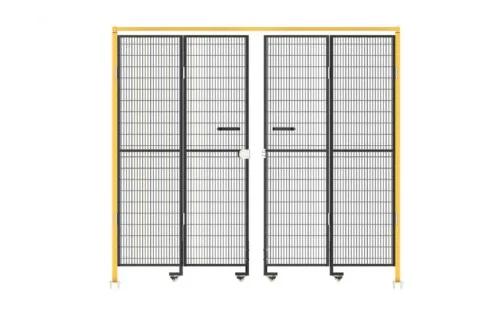

|
In automotive system integration, a “standard” fence isn’t just about mesh thickness—it’s about how fast you can get the cell signed off. When your PLC logic is ready and the Fanuc arms are programmed, the last thing you need is a safety barrier that fails the ISO 14120 impact test or requires hours of on-site fabrication to mount a simple Omron interlock. Here is the engineering reality behind safety standards. |
The Physics of ISO 14120: Why Material Specs Matter
For system integrators designing robotic welding cells or assembly lines, the “standard” is defined by kinetic energy containment. A Recinzione di sicurezza per robot system must do more than visually demarcate a zone; it must withstand the potential impact of a rogue manipulator arm or a ejected workpiece without catastrophic failure.
The standard we adhere to starts with the metallurgy. We utilize high-grade Acciaio al carbonio Q235 for our posts and frames. Unlike generic perimeter fencing, our posts feature a 1.5mm to 2.0mm wall thickness with a 60x60mm profile. This isn’t over-engineering; it’s the baseline requirement to ensure that if a servo fails and a payload strikes the perimeter, the barrier holds, protecting the personnel in the aisle and the expensive equipment adjacent to the cell.

Figure 1: Cross-section of the Q235 steel post showing the robust wall thickness and anchoring base required for high-impact resistance.
Integration Standards: The “Interlock Headache” Solved
In the automotive sector, the bottleneck often isn’t the steel—it’s the electronics integration. A common failure point in project timelines occurs when the electrical team arrives to mount safety switches (like Pizzato or Omron D4NL series) and finds no mounting provisions. This leads to drilling on the shop floor, compromising the Rivestimento in polvere and introducing metal shavings into a clean assembly environment.
Our standard involves a pre-engineered Supporto per interblocco di sicurezza. We don’t just sell a door; we provide a “lock carrier” kit compatible with major safety switch brands. This transforms the Recinzioni di sicurezza per macchine from a passive barrier into an active component of your safety circuit (SRP/CS), ensuring seamless integration with your PLC’s emergency stop logic.

Figure 2: Dedicated mounting solutions for safety interlocks, eliminating on-site fabrication and speeding up commissioning.
Layout Standards: Managing Cell Access and Cycle Times
Space on the factory floor is premium real estate. A standard swing door is often viable, but in tight AGV (Automated Guided Vehicle) corridors or material handling zones, the swing radius consumes valuable aisle width. The standard for modern automotive lines is the sliding or folding mechanism.
For large robotic cells requiring forklift access for die changes, we utilize a heavy-duty top-track system. Our double sliding doors can span up to 4300mm (approx. 14 ft), allowing ample clearance for machinery movement without sacrificing the structural integrity of the Pannello incorniciato system. The overhead track ensures the floor remains clear of tripping hazards, a critical requirement for ISO 13857 compliance regarding safe access.

Figure 3: Double sliding door configuration ideal for wide robot cells, allowing AGV or forklift entry without obstructing the aisle.
Installation Standards: Zero-Weld Assembly
In a live automotive plant, “hot work” permits for welding are a logistical nightmare. The Mdfence standard is a completely modular, bolt-together assembly. Using a high-strength Expansion Bolt (M10 x 70mm), the posts are anchored rapidly to the concrete slab.
The panels attach via a specialized fixing ring system that allows for adjustments to accommodate uneven floors—a common reality in retrofitted facilities. This modularity means that if a forklift damages a single panel, it can be swapped out in minutes using standard hand tools, minimizing line downtime. The Recinzione di sicurezza industriale is designed for life-cycle efficiency, not just initial installation.

Figure 4: The modular assembly process using connection rings and framed panels, eliminating the need for on-site welding.
Frequently Asked Questions: Automotive Safety Standards
1. Does your fencing meet the “Safety Distance” requirements of ISO 13857?
Yes. Our mesh aperture (grid size) and installation distance from the hazard zone are calculated to prevent upper and lower limb reach-through, ensuring compliance with ISO 13857 and preventing operators from reaching the robot’s working envelope.
2. Can we integrate light curtains with the physical fence?
Absolutely. In hybrid cells where physical barriers meet open loading zones, our posts are rigid enough to mount brackets for safety light curtains, creating a seamless transition between physical and opto-electronic guarding.
3. How do you handle welding spatter in body-in-white (BIW) shops?
For arc welding cells, we recommend swapping standard wire mesh for our solid steel sheet or polycarbonate panel options. This contains sparks and UV radiation, protecting nearby personnel and sensors from damage.
4. What is the impact rating for robotic crashes?
Our system is TUV certified for high impact resistance. The combination of 60x60mm posts and framed panels is designed to absorb significant kinetic energy, meeting ISO 14120 requirements for retaining ejected parts or containing low-speed robot collisions.
5. We have a non-standard layout with 45-degree angles. Can you support this?
Yes. Unlike rigid systems, our connection hardware allows for flexible angular installation. We can follow the precise contours of your machine layout, optimizing floor space usage.