IT
IT  EN
EN  DE
DE  RU
RU  PT
PT  JA
JA  ES
ES 

|
Stop nuisance tripping in your robotic welding cells. While light curtains have their place, they can’t stop weld spatter, flying debris, or a forklift driver cutting a corner too close. For heavy automation integration, you need a physical barrier that defines the perimeter without relying on constant sensor resets. |
The Invisible Wall vs. The Steel Reality in Automotive Automation
In the design of automated production lines—specifically for automotive body-in-white (BIW) welding stations or high-speed pick-and-place robot cells—the debate often lands on “Hard Guarding” (Physical Fencing) versus “Soft Guarding” (Optical Light Curtains/Scanners).
As a System Integrator, you aren’t just selling safety; you are selling Cycle Time e OEE (Overall Equipment Effectiveness). While light curtains offer an “open” aesthetic, they often become the primary source of downtime in harsh industrial environments. Here is why Recinzioni di sicurezza per macchine remains the superior choice for perimeter guarding in heavy automation.
1. Physical Containment: Light Curtains Can’t Catch Debris
An optical sensor stops the machine when a beam is broken, but it does absolutely nothing to stop a part that has already been ejected due to a gripper failure or tool breakage. In a CNC machining center or a robotic welding cell, the risk isn’t just a human walking in; it’s high-velocity debris flying out.
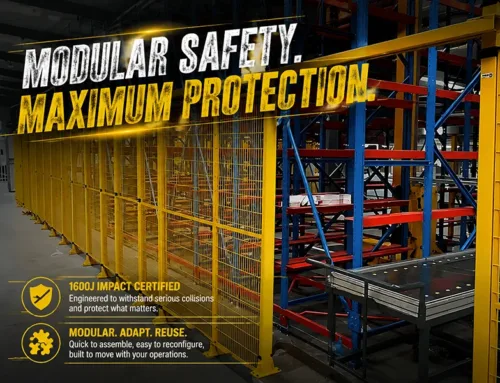
Il nostro Mdfence system utilizes Acciaio al carbonio Q235 framed panels. Unlike simple wire mesh, our Recinzione di sicurezza industriale features a 20x30mm steel tube frame with fully welded mesh points. This structure is TUV-certified for high impact resistance, ensuring that if a robot arm errs or a workpiece is thrown, the kinetic energy is absorbed by the fence, not by an operator standing in the aisle.

Figure 1: Standard Framed Panel construction designed to contain high-velocity debris within the robot cell.
2. The “Nuisance Trip” Factor: Protecting the Process
In an active automotive plant, AGVs (Automated Guided Vehicles) and forklifts are constantly moving materials to line-side supply racks. Light curtains are notoriously sensitive. Dust from welding smoke, vibration from stamping presses, or a forklift passing just 2 inches too close to the “invisible line” can trigger an E-Stop.
Every time that happens, the robot cell requires a reset sequence. If this happens 5 times a shift, your customer’s ROI plummets.
Physical Recinzione di sicurezza per robot provides a definitive “hard” boundary. It allows AGVs to operate right up to the perimeter without risking a trip. Furthermore, our system includes robust 60x60mm posts anchored with M10 expansion bolts, capable of withstanding the accidental bumps and scrapes typical of a busy logistics floor.
3. Integration Speed: The “Lock Carrier” Advantage
One of the biggest hidden costs in using fencing is the electrical integration. Usually, SIs have to fabricate custom brackets on-site to mount safety interlocks (like Omron D4NL or Pizzato switches).
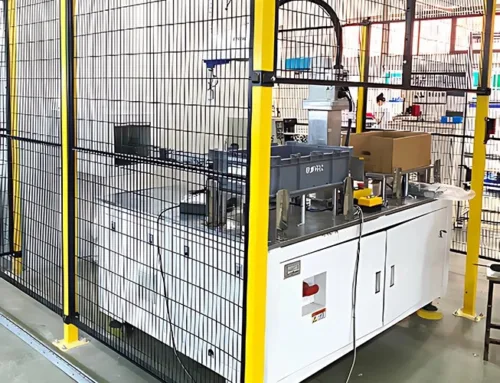
We have solved this. Mdfence isn’t just steel; it’s an integration-ready platform. We provide pre-engineered lock carriers and installation kits specifically designed for major safety switch brands. This turns the door from a passive barrier into an active node in your PLC’s safety circuit.

Figure 2: Integration-ready lock options and carriers reduce electrical installation time significantly.
4. Layout Flexibility for Complex Cells
Automated assembly lines are rarely simple rectangles. You have conveyors entering, finished parts exiting, and maintenance access required at specific points. Light curtains struggle with complex geometries without using multiple mirrors (which are a nightmare to align).
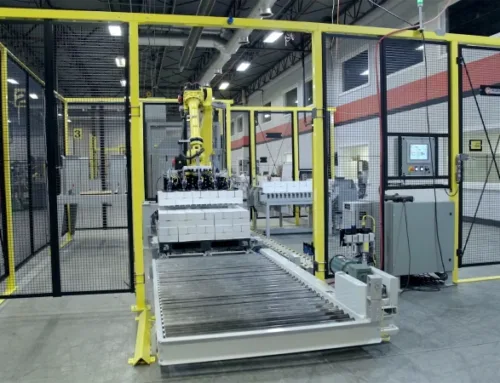
Our system is modular. Whether you need a 45-degree turn, a custom cut-out for a conveyor, or a Porta scorrevole for a tight maintenance bay where a swing door won’t fit, the system adapts. We can work directly from your CAD layouts to deliver a “Kit of Parts” that fits your specific floor plan.

Figure 3: Custom layout capability allows for precise integration around complex robotic machinery.
Domande frequenti (FAQ)
1. Can I mount third-party safety interlocks like Omron or Euchner to your doors?
Yes. We offer specialized “Lock Carrier” kits (e.g., KKCK-LCK-B-D4NL-SET) designed specifically to interface with standard safety switches from Omron, Pizzato, and others, eliminating the need for on-site fabrication.
2. How does the fence withstand weld spatter and corrosion?
The system uses Q235 carbon steel with a high-quality powder coating that meets GB/T9286-1998 standards. It has passed ISO9227 salt spray testing, ensuring resistance to industrial environments, including weld fumes and mild corrosives.
3. What is the standard height for robotic cell guarding?
Our standard posts are 2000mm (approx. 78 inches), which generally satisfies ISO 13857 reach-over requirements for most robotic applications. We can customize heights up to 2440mm (8 feet) for high-risk zones.
4. Do you offer solid panels for welding arc protection?
Yes. While wire mesh is standard, we can swap panels for solid steel sheet or polycarbonate/acrylic to block welding flash (UV radiation) and sparks, protecting personnel passing by the cell.
5. How quickly can the system be modified if the production line changes?
The system is fully modular. Panels connect to posts using metal fixing rings and bolts—no welding is required during assembly. This allows for rapid disassembly and reconfiguration (“Design for Automation”) as your line layout evolves.