IT
IT  EN
EN  DE
DE  RU
RU  PT
PT  JA
JA  ES
ES 

|
Integrating a 6-axis robot or a new CNC machining center into an already crowded automotive assembly line is a spatial nightmare. When AGV paths and existing conveyors leave you with zero breathing room, standard off-the-shelf guarding won’t cut it. You need a physical barrier that shrinks the ISO 13857 safety distance without eating up your valuable footprint. Discover how our modular, finger-safe architecture fits into the tightest robotic layouts while keeping your STO (Safety Torque Off) circuits fully compliant. |
The Nightmare of Integrating Robotic Cells in Squeezed Footprints
As a system integrator, your biggest enemy on the shop floor isn’t the complex PLC logic—it’s the physical layout. You are tasked with dropping a high-speed mechanical assembly machine into a facility where every square inch is accounted for. If you use a generic Recinzione di sicurezza industriale system with standard 2″ x 2″ (50x50mm) mesh, OSHA and ISO 13857 regulations dictate that the barrier must be placed up to 33.5 inches (850mm) away from the hazard zone to prevent an operator’s arm from reaching through.
Pushing the perimeter out by nearly three feet per machine instantly chokes your AGV/AMR paths, blocks forklift access to material handling areas, and often forces a complete, budget-destroying redesign of the production line. You don’t have the luxury of space, nor do you have the time to wait for a local fabricator to weld custom barriers on-site, sparking hot work permit delays and leaving a trail of grinding dust across clean precision machining zones.
How We Engineer Custom Guarding for Tight Spaces
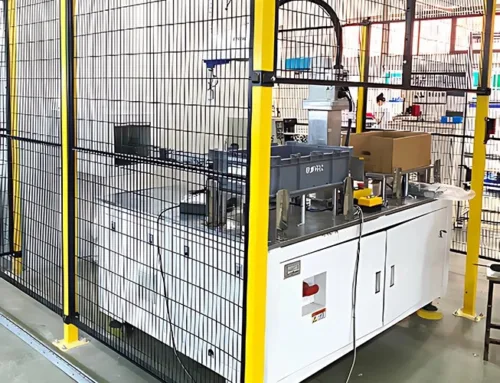
The solution to a tight footprint isn’t compromising on safety; it’s upgrading the structural geometry of the barrier. The Mdfence system is engineered specifically for these high-density automation environments. By utilizing a highly specific 0.78″ x 3.93″ (20x100mm) narrow mesh design, we restrict access strictly to the fingertip.

This “finger-safe” engineering logic legally and safely reduces the required ISO 13857 reach distance from 850mm down to just 4.7 inches (120mm). For a typical 50-meter automated production line, pulling the perimeter inward by that margin reclaims over 370 square feet of premium manufacturing space. Furthermore, every panel is built with a robust 20x30x1.5mm seamless Q235 carbon steel tubular frame. This framed architecture allows us to cut and customize panel widths down to the millimeter without losing structural rigidity. Whether you need to navigate around a structural building column, integrate a tunnel guard for a passing conveyor, or create a precise 45-degree corner to clear a CNC tool changer, the modular framework adapts effortlessly.
Navigating Narrow Aisles with Smart Access Doors
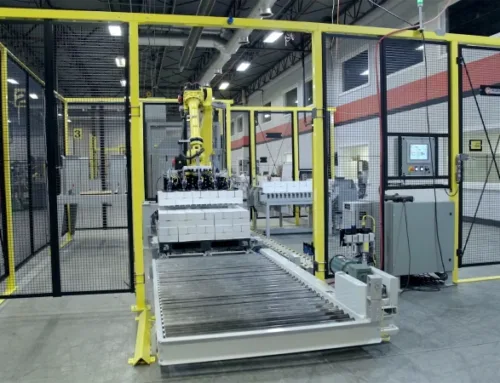
Customizing the shape of the Recinzione di sicurezza per robot is only half the battle; operators still need access for maintenance and tooling changeovers. In cramped automotive welding stations, a standard hinged door swinging outward will crash into passing forklifts or block an active AMR path.

To solve this, our system integrates heavy-duty sliding doors that operate on top-hung bearing rails. These doors glide parallel to the fence line, requiring zero swing radius. For ultra-wide openings needed to load heavy engine blocks or mechanical assemblies, we deploy multi-panel folding doors that compress tightly to the side. Most importantly for system integrators, the robust 60x60mm Q235 steel posts prevent door sag. This structural integrity guarantees that the actuator keys on your Omron D4NL or Pizzato safety interlocks align perfectly with the switch body every single time, eliminating the nuisance machine trips that destroy OEE (Overall Equipment Effectiveness).
Real-World ROI: The “After” Scenario for System Integrators
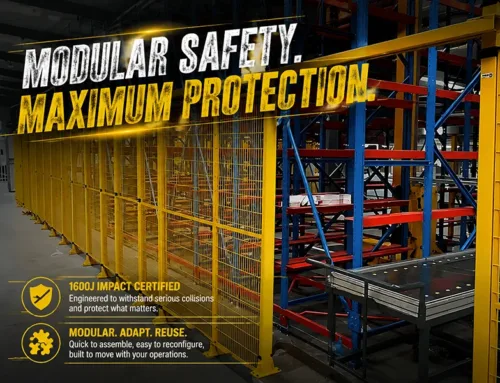
When you switch from generic wire mesh to a purpose-built Sistemi di protezione delle macchine architecture, the impact on your project delivery is immediate. There is no on-site measuring, cutting, or welding. Your technicians assemble the pre-powder-coated (RAL 9005/1023) panels using standardized M8 flange bolts. The safety interlocks bolt directly onto our pre-engineered lock carriers (e.g., KKCK-LCK-B-D4NL-SET) without a single drill shaving contaminating the facility. You deliver a turnkey, ISO 14120 compliant cell that withstands 1600 Joules of impact (equivalent to a 220 lb object striking at 12.4 mph), passing the end-user’s EHS audit on the first walkthrough.
| Workflow Phase | Traditional Fabrication (Before) | Modular Mdfence System (After) |
|---|---|---|
| Layout & Design | Guesswork on safety distances; large 50x50mm mesh eats up 850mm of floor space. | CAD verified ISO 13857 compliance; 20x100mm mesh shrinks clearance to 120mm. |
| Installazione | Requires hot work permits, welding sparks, and toxic paint fumes next to sensitive CNCs. | Cold assembly. 100% bolt-on installation using standard hand tools. Zero facility disruption. |
| Safety Integration | Hinges sag over time; PLC interlocks misalign, causing false E-stops and downtime. | Pre-drilled mounting carriers for Omron/Pizzato; rigid framed doors ensure perfect STO alignment. |
Frequently Asked Questions in Automation Guarding
1. Can we route our servo and sensor cables through the fence posts?
Yes. We offer specialized 80x80mm posts designed specifically to act as integrated cable raceways, allowing you to route wiring for safety light curtains and HMI panels directly inside the structure, keeping the cell clean and protecting cables from forklift damage.
2. How do we accommodate a conveyor belt passing through the guarding perimeter?
We design custom tunnel guards (cutouts) in the mesh panels. These are engineered strictly to ISO 13857 standards, ensuring the opening is just large enough for the material handling trays to pass, but deep and narrow enough to prevent an operator from reaching the hazard zone.
3. What if the concrete floor around the CNC center is uneven?
Our connection clips utilize a slotted design that allows the framed panels to be adjusted vertically on the 60x60mm posts during installation. This compensates for uneven floors without leaving dangerous gaps at the bottom.
4. Do you provide 3D CAD models for our layout engineering?
Absolutely. We provide comprehensive STP files for all posts, panels, sliding doors, and interlock carriers. You can drop these directly into your robotic cell layout software to verify clearances and eliminate interference risks before deployment.
5. How quickly can a damaged panel be replaced to minimize MTTR?
If a forklift breaches the area and damages a panel, the modular design allows a maintenance tech to unbolt and replace the single affected mesh panel in under 10 minutes using an Allen wrench. The machine’s MTTR (Mean Time To Repair) is drastically reduced compared to cutting and re-welding steel.