IT
IT  EN
EN  DE
DE  RU
RU  PT
PT  JA
JA  ES
ES Alfence | Modular safety fence for retrofit guarding
Sistema di protezione di sicurezza per la riconfigurazione delle linee di produzione senza sostituzione delle recinzioni
When a production line changes, an Alfence safety guarding system lets teams dismantle, move, and reuse posts, panels, doors, connectors, and floor fittings instead of scrapping a welded steel fence. The modular aluminum safety fence supports faster retrofit guarding, controlled investment, and a reconfigurable perimeter around automation equipment.
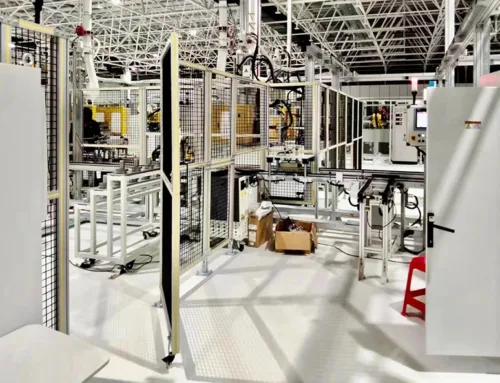
Why a reconfigurable safety guarding system fits line changes
Automotive, machine-tool, packaging, AGV, and robot-cell projects often change after installation. A welded steel fence can isolate the hazard, but its welded frame and fixed layout make relocation expensive: dismantling can damage the structure, moving panels may require new welding, and unused sections become sunk cost. Alfence uses a post-and-panel system so the guarding footprint can change with the process.
| Requisito di progetto | Alfence safety guarding system evidence |
|---|---|
| Rebuild after a line rearrangement | Removable and reconfigurable panels connect to T-slot aluminum posts; sections can be added, reduced, or moved without on-site welding. |
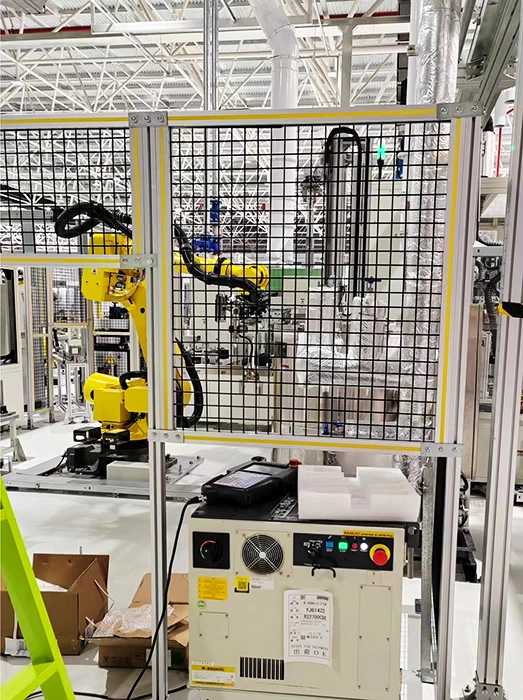
| Reuse of purchased components | Posts, steel wire mesh panels, safety doors, foot connectors, and floor-mounted expansion-bolt fittings are designed as separable system parts. |
| Fit around different hazards | Typical panel heights are 1000, 1800, or 2000 mm, widths are 200–1200 mm, and 40×40 mm or 45×45 mm post options support varied layouts. |
| Safety distance and access planning | A 20×100 mm mesh grid can support a layout close to the hazard, around 120 mm where the risk assessment and EN ISO 13857 requirements allow; hinged or sliding safety doors can be specified for access. |
| Future maintenance and access | Bolt-free panel swap, magnetic handles, safety interlock switches, and safety light curtains can be integrated according to the machine safeguarding design. |
How Alfence reduces the cost of the next layout change
1. Move a complete guarding section instead of rebuilding it
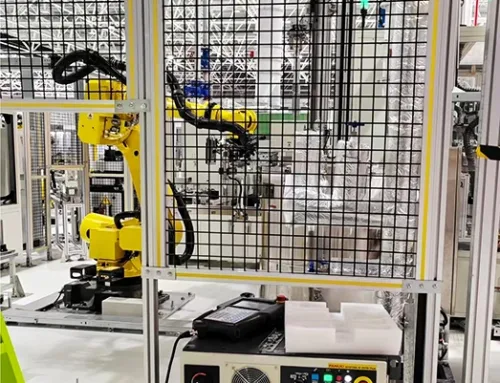
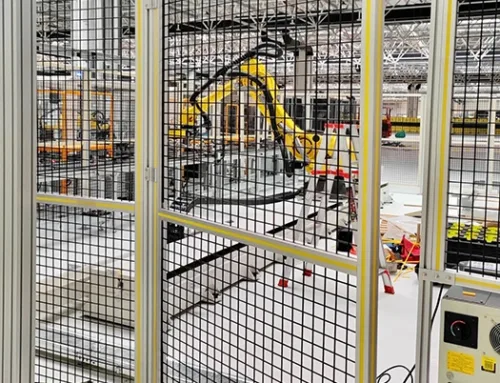
The aluminum profile safety fence is assembled from modular frames, welded wire mesh panels, doors, connectors, and floor anchors. During a retrofit, the team can release the relevant connections, move a complete section or change one bay, then reinstall the same parts at the new perimeter. This replaces repeated cutting, fitting, and welding associated with a one-time welded steel fence.
2. Adapt the perimeter while keeping visibility and access
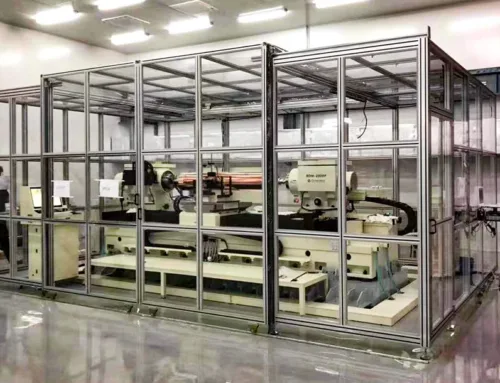
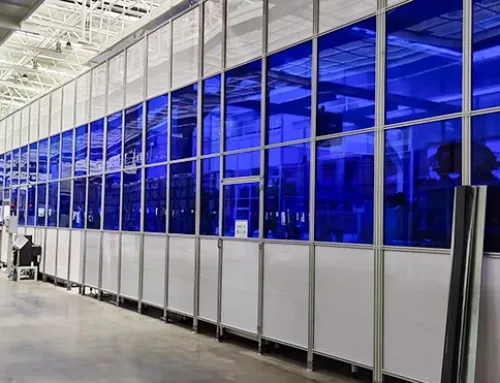
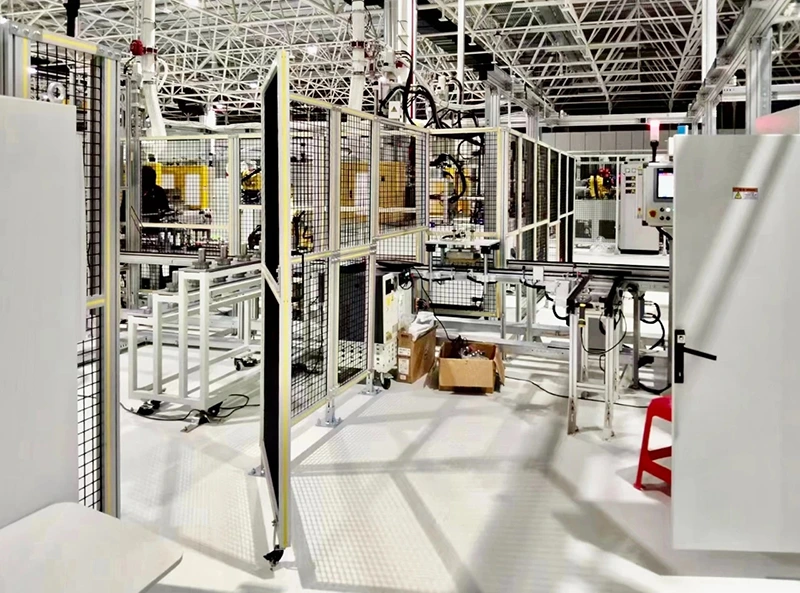
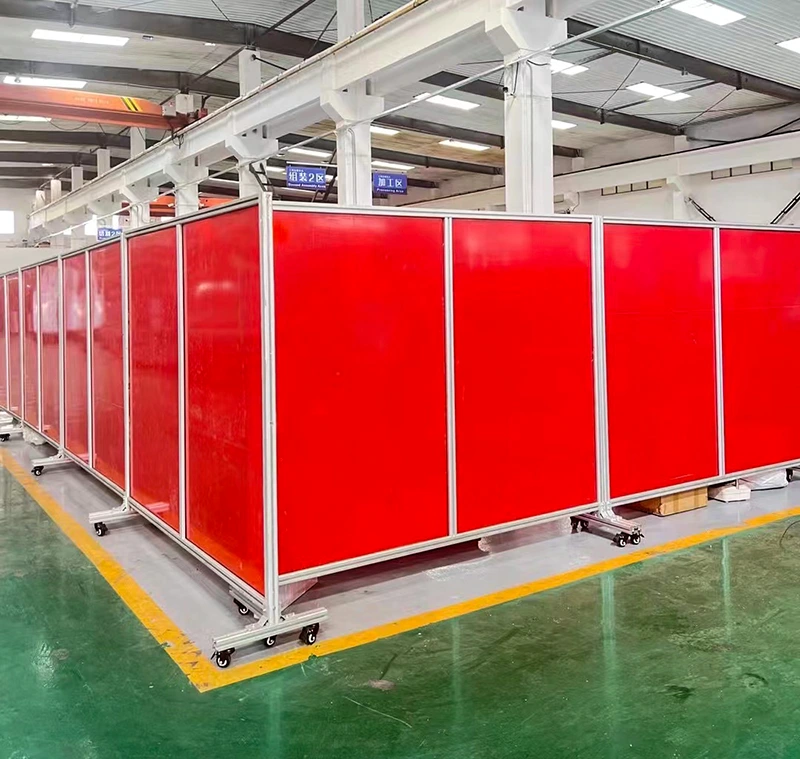
Production equipment still needs observation, service access, and controlled operator entry after a process change. Alfence can combine steel wire mesh with transparent polycarbonate or acrylic panels, hinged, sliding, or folding safety doors, and access-control components. The installed evidence shows continuous modular frames, divided panel zones, and an integrated access door around a long production line.
3. Reuse the system for relocatable guarding
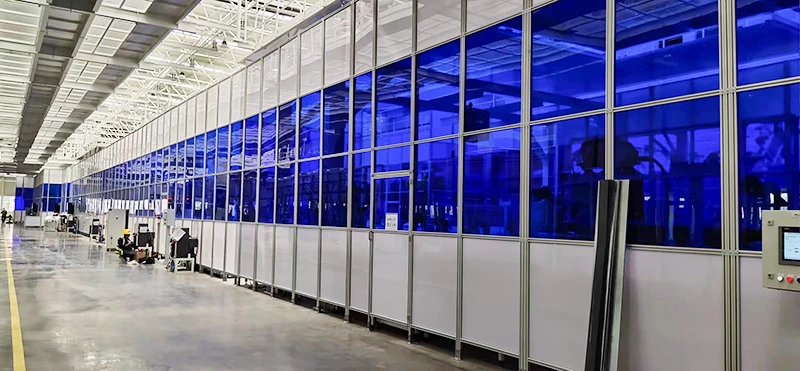
For indoor plant installation and retrofit guarding, lightweight aluminum profiles and modular barrier panels make relocation more practical than a fixed welded structure. Where the application calls for a movable partition, caster-wheel configurations can support temporary or changing work zones; for permanent perimeter guarding, floor connectors and expansion bolts provide a defined anchored installation. The same design principle reduces repurchase when the line is rearranged again.
Where a reusable safety guarding system is most useful
- Robot cell guarding: isolate an industrial robot or welding cell while retaining hinged access and maintenance routes.
- AGV path guarding and conveyor guarding: adjust the perimeter when traffic lanes, transfer points, or material-handling equipment move.
- CNC machine guarding and machine tool guarding: create a defined machine boundary that can be changed during a retrofit.
- Automated warehouse guarding and ASRS protection: separate storage zones, shuttle-car paths, and service access areas with modular bays.
- Packaging and palletizing zones: expand or reduce the guarding footprint as line capacity and equipment arrangement change.
- Cleanroom and indoor plant installation: use a rigid, visible perimeter guarding layout where soft curtains or improvised barriers are not suitable.
For each application, the final layout should be checked against the machine risk assessment, access sequence, safeguarding controls, and applicable requirements such as EN ISO 14120 and EN ISO 13857. Alfence supplies the modular structure; the guarding design must match the specific hazard and operating procedure.
What to define before specifying Alfence
Share the machine or line footprint, the proposed guarding height and bay widths, access-door locations, hazard-to-fence distance, floor condition, and any required interlock or light-curtain interfaces. The resulting bill of components can identify which panels, posts, doors, and connectors can be reused when the production line changes.
Plan a safety guarding system that can move with your line
Replace the disposable-fence cycle with a modular aluminum safety fence built for disassembly, relocation, and selective expansion. Contact SGF to review a reconfigurable Alfence perimeter for your robot cell, conveyor, CNC, warehouse, or retrofit project.