IT
IT  EN
EN  DE
DE  RU
RU  PT
PT  JA
JA  ES
ES GLOBAL FACTORY STANDARDIZATION | MEFENCE INDUSTRIAL SAFETY FENCING
Standardizzazione delle barriere da cantiere per la zonizzazione di fabbriche globali
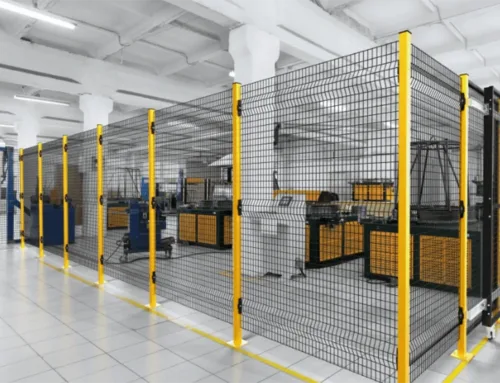
For groups operating around 340 factories in more than 70 countries, Mefence construction barrier systems turn one EHS zoning drawing into a repeatable installation method: frameless 3D welded mesh, clip-fixed assembly, and clear yellow-black area demarcation without relying on local welding capability.
Discuss a globally standardized construction barrier package
Why Multi-Country Factory Projects Struggle with the Old Method
A multinational food or beverage group can define the same pedestrian separation, storage zoning, and machine guarding rules for every site. The installation result, however, often changes from country to country. Traditional framed fencing or welded square tube fence depends on local fit-up, welding, grinding, and finishing skills. Where qualified welders or consistent fabrication controls are difficult to secure, posts drift, panels need rework, and every retrofit becomes a local interpretation of the group standard.
| Global rollout requirement | Mefence construction barrier response |
|---|---|
| Same zoning appearance at each plant | Standard wire mesh panels, posts, clips, and a shared yellow-black or custom color specification |
| Uneven local installation capability | Plastic clip and self-tapping screw connection; one maintenance worker can follow the drawing and install without a welding step |
| Changing equipment or aisle dimensions | Frameless design supports on-site cutting and modular reconfiguration |
| Short retrofit windows | Cold-work assembly with a documented three-step installation method and a stated 50%+ installation-time saving |
| AGV, AMR, and forklift route visibility | Open welded mesh provides a visible boundary for pedestrian-vehicle separation instead of creating a blind solid wall |
How the Frameless 3D Fence Makes the Standard Repeatable
1. A fixed installation logic, not a local welding interpretation
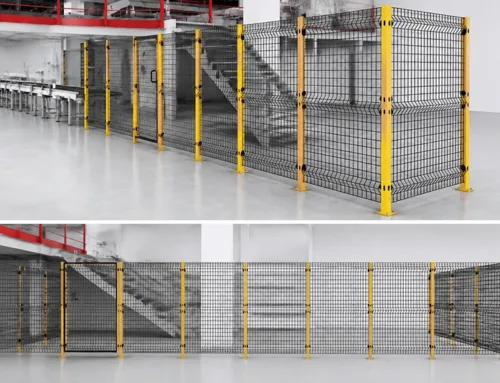
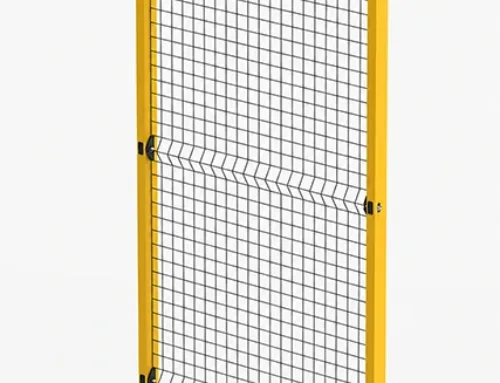
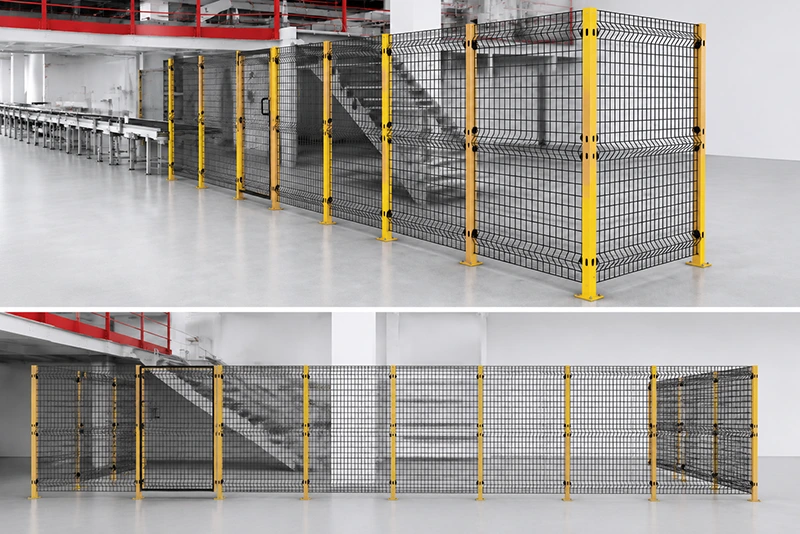
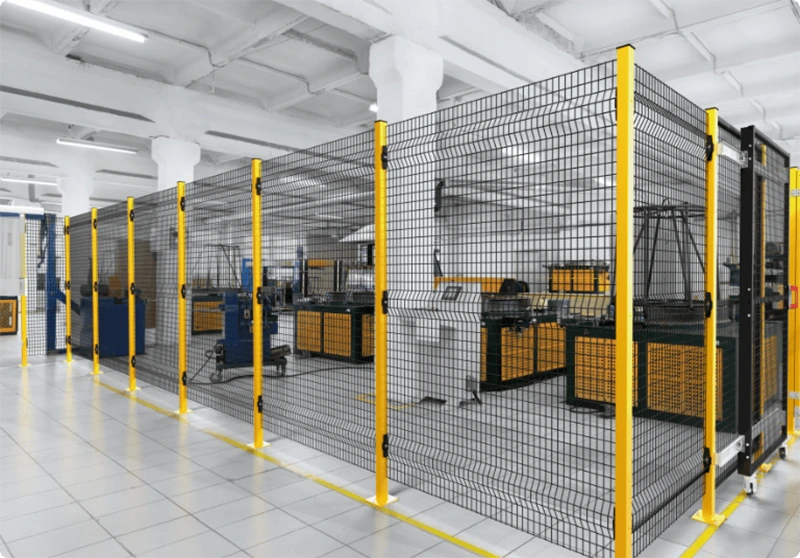
Mefence uses a frameless 3D welded mesh panel, powder-coated Q235 carbon steel, and a defined post-and-clip assembly. The panel is secured to the steel post with plastic clips and self-tapping screws, while base plate posts and expansion bolts provide a practical floor-fixing option. That makes the construction barrier a kit of standard parts: the group can issue one drawing, one bill of materials, and one installation sequence to plants in different regions.
2. Defined dimensions for procurement and local adaptation
The specification can be standardized before a global purchase order is released: 3 mm or 4 mm wire diameter; 20×100 mm or 50×50 mm mesh opening; panel widths from 200 to 1,400 mm; panel heights from 200 to 3,000 mm; and 40×60 mm or 60×60 mm posts. The 140 mm ground clearance and repeated T-shaped ridges are also part of the layout discussion. Local teams can adapt a panel on site when a column, conveyor, or irregular wall interrupts the planned line, without redesigning the complete system.
3. One visible boundary can support several factory controls
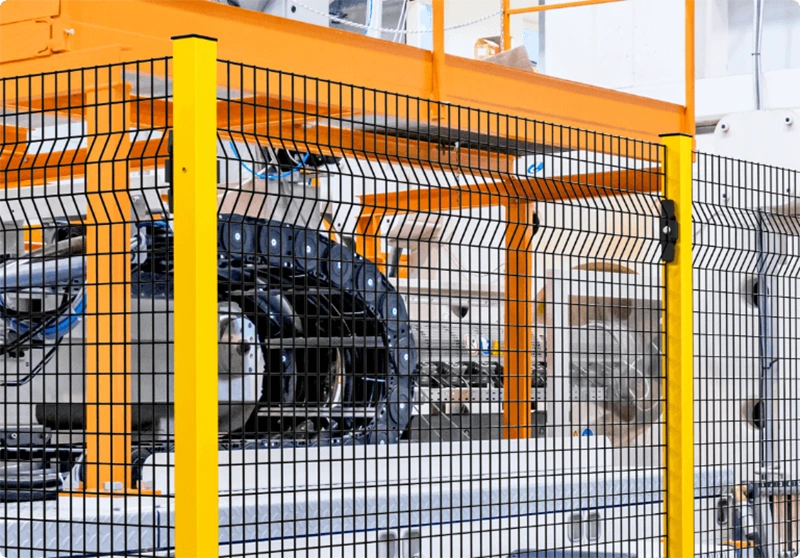
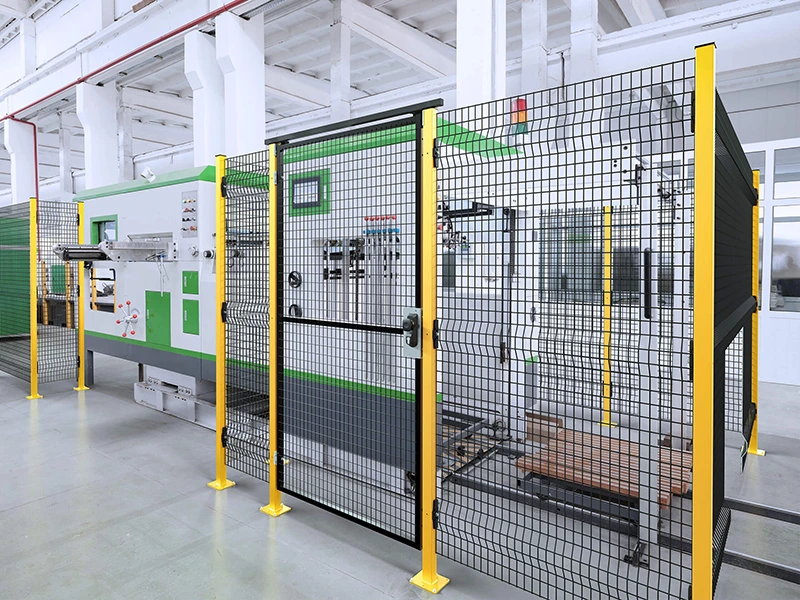
The folded mesh profile is not only a visual detail. Its T-shaped ridge creates useful space for cable routing, helping lines stay within the fence footprint instead of hanging into an aisle. Wood slat inserts can be added where a process requires visual shielding. A gate module establishes controlled access to an automated equipment perimeter, while the open mesh keeps machinery and route conditions visible. This combination supports warehouse zoning, forklift path barrier layouts, robotic workstation enclosure, conveyor belt isolation, and workshop isolation with the same modular logic.
Where a Group Standard Can Be Reused
- Zonizzazione del magazzino: mark storage areas, tool crib enclosures, pedestrian walkways, and forklift paths with the same panel, post, and color schedule.
- Protezione di attrezzature automatizzate: define a robot workstation enclosure or conveyor belt isolation perimeter while keeping sightlines open for operators and maintenance staff.
- Retrofit and expansion: use on-site cutting, clip fixing, and reusable modules when production lines move or a workshop layout changes.
- Global OEM and batch procurement: unify yellow-black safety fence or custom color safety fence requirements, mesh openings, post sizes, and approved installation drawings before shipment.
Mefence is intended for fixed or semi-fixed demarcation, traffic planning, and non-high-impact machine guarding. It should not be specified as a certified anti-collision guard or impact-containment system. For direct impact containment, the higher-spec Machine Fence line should be evaluated separately.
Make the Construction Barrier a Standard Purchasing Item
A practical rollout package should define the site zoning plan, panel and post schedule, gate positions, floor-fixing method, approved color, and installation sequence. Mefence supports OEM and batch purchasing so a group can convert its area-demarcation standard into a construction barrier package that local maintenance teams can install consistently. Send the target factory count, typical panel heights, mesh opening, and color requirements for a consolidated review.
Plan One Mefence Specification for Every Plant
Share your warehouse zoning, pedestrian-vehicle separation, or automated equipment guarding layout. SGF can help map the repeatable panel, post, clip, gate, and color specification for OEM and multi-country batch procurement.