IT
IT  EN
EN  DE
DE  RU
RU  PT
PT  JA
JA  ES
ES ROBOT CELL GUARDING | MODULAR ALUMINUM SAFETY FENCE
Make the high-speed welding robot boundary measurable before the EHS walkthrough
High-speed welding cells combine robot motion, pinch points, weld spatter and maintenance access in one compact area. Alfence is a modular safety fence for machine guarding: 20×100 mm welded wire mesh, aluminum profile posts, controlled access doors, safety light curtains and interlocks can be coordinated into a reconfigurable perimeter for EN ISO 14120 and EN ISO 13857 design review. The result is a checkable guarding layout—not a claim that a fence alone replaces the project risk assessment.
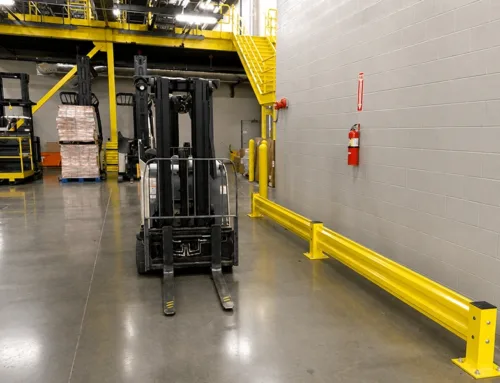
From welding-cell risk to a checkable guarding specification
A welded steel fence or chain-link partition can mark a boundary, but an automation retrofit quickly exposes the weak points: cutting and rewelding for a new opening, improvised light-curtain brackets, difficult door changes and no clean interface for guard locking. Those field modifications add downtime and make the EHS review harder to document. For a high-speed robot cell, the physical perimeter, safety distance, maintenance access and protective-device circuit need to be planned together.
| Guarding item | Alfence project basis and review point |
|---|---|
| Design basis | Use EN ISO 14120:2015 for general guard design and EN ISO 13857 for reach and safety-distance checks; coordinate the robot application with EN ISO 10218-2 and ANSI/RIA R15.06. Final acceptance remains project-specific. |
| Maglia di apertura | The 20×100 mm welded-wire grid is selected to control finger access and opening geometry. Confirm the actual reach distance against the hazard location rather than treating the grid alone as proof of compliance. |
| Aluminum posts | 40×40 mm or 45×45 mm aluminum profile posts support a lightweight, corrosion-resistant, bolt-free modular frame. The Schmersal AJM150 example is suited to a 40×40 mm profile. |
| Presence detection | A safety light curtain example covers 150–1800 mm detection height. Mounting position, resolution, stopping time and reset logic must be validated for the robot cell. |
| Guard locking | The Schmersal AJM150 example provides 1500 N locking force. Use it with the door and safety circuit specified for the application; the integrator validates the complete control function. |
| Evidence package | CE / Machinery Directive 2006/42/EC supporting documents can be supplied with the project package to support the customer’s EHS review. They do not replace the integrator’s declaration, risk assessment or required validation. |
Why Alfence fits a welding robot retrofit
Start with a visible robot perimeter, not a generic partition
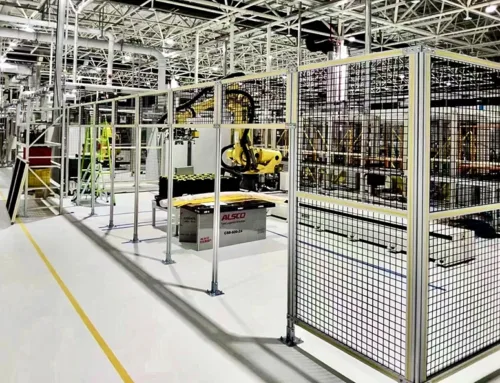
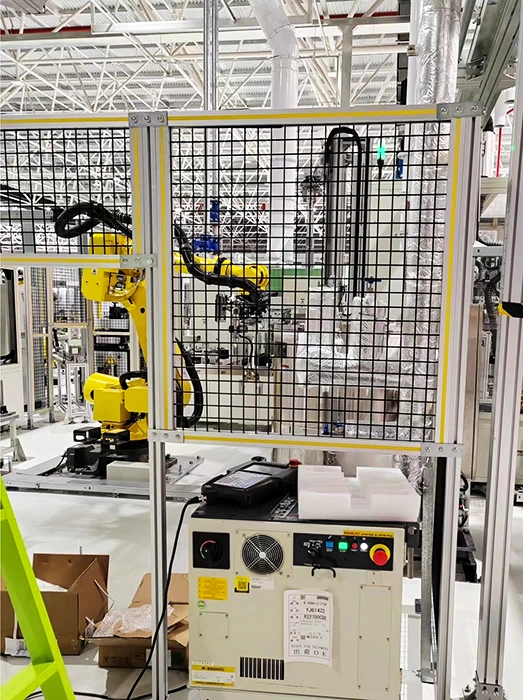
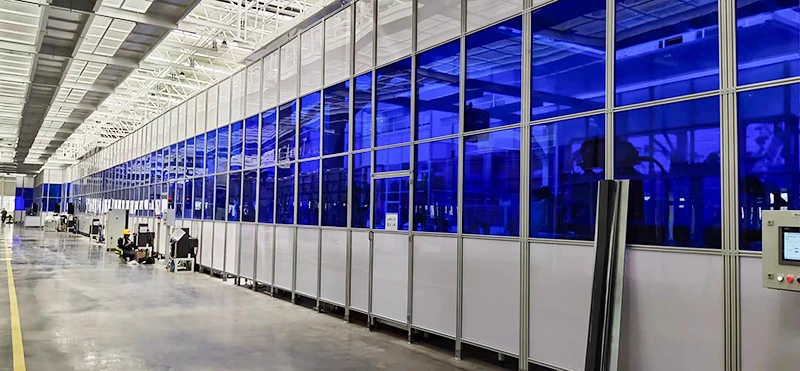
The aluminum profile frame, black welded wire mesh and guarded automation cell shown here reflect the basic machine guarding relationship: the hazard stays inside a defined perimeter while the control cabinet and operating view remain accessible from outside. Alfence uses connectors inserted into the profile groove and locked in place, avoiding on-site welding when a section, corner or maintenance panel has to be changed. Its lightweight, corrosion-resistant aluminum construction suits indoor automation and light-corrosion environments; it should not be specified as an equivalent to a high-impact steel barrier without a separate impact review.
Make the access door part of the safeguarding circuit
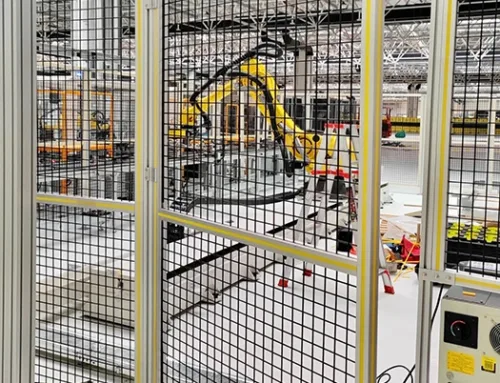
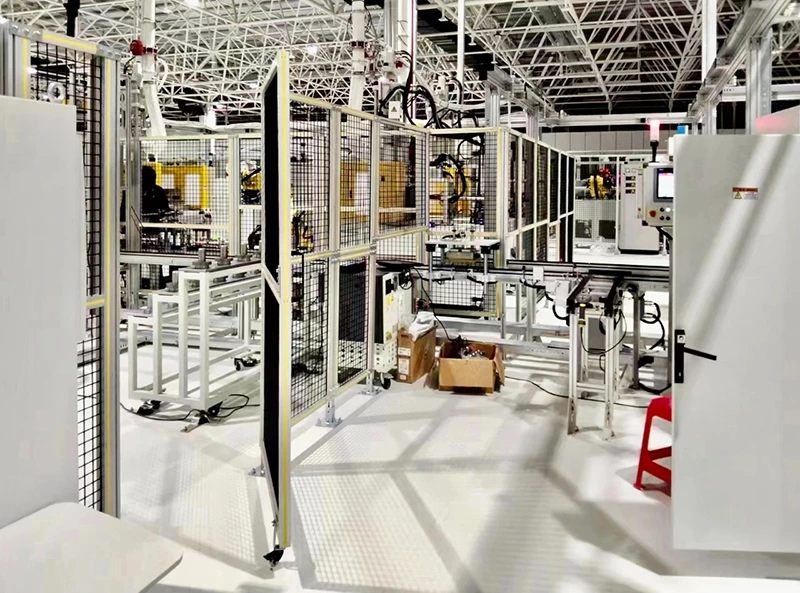
The hinged access gates and control panels shown in this robot-cell example are not just fabrication details. Alfence can be configured with hinged, sliding, folding or telescopic doors, then coordinated with a safety interlock and a light curtain at the access or transfer point. A 150–1800 mm light-curtain range and the 1500 N AJM150 locking-force example give the engineer concrete interface values to place on the layout. Door type, opening direction, escape needs, robot stopping time and safety-circuit performance still require application validation.
Keep visibility and future line changes in one modular frame
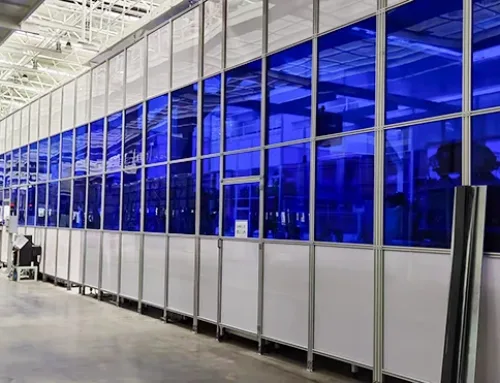
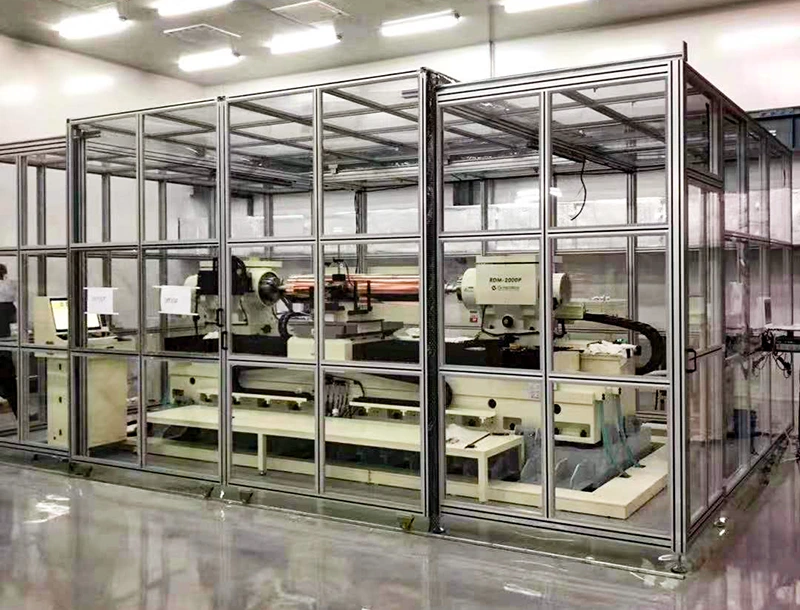
A continuous guarding line with an integrated access door lets the production team separate the robot, welding equipment and personnel route without losing visual supervision. The panel mix can be selected around the process: welded mesh for visibility, PC or acrylic for a more closed view, or a tinted panel where arc-flash screening is required. The project brief includes panel heat resistance up to about 60°C; confirm the material and process temperature before ordering. Removable and reconfigurable panels make Alfence practical for line changes, retrofit guarding and relocatable indoor installations.
Where this guarding approach delivers a practical result
- Welding cell and robot cell guarding: define a physical perimeter around high-speed motion, pinch points and weld-spatter zones, with doors and protective devices planned together.
- Automated production line and CNC machine guarding: use a post-and-panel system that preserves visibility and leaves a clear route for maintenance access.
- Protezione retrofit: replace a welded steel fence or wire partition with removable panels and bolt-free assembly where frequent cutting and rewelding would extend downtime.
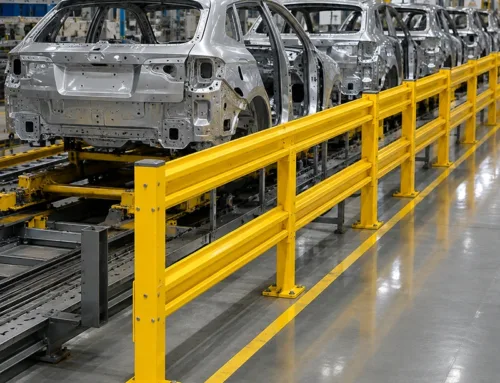
- AGV path guarding and material-handling robot guarding: coordinate a visible boundary with floor-mounted foot connectors and expansion-bolt anchoring, subject to the vehicle and collision-risk review.
- Indoor plant and cleanroom-adjacent installations: use the slim aluminum profile, custom RAL finish and selected transparent panel where a clean, reconfigurable boundary matters.
Across these applications, the measurable outcome is a documented boundary with controlled openings, integrated access logic and components that can be reused when the line changes. It reduces retrofit disruption while keeping the limits of an aluminum safety fence explicit.
Prepare the evidence pack before the robot is commissioned
Request a project layout with the post size, 20×100 mm mesh schedule, door type and dimensions, light-curtain position, interlock interface and floor-fixing method. The supporting package can include CE / Machinery Directive 2006/42/EC documentation for the customer’s review. Where source documents show different height or width variants—such as 1000, 1800 and 2000 mm panels—the project drawing takes priority. The safety distance, robot stop time and complete control-system validation remain with the responsible integrator.
Specify the boundary before the welding cell is commissioned
Share the robot-cell footprint, access points, maintenance route and EHS requirements. SGF can help translate them into an Alfence modular safety fence layout with 20×100 mm mesh, aluminum profile posts, safety doors, light curtains and interlocks—so the final review is based on visible structure and project evidence rather than field improvisation.