IT
IT  EN
EN  DE
DE  RU
RU  PT
PT  JA
JA  ES
ES Protezione delle macchine
Recinto di sicurezza industriale
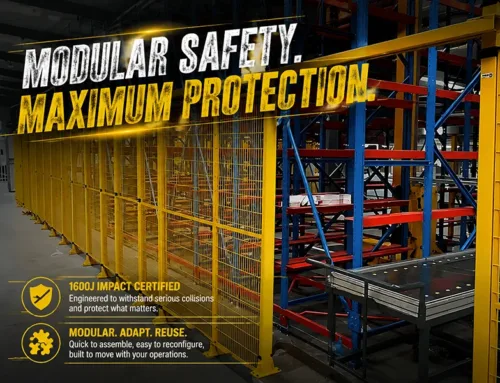
For cube-based storage projects, the real fight is not only risk control. It is how to keep the safety boundary close enough to the machine so every meter of the layout still works for automation, flow, and storage density.

safety fence industrial: why Mdfence fits tight automation layouts
Traditional wide-aperture wire mesh often forces the guardrail to stand far away from the hazard source. That extra setback creates dead zones around the equipment, lowers usable footprint efficiency, and makes cube-based storage or dense automation layouts harder to win in front of end customers. Mdfence is designed to solve that exact conflict with a 20×100 mm anti-probe narrow opening and a close installation distance of only 120 mm.
| Requisito | Supporto Mdfence |
|---|---|
| Space efficiency | Allows the fence line to sit close to the hazard, reducing unused perimeter area around automated equipment. |
| Safety distance control | The 20×100 mm narrow opening supports a legal close-install approach at 120 mm, instead of a bulky stand-off layout. |
| Anti-intrusion performance | The micro narrow mesh helps block finger or tool access better than common wide-aperture wire mesh. |
| Bid competitiveness | Better footprint efficiency helps system integrators score higher when they need to prove layout density and usable space. |
Structure and evidence behind the close-fit guard
1. The cell is enclosed without wasting the aisle
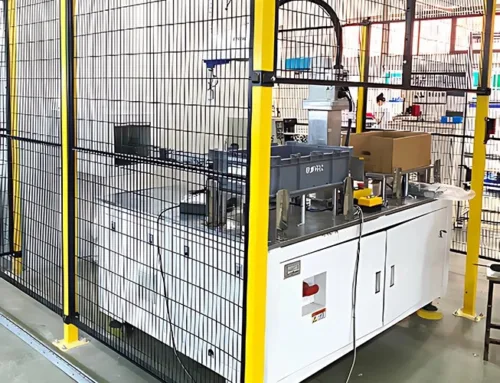
The hero image shows a complete machine cell guarded by black mesh and yellow posts. That visual matters because it proves the fence is doing real perimeter work, not just standing as a symbolic barrier. In a dense automation project, a guard that consumes less border space directly improves usable layout efficiency.
2. The structure supports close, repeatable installation
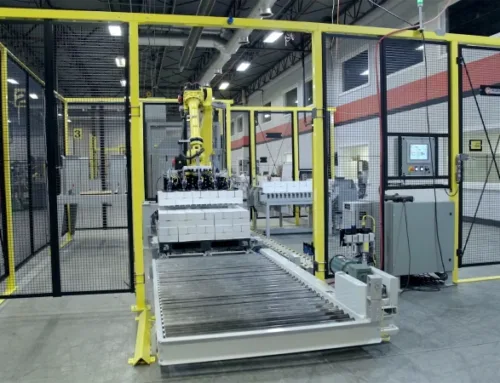
The technical front view makes the post, mesh panel, and fixing clamp relationship visible. That is the kind of evidence engineers need when they ask whether the system can be installed tightly, aligned cleanly, and extended in modules without creating random gaps. For layout-driven projects, consistent structure is what keeps the safety line from becoming a space leak.

3. The installation method matches the specification claim
The installation diagram shows base plate drilling, expansion bolts, and retaining rings. That is the practical proof behind the 120 mm close-install claim: the fence is not relying on a vague framing idea, but on a fixed mechanical method that can be repeated on site. This is important for machine guarding because the design must stay stable while still sitting close to the hazard source.

Where this safety fence industrial layout works best
- Cube-based storage lines that need the maximum possible usable footprint around automation equipment.
- Robot cells and machine zones where the guard must stay close to the source while still protecting workers.
- Integrator projects that need to improve space-utilization scores in customer bidding.
- Clean factory layouts where perimeter isolation must look controlled, modular, and easy to extend.
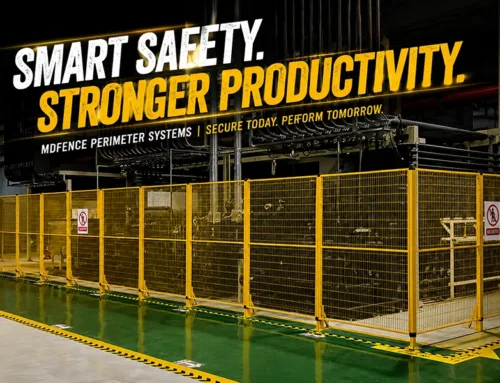
The perimeter-isolation image shows how the fence line can run cleanly along a machine line without turning the whole area into a dead zone. That is the final result customers care about: safer access control, less wasted space, and a more competitive layout.
What to specify before the layout is frozen
Before final approval, confirm the hazard map, required guard distance, access points, and any footprint restrictions from the storage system. For Mdfence, the key specification is simple: narrow 20×100 mm opening, close 120 mm installation distance, and a modular structure that supports dense machine guarding without surrendering space to oversized setbacks.
Bring the safety line closer to the machine
If your project needs both safety and layout efficiency, Mdfence gives you a guardrail concept that is built for tight automation footprints, not just for general separation.