JA
JA  EN
EN  DE
DE  RU
RU  PT
PT  ES
ES  IT
IT 

|
In a high-intensity manufacturing environment, machine guarding is judged not by its presence, but by its performance under stress and its ability to facilitate operational flow. The real value of a safety perimeter is realized when it consistently withstands heavy impacts, protects high-value assets, and allows large equipment or materials to pass through wide access points without compromise. We focus on the engineering details that prevent minor collisions from becoming costly structural failures. |
From Barrier to Fortress: The Value of True Impact Resistance
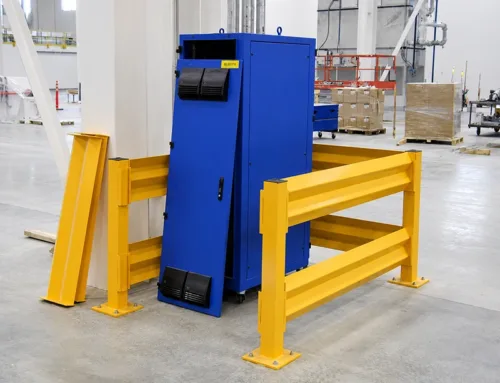
Protecting a £500,000 automated system or a high-precision CNC machine from accidental forklift damage is the first job of any machine guard. But few systems are truly engineered to turn away a significant impact without yielding. The knowledge point here is simple: **durability is defined by the core structural components and manufacturing process.**
A perimeter solution built with high-strength Q235 carbon steel posts (60x60mm cross-section with a 2.0mm wall thickness) and fully welded framed panels delivers certified TUV impact resistance. This engineering specification means that when an inevitable collision occurs, the barrier absorbs and disperses the energy, leaving your critical equipment—and the fence’s structural integrity—uncompromised. This removes the secondary cost of fence repair and the primary risk of catastrophic asset loss, leading to less downtime and predictable maintenance cycles.
The Detail of Welded Rigidity
Many systems rely on simple bolt-together panel connections that can weaken under repeated stress or impact. A high-quality 工業用安全フェンス solution uses **flat welding** to join the wire mesh to the panel frame at every contact point. This full-weld connection transforms the panel into a single, highly rigid structural component. For the operations manager, this means the barrier is less likely to vibrate, less susceptible to long-term wear, and maintains safety distances even in the most demanding environments, providing confidence that the physical guard will meet the safety standards as designed.
Wide Access without the Footprint Problem
Access management for large materials, AGVs, or maintenance equipment often presents a dilemma: wide openings (e.g., 3 to 4.8 meters) typically require enormous swinging hinged doors, consuming valuable floor space in the opening arc. The true operational optimization comes from implementing high-capacity sliding or folding door systems.

For operations that demand wide equipment passage while minimizing obstruction, a **Sliding Door Safety Fencing** system, supported by bearing rails and reinforced frames, is the change agent. This allows the entire width to open without disrupting adjacent pathways or demanding additional space for the swing radius. Similarly, folding doors maximize access width in tight corners, collapsing efficiently when opened. The value is a streamlined flow of materials and personnel, translating into faster turnover, reduced congestion, and a simpler path for large-scale maintenance access.
Elevating Site Aesthetics and Safety Management
Safety management is also about perception and compliance. While often overlooked, small details contribute significantly to a professional site. For instance, plastic post base protective covers cleanly shield the floor anchors and bolts from view, preventing tripping hazards and making floor cleanup far easier. This practical aesthetic commitment enhances the overall safety culture and simplifies adherence to factory floor hygiene standards.
Finally, a modular, bolt-together design, secured by expansion bolts, ensures that as your production footprint evolves, your perimeter guarding can be quickly reconfigured or expanded. This preserves the original investment, allowing the system to adapt to new layouts or robot cells without requiring new fabrication, giving you unmatched control over future factory optimization.
よくある質問(FAQ)
How do folding doors provide better access than sliding doors for extremely large openings?
Both systems save space compared to hinged doors, but folding doors (up to 4.8 meters wide) offer a clear aperture with minimal stored footprint, as the panels stack like an accordion against the perimeter. This is ideal when you need to occasionally move very large pieces of machinery or tooling that require the widest possible opening.
What material specifications ensure true high-impact resistance?
True high-impact resistance relies on a combination of factors: the use of structural grade Q235 carbon steel, minimum 2.0mm wall thickness for posts, and most critically, fully welded mesh panels instead of friction-fit components. This unified structure ensures that energy from a collision is managed efficiently, preventing structural failure or deformation.
Why is a modular, bolt-together system better than a welded-in-place fence?
A modular system is entirely reusable and reconfigurable. It eliminates the need for hot work permits and on-site welding during installation or layout changes. This significantly reduces installation time, lowers project cost, and future-proofs the investment by allowing rapid adaptation to new manufacturing processes.
What is the benefit of covering the floor anchoring bolts?
While a simple aesthetic feature, the protective covers over the ground-anchored expansion bolts serve two key operational purposes: they eliminate potential trip hazards caused by exposed bolt heads and they simplify routine floor cleaning and maintenance, contributing to a safer and tidier 5S-compliant work environment.
Are these safety fences compliant with UK and European standards?
Yes, all engineered safety fencing designed for the European market must comply with standards like ISO 14120 (General requirements for guards) and often undergo independent certification (such as TUV) to prove their resistance and safety distances meet strict regulatory requirements.