JA
JA  EN
EN  DE
DE  RU
RU  PT
PT  ES
ES  IT
IT FORKLIFT STRIKE × CONCRETE SLAB
Steel crash barriers pull cracks through the floor — FCBarrier ARMORFLEX polymer guards re-route anchor-bolt repair cycles before they reach the slab
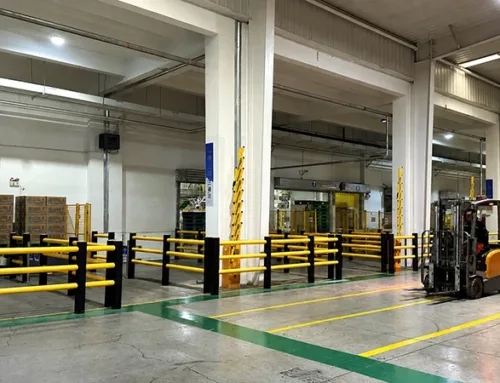
A forklift strike on a painted steel crash barrier does not stop at the rail. Half the kinetic energy walks down the post, through the bolt pocket, and into the concrete slab — and shows up the next maintenance window as a spalled anchor pocket, a loosened expansion bolt, and a slab patch that nobody budgeted. ARMORFLEX™ polymer absorbs roughly 80% of that strike energy and rebounds, so the energy never reaches the anchor in the first place and the recurring repair cycle stops.
Talk to a FCBarrier engineer about your floor-anchor exposure →
From 3,850 J to 28,950 J: one Joule ladder, one anchor pocket
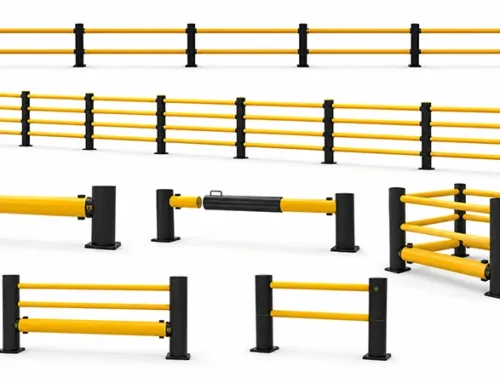
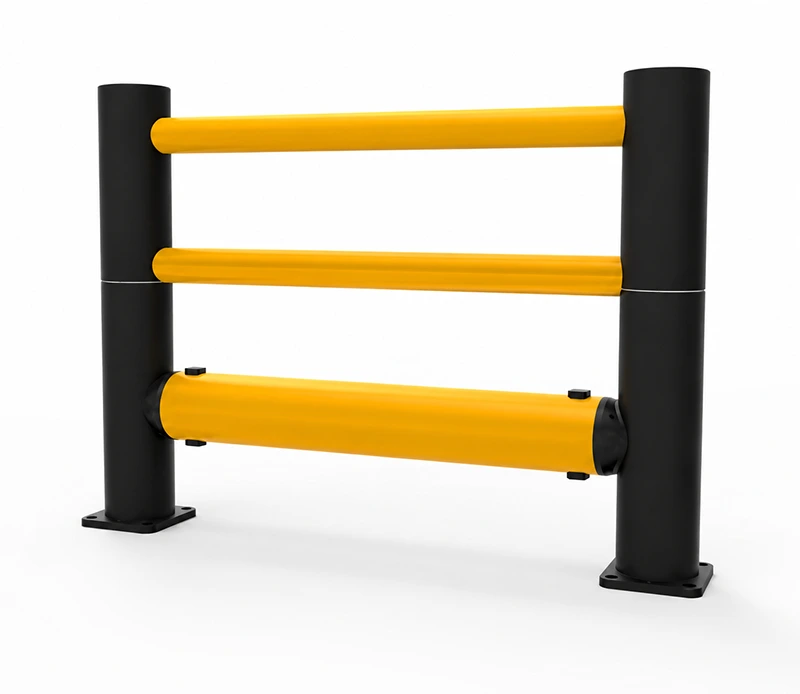
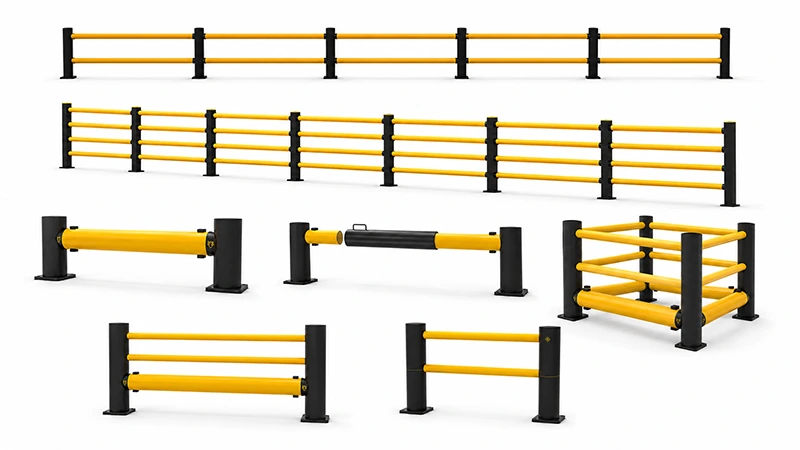
Steel crash barriers force a choice between heavy wall tube (and a heavier floor-repair bill) and thin wall tube (and a bent rail that pops the next anchor). FCBarrier publishes four series on a single Joule ladder so the same modular base-plate pattern absorbs 3,850 J at the rack end and scales to 28,950 J at the dock door without changing the anchor geometry the slab has to host.
| FCBarrier series / model | Rated impact energy | Equivalent forklift condition | Anchor footprint |
|---|---|---|---|
| SR100 single rail | 3,850円 | 1.5 t @ 8 km/h | Single base-plate module |
| SR148 single rail | 14,400円 | 4 t @ 9.6 km/h | Single base-plate module |
| SR190 single rail | 21,350円 | 6 t @ 9.6 km/h | Single base-plate module |
| DR100 double rail | 6,500円 | 3 t @ 7.5 km/h | Single base-plate module |
| DR148 double rail | 19,000円 | 6 t @ 9 km/h | Single base-plate module |
| DR190 double rail | 28,950円 | 8 t @ 9.6 km/h | Single base-plate module |
| TR100 / CTR100 pedestrian + column | 8,200円 | 3 t @ 8.4 km/h | Single base-plate module |
| TR148+ / CTR148+ pedestrian + column | 19,000円 | 6 t @ 9 km/h | Single base-plate module |
| TR190+ / CTR190+ pedestrian + column | 28,950円 | 8 t @ 9.6 km/h | Single base-plate module |
Why the energy stops before it reaches the concrete
ARMORFLEX polymer absorbs up to 80% of strike energy and rebounds inside the post
An ARMORFLEX polymer post deforms under a forklift strike, dissipates roughly 80% of the kinetic energy through the molecular chain, and returns to within working tolerance of its original shape. Steel deforms plastically and stays deformed — which is why the same strike keeps loading the anchor pocket on every subsequent hit and keeps opening the slab micro-crack that turns into the next concrete patch. The base plate on an FCBarrier post only has to react to the residual 20% of energy the polymer already gave back to the forklift.
Modular mortise & tenon quick-release isolates damage to one rail, not the whole run
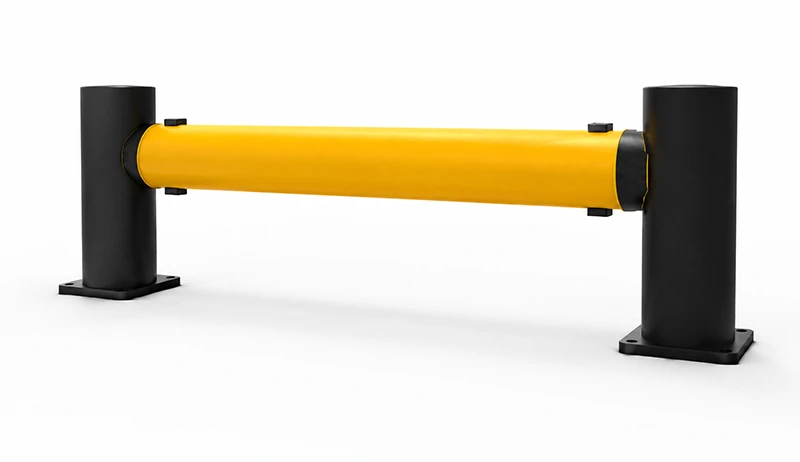
The basic FCBarrier cell is three rails and two posts. A damaged rail slides out through the mortise, a new rail drops in through the mortise, and the internal long pin locks it back. The first and last segments of the run do not need to come up. Painted-steel barriers typically force the full run between bends to be cut out and re-welded, because a bent rail locks the next weld joint and the floor crew has nowhere to put the new anchor pocket without grinding the old one out. The slab pays for that every time.
No paint, no rust, no repaint cycle, no repaint shutdown
Painted-steel crash barriers get a fresh coat every two to three years in damp warehouse aisles — and the repaint cycle is exactly the line item most procurement boards miss when they compare purchase price. ARMORFLEX polymer keeps its yellow-black finish across chemical, moisture and UV exposure without repaint. There is no repaint work order, no maintenance shutdown, no chemical strip residue entering the floor drain, and no sand-blasting dust settling into the racking above the aisle. The painting sub-contractor never has a reason to walk back to that anchor pocket.
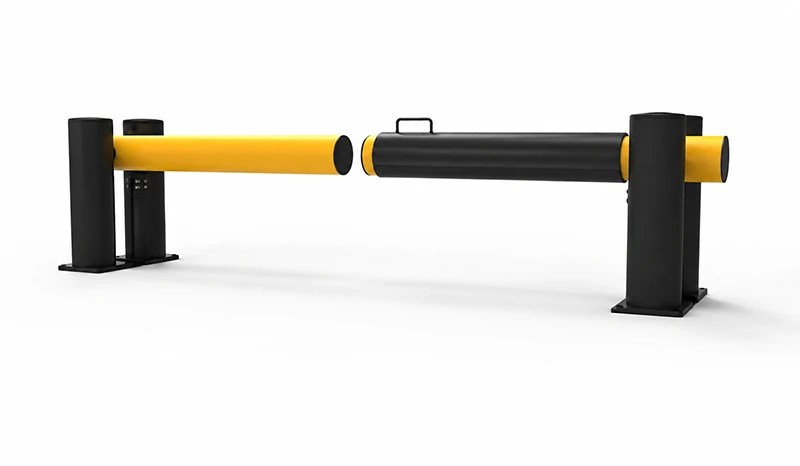
Where the floor-anchor repair bill goes away
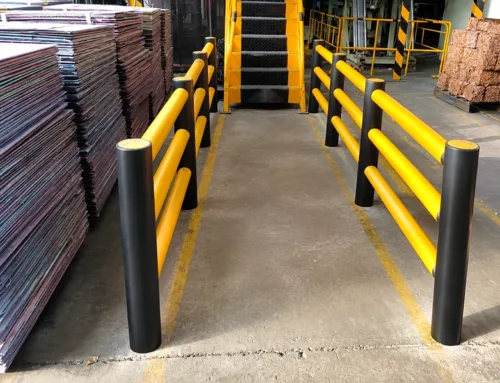
- Warehouse aisles where the same rack end takes a forklift strike every quarter — the anchor pocket is the failure surface, not the rail.
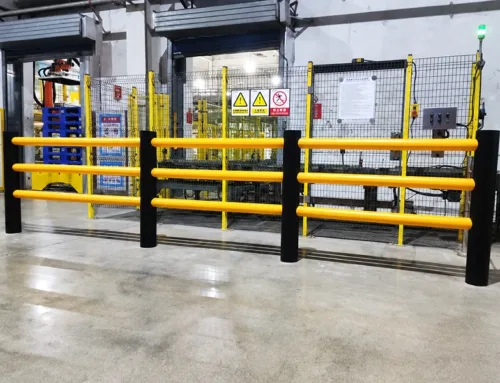
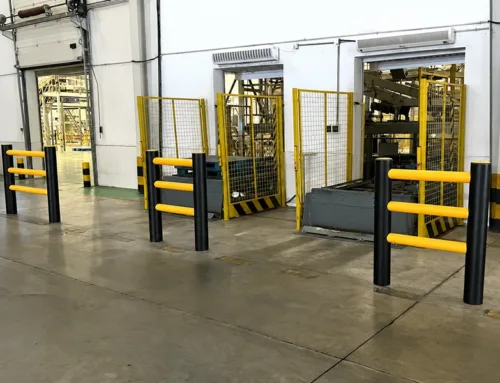
- Distribution centre dock doors where 90° corner strikes pop anchor welds and shear the expansion bolt out of the slab edge.
- Cold-storage and ambient aisles where condensation attacks the painted-steel finish and creeps under the base plate.
- Logistics hubs running 24/7 three-shift cycles where a repaint shutdown is impossible but a strike is statistically certain.
- Mezzanine edges and dock column corners under mixed AGV + reach-truck traffic where the strike vector loads the bolt laterally.
Every application above shares one pattern: the bolt pocket is the failure surface, not the barrier rail. Re-routing the energy at the post — instead of passing it through to the slab — is what kills the recurring warranty line and stops the slab patch count from climbing every quarter.
Get the Joule ladder and the floor-anchor specification
Send your site floor plan, forklift roster (model, mast tilt, lift height, max laden speed) and the slab thickness at the proposed anchor points. The FCBarrier engineering team returns a Joule tier, a base-plate pattern, a documented two-person install plan for your slab, and a side-by-side repair-cycle projection against your current painted-steel guard so procurement can audit the hidden-cost gap before the next strike hits.
Stop rebuilding the concrete every time the steel barrier gets hit
Talk to a FCBarrier engineer about Joule-rated, self-rebounding ARMORFLEX polymer crash barriers for your distribution centre floor — and the floor-anchor repair bill that quietly disappears with them.