JA
JA  EN
EN  DE
DE  RU
RU  PT
PT  ES
ES  IT
IT WAREHOUSE AUTOMATION | HSAFETY
Give AGV and Forklift Traffic a Physical Boundary
This safety barrier system uses heavy-duty warehouse guard rails to define AGV and AMR lanes, separate pedestrians from vehicles, and reduce forklift collision risk around conveyors, racks, and fixed equipment.
Why Mixed AGV and Forklift Traffic Needs More Than Software
When automated guided vehicles share aisles with manual forklifts, the number of collision paths increases. A dispatch system can assign routes and issue right-of-way instructions, but it cannot physically stop a vehicle that crosses a line, loses localization, or enters a shared zone at the wrong moment. Painted markings, rope or strap barriers, wooden barriers, and ad hoc steel pipe railing make the boundary visible only under ideal conditions. Concrete bollards may stop a vehicle, but they do not continuously define a route or provide a clean pedestrian-vehicle separation line.
Hsafety adds the missing physical layer: a warehouse safety barrier system positioned outside the operating envelope. It works with the customer’s existing AGV or AMR scheduling system rather than replacing it. Digital dispatch determines where a vehicle should travel; the floor-mounted steel guard rail makes an unintended crossing difficult and visible.
| プロジェクト要件 | Hsafety design response |
|---|---|
| Mixed automated and manual vehicle routes | Continuous double-rail guardrail establishes a clear, physical lane edge for forklift area barrier and pedestrian safety separation. |
| Protection near conveyors, robots, and controls | Q235 steel guardrail, square posts, and bolted floor plates create an external impact-protection boundary around fixed assets. |
| Different aisle lengths and turning points | Modular guardrail sections support straight runs, corners, and custom length guardrail layouts. |
| Installation on an operating concrete floor | Bolted guard rail system uses post base plates and expansion anchors; final anchor selection and floor checks follow the project drawing. |
Structure and Site Evidence for a Physical Route Boundary
1. Continuous protection around automated equipment
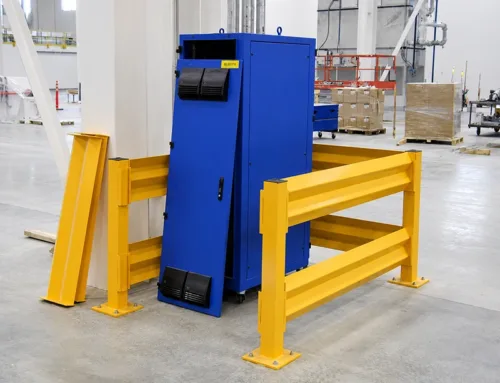
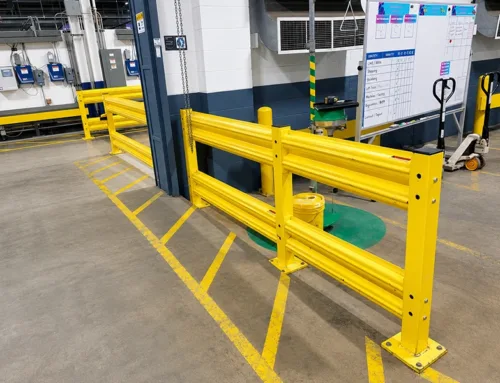
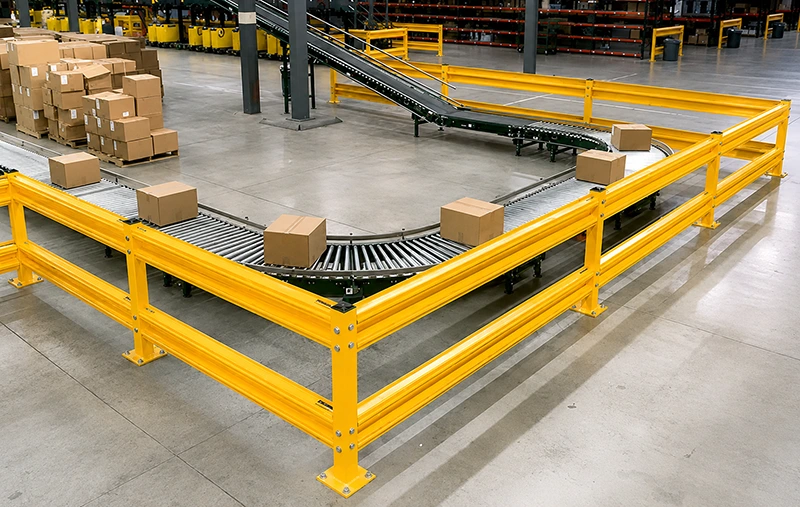
The warehouse scene shows double rails following a conveyor perimeter, including straight and intersecting areas. That arrangement is relevant to AGV and AMR route control because the barrier can define the edge of a machine guarding or conveyor zone without turning the whole area into a closed safety fence. The corrugated guard rail uses formed peaks and valleys to add section stiffness. It is intended as an impact barrier for warehouse and industrial environments; collision inspection and replacement decisions still require site-specific engineering review.
2. A bolted assembly that can be planned by module
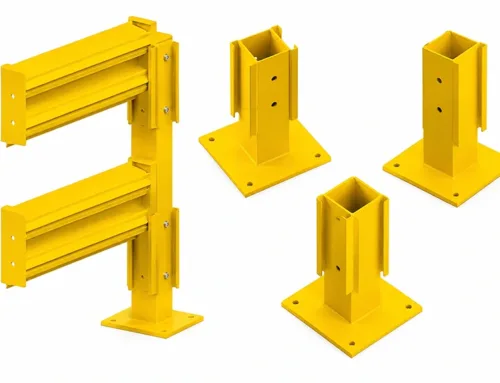
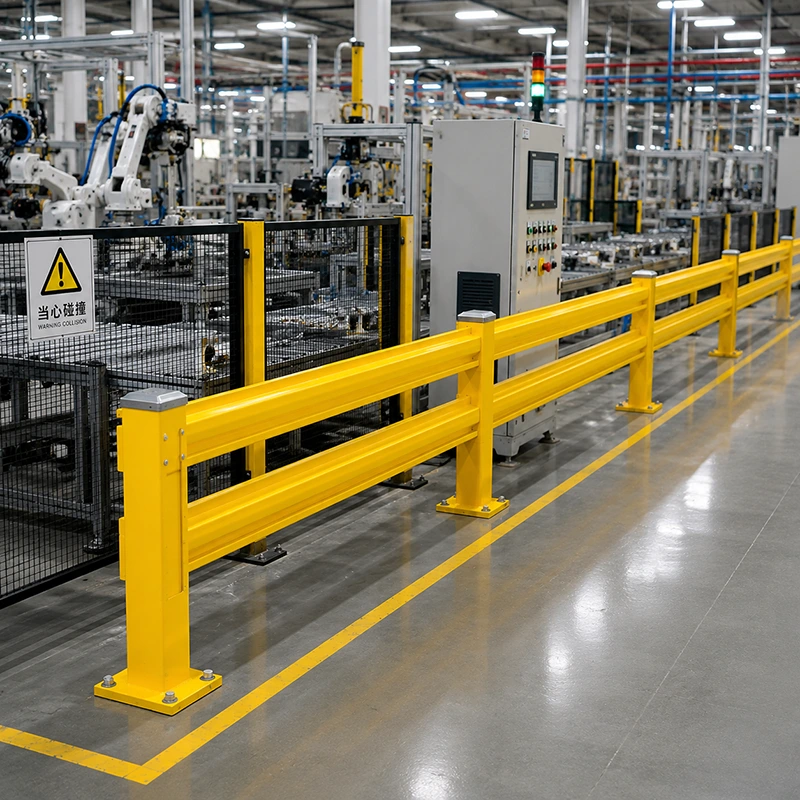
At the robot-cell edge, the yellow steel guard rail is visibly separated from the black mesh enclosure. This distinction matters: Hsafety is external collision protection for people, equipment, racks, and walls, while a machine safety fence controls access to an internal hazardous machine zone. The modular, bolted arrangement allows project teams to discuss single rail guardrail or double rail guardrail configurations, lift-out access, end caps, brackets, and blockouts according to the route and maintenance plan.
3. Dimensions that connect the barrier to the layout
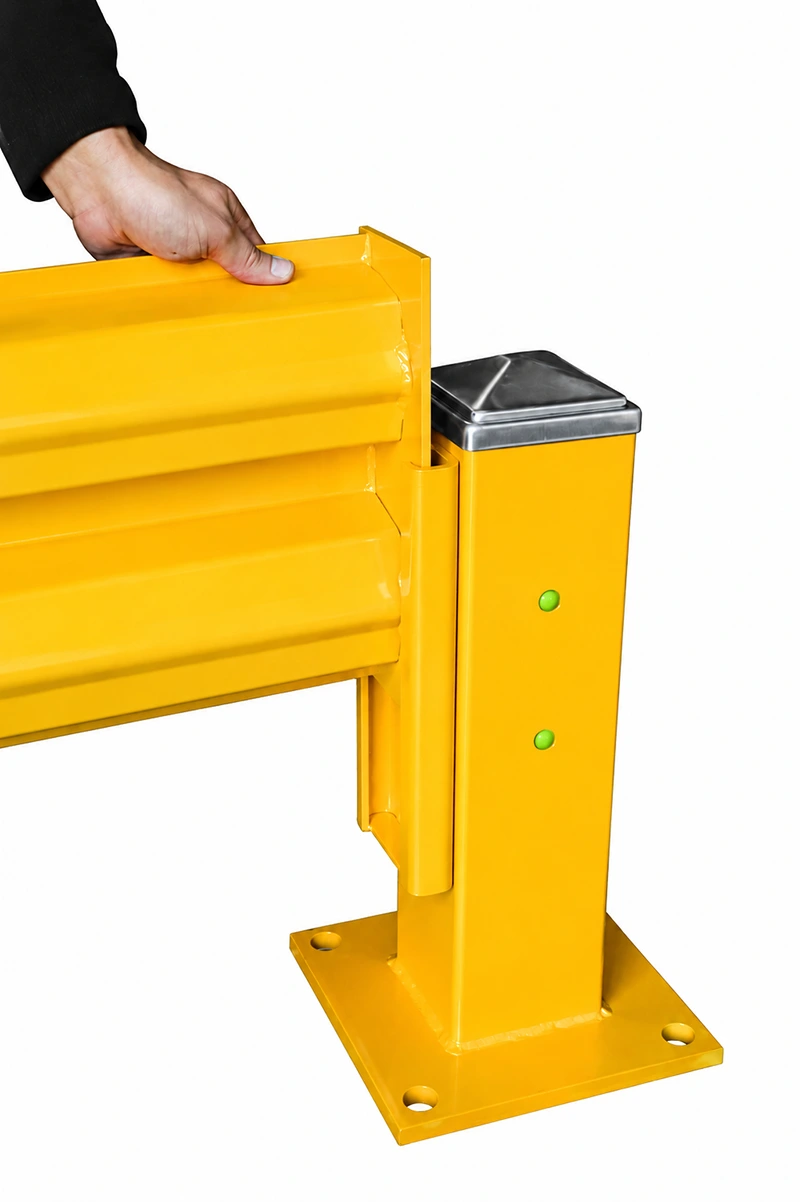
The component detail supports the key specification discussion: Q235 carbon steel, 3 mm or 4 mm corrugated beam options, approximately 310 mm rail width, 85 mm wave height, and a nominal 1,000 mm overall guardrail height. A recorded multi-zone design used 1,500 mm standard modules with special rail sections from 680 mm to 1,140 mm to close four different runs. Post and anchor dimensions must be confirmed against the final drawing; a typical project reference uses an 80×80×6 mm square post and a 160×160×16 mm base plate.
Where the Safety Barrier System Delivers the Most Value
- AGV and AMR lanes: define fixed travel corridors and discourage route-cutting into pedestrian or forklift areas.
- Conveyor and sortation zones: protect rollers, control cabinets, cartons, and transfer points from vehicle impact.
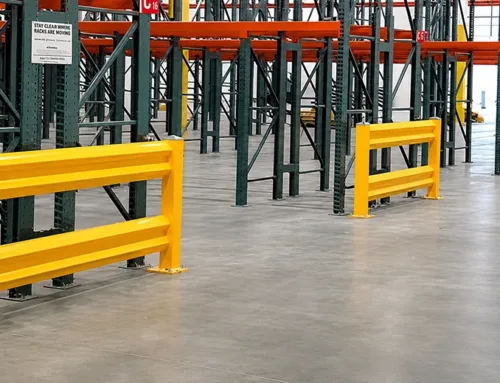
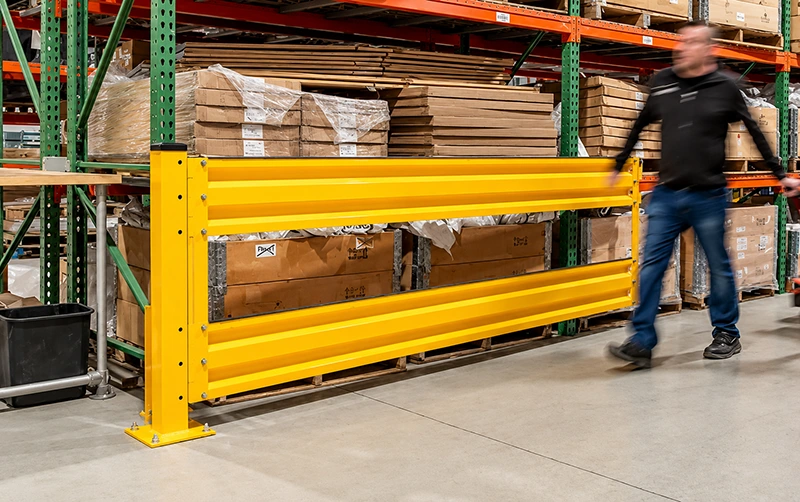
- Rack ends and loading docks: provide rack end protection and loading dock protection where turning forklifts need a visible boundary.
- Equipment and utility edges: support asset protection guardrail layouts around electrical rooms, pipework, robot cells, and walls.
Yellow powder coated guardrail improves visual recognition in active aisles. Hot-dip galvanized steel, reflective tape, custom colors, or access components can be specified when the environment or operating procedure requires them. These are configuration choices, not assumed inclusions.
Specify the Route Before You Specify the Rail
Provide the AGV/AMR lane map, manual forklift paths, pedestrian crossings, protected assets, turning points, required openings, concrete-floor condition, and target barrier lengths. SGF can then match the rail arrangement, post spacing, 2-rib or 3-rib profile, surface treatment, and custom sections to the actual warehouse guardrail layout. Any collision load, anchor capacity, OSHA guardrail compliance requirement, or local safety rule should be checked by the responsible project engineer rather than inferred from a product photograph.
Build a Digital Dispatch + Physical Boundary Layer
Use your existing automation system for decisions and Hsafety heavy duty guardrail for the last physical line of defense. The result is a clearer route, stronger pedestrian-vehicle separation, protection for racks and equipment, and less accident downtime after an unintended vehicle movement.