JA
JA  EN
EN  DE
DE  RU
RU  PT
PT  ES
ES  IT
IT WAREHOUSE SAFETY / FORKLIFT IMPACT PROTECTION
高回転倉庫フォークリフトゾーン:衝撃損傷を軽減する施設ガードレール境界
设施护栏取代了要求每位工人记住规则这种脆弱的控制方式。Hsafety仓库护栏使用可见的黄色钢制边界、可选反光带和螺栓固定保护,将行人、叉车、货架和固定资产分隔开来——即使新员工或临时工尚未掌握所有安全指示。.
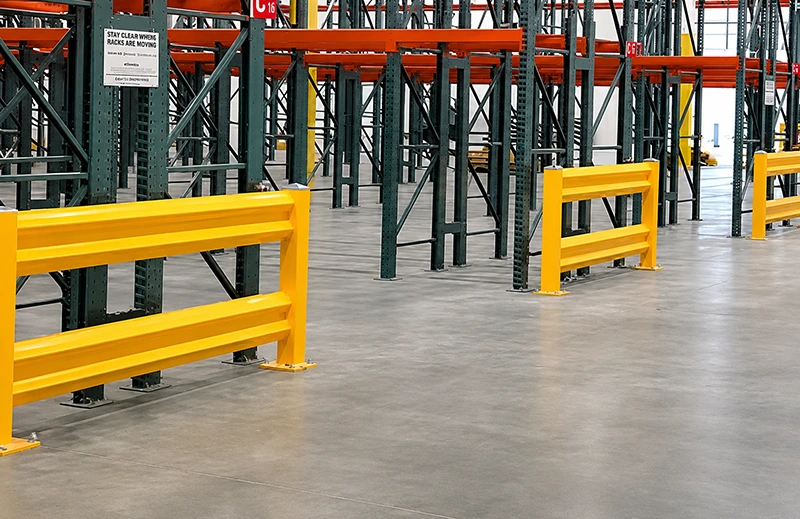
Why high staff turnover exposes weak safety controls
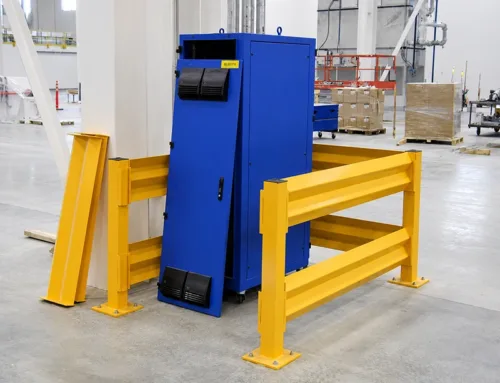
In a distribution center, warehouse, or loading dock, people change faster than the layout does. A trained operator may understand a rack-end exclusion zone; a new picker, contractor, or visiting driver may see only an open route. Painted lines, rope barriers, wooden barriers, and verbal briefings depend on recognition and consistent behavior. A steel pipe railing fabricated on site can also leave uneven protection, exposed welds, or gaps around corners. When a vehicle enters that gap, the business faces more than repair work: damaged racks, walls, conveyors, and equipment can create accident downtime and complicate responsibility after an injury.
| 管理要件 | Hsafety facility guardrail response |
|---|---|
| Make the boundary understandable without a briefing | Yellow safety coating provides an immediate visual stop cue; reflective tape can be specified for low-light areas. |
| Protect assets from forklift impact | Q235 carbon steel corrugated beams, square posts, and floor-mounted anchor bases create a physical separation line. |
| Fit several warehouse zones | Modular bolted sections support straight runs, corners, single-rail or double-rail layouts, and custom length guardrail sections. |
| Keep installation inspectable | Posts and rails are mechanically connected; the final anchor and concrete-floor design should follow the approved project drawing. |
How the physical boundary works in the warehouse
1. Corrugated steel turns a line into a visible barrier
The Hsafety system is built around Q235 steel guardrail beams with a corrugated profile. The wave form adds structural depth through peaks, valleys, and bends, while the yellow finish makes the facility guardrail easy to distinguish from ordinary warehouse equipment. Standard discussions can include 2-rib W-beam or 3-rib thrie-beam profiles, 3 mm or 4 mm beam thickness, and approximately 310 mm beam width; the exact combination should be confirmed against the selected drawing. This is not a substitute for a site-specific impact calculation, but it is a clear physical boundary rather than a reminder painted on the floor.
2. Bolt-down posts establish a continuous exclusion zone
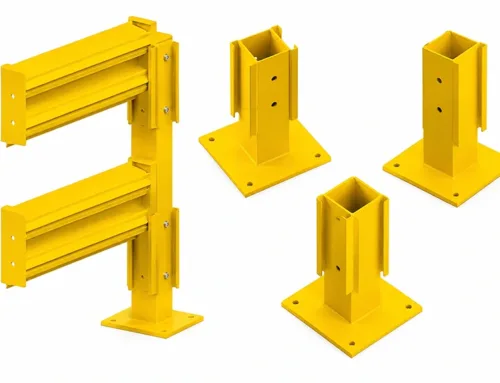
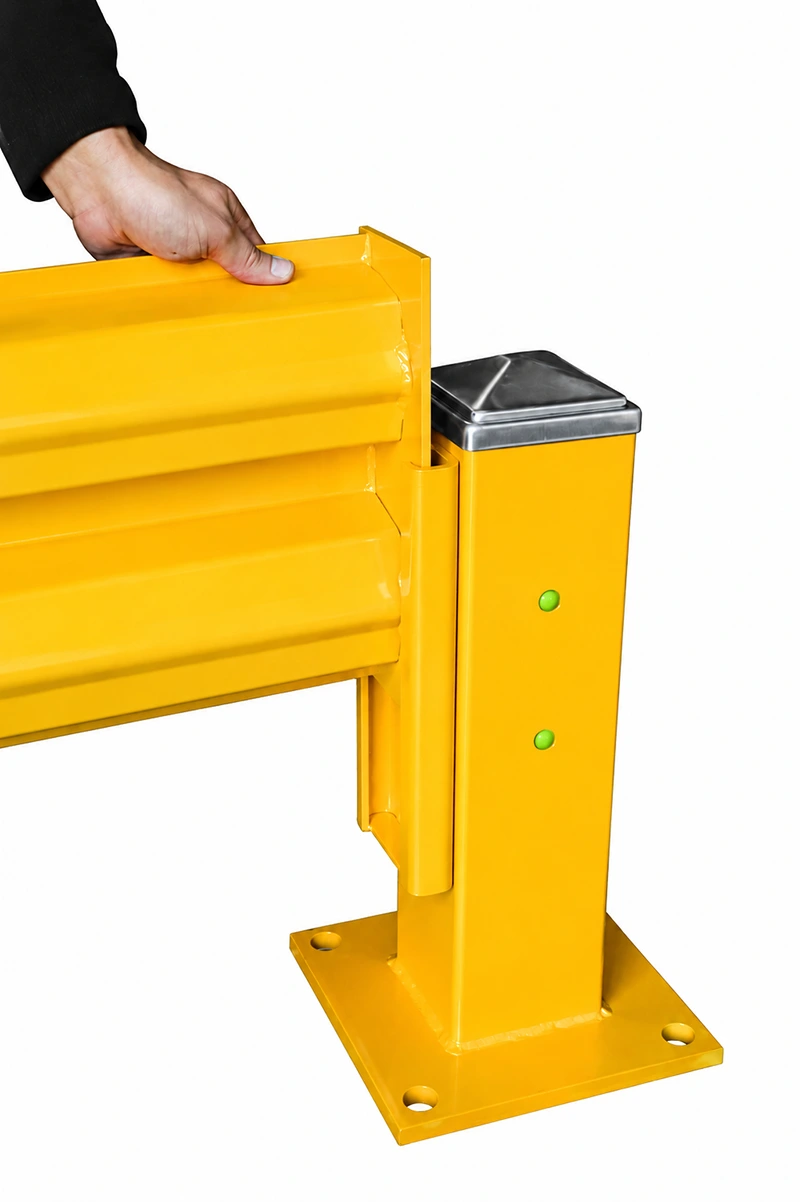
The product detail shows twin corrugated panels, a square post, connection hardware, and a square base plate with anchor holes. In the recorded project configuration, the post was 80 × 80 × 6 mm, the base plate was 160 × 160 × 16 mm, and the assembled height was 1,000 mm. Those figures belong to that defined project configuration, not a universal promise for every Hsafety model. With concrete floor anchoring and bolt-on installation, the barrier can run beside pallet racking, electrical rooms, walls, or machine guarding zones without relying on a welded pipe railing to define the edge.
3. Modular lengths close the gaps that create liability
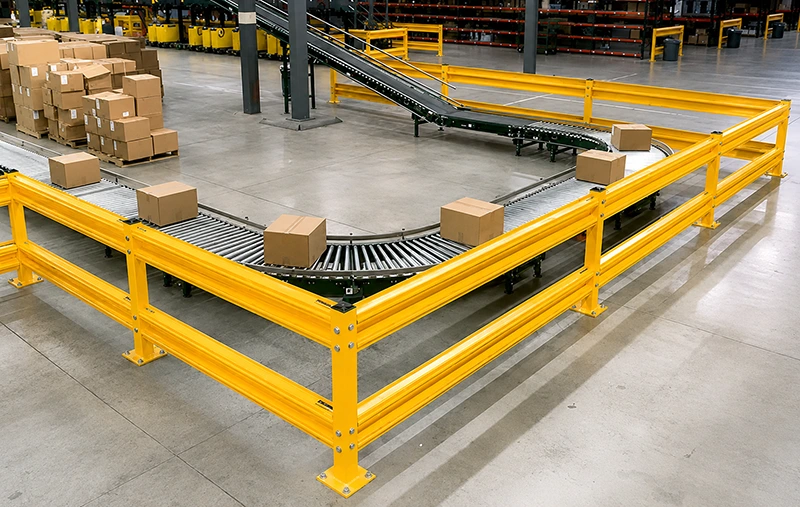
A warehouse rarely has one perfectly repeatable run. Hsafety can combine common 1,500 mm rail modules with special-length panels. In one four-zone layout, the required runs were 17,000 mm, 12,000 mm, 17,100 mm, and 11,900 mm. The design used 64 standard panels plus eight special panels from 680 mm to 1,140 mm, with 42 posts in total. This kind of length planning matters because a short unprotected section beside a rack end or conveyor corner can undermine the entire pedestrian-vehicle separation strategy.
Where this facility guardrail is most useful
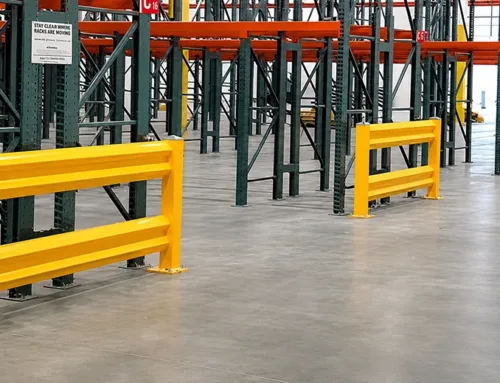
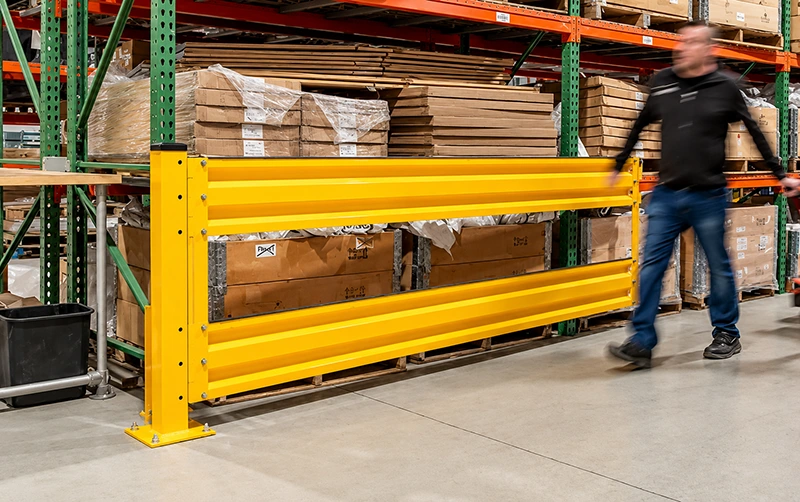
- Rack end protection: place a double-rail warehouse safety barrier in front of pallet rack uprights and at aisle approaches.
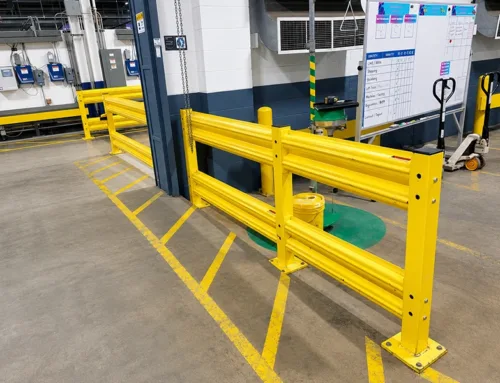
- 荷積みドック保護: define the edge of forklift areas and protect walls, doors, and fixed services from vehicle approach.
- Conveyor and equipment isolation: run the industrial guard rail beside conveyors, electrical cabinets, robot cells, or production-line equipment.
- Pedestrian-vehicle separation: create an unmistakable workplace safety barrier where new employees and visitors cross logistics routes.
The barrier is an external asset-protection control. It should not be confused with a machine safety fence, which performs a different internal guarding function, or with a highway guardrail. Outdoor use, unusually high impact energy, OSHA guardrail compliance, and anchor design require separate engineering review.
Specify the risk boundary before ordering
Start with a site plan showing forklift paths, pedestrian crossings, rack ends, walls, equipment, corners, and loading points. Confirm the required height, rail profile, 3 mm or 4 mm thickness, standard and custom lengths, single-rail or double-rail arrangement, concrete condition, and anchor details. Select powder coated yellow steel for high visibility, or discuss hot-dip galvanized finish and reflective tape where the environment requires them. The project record may describe a 3-ton forklift at 10 km/h and a target load of approximately 16,680 N; that is a project design condition, not an independent certification claim.
Replace rule memory with a facility guardrail boundary
Hsafety helps warehouses protect racks, walls, conveyors, and people with a physical line that remains present when staffing changes. Send the zone lengths and site constraints for a practical warehouse guard rails layout based on the actual risk boundary.