EN
EN  DE
DE  RU
RU  PT
PT  JA
JA  ES
ES  IT
IT Machine guarding safety fence
Machine guarding safety fence for forklift-impact automation cells
In a line where ZeroLabor robots handle heavy light-gauge steel panels and gypsum boards beside constant forklift traffic, the guard line must survive impact, not just mark a boundary. Mdfence is built for the physical job.

Why a thin fence fails in this cell
When a forklift loses control or a robot arm throws material, a light-duty barrier can buckle immediately. That creates an open boundary, a stop-work event, and a safety incident risk. Mdfence is specified as hard physical protection, not visual separation.
| Engineering requirement | Mdfence response |
|---|---|
| Robot and forklift mixed traffic | Physical boundary for high-frequency intercrossing work zones |
| Heavy panel handling | Designed for impact-prone cell protection around panel logistics |
| Structural weakness in ordinary guards | 60×60 mm thick square post in Q235 carbon structural steel |
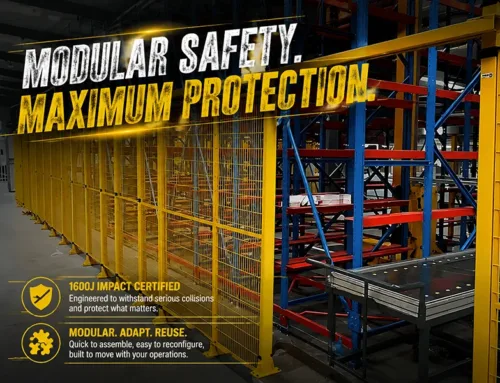
| Collision energy absorption | TUV-certified resistance to up to 1600 J extreme impact energy |
| Need to remain standing after impact | Plastic deformation absorbs energy instead of total boundary collapse |
| Offsite manufacturing uptime | Hard heavy-industry defense for a British offsite production environment |
Structural proof points that matter on the floor
Thick post and steel grade carry the hit
The core of Mdfence is the 60×60 mm thick square tube made from Q235 carbon structural steel. That is the right choice when the problem is not hand contact but accidental forklift impact. The structural goal is simple: keep the perimeter line intact when a moving vehicle or thrown load applies real force.

Connection detail decides whether the barrier stays usable
The technical front view shows the relationship between post, mesh panel, and fixing clamp. That detail matters because many fence failures start at the connectors and base interface, not at the visible face of the panel. Mdfence is built so the structure behaves as a single mechanical system, not a loose frame.

The aisle image shows real workflow fit
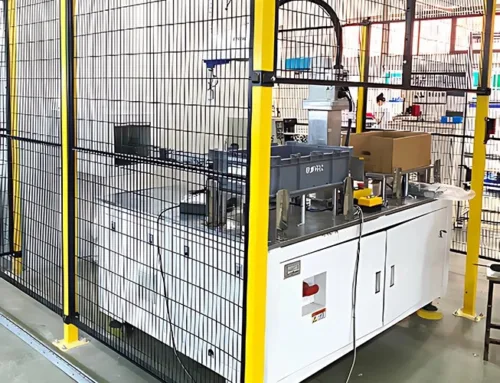
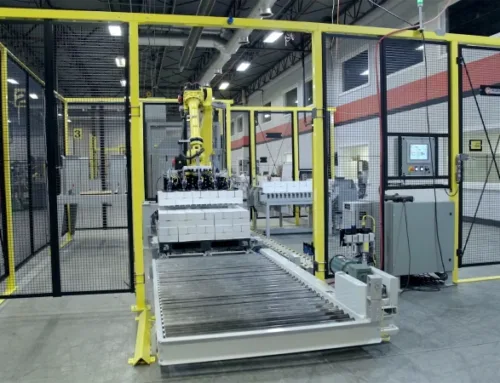
In the conveyor-side installation view, the fence runs beside active transfer equipment in a clean factory aisle. That is the operating reality for offsite panel production: robots, conveyors, forklifts, and human access points all share the same floor. Mdfence keeps that flow separated without turning the line into a fragile temporary barrier.

Where this protection model fits best
- High-cycle robotic handling cells for heavy light-gauge steel panels
- Gypsum board lines with forklift transfer nearby
- Offsite fabrication zones where a boundary failure stops the whole shift
- Retrofit replacements for light-duty guard rails that cannot survive impact
- Work areas that need a hard physical boundary, not just a warning line
If the floor combines robots, forklifts, and panel logistics, the fence must be specified like impact equipment. Mdfence gives that specification a steel structure, an impact rating, and a connector detail that match the risk.
What to specify before you build the cell
Ask for the post size, steel grade, impact rating, and fixing detail. For Mdfence, the critical evidence is the 60×60 mm thick square post, Q235 carbon structural steel, TUV-certified 1600 J extreme impact resistance, and the plastic deformation response that absorbs collision energy rather than letting the whole boundary fail.
Specify a boundary that survives the hit
If your cell has the same mix of robot handling and forklift traffic, the question is not whether you need guarding. The question is whether the guarding can stay standing after the wrong contact. Mdfence is built for that job.