EN
EN  DE
DE  RU
RU  PT
PT  JA
JA  ES
ES  IT
IT 
1.Raw material procurement
The main raw materials to be purchased for this product are 50*50mm galvanized square pipe and 2mm diameter wire roll.
2.Pipe Cutting
 (1) Place the pipe to be cut on the laser cutting machine and keep it horizontal and stable.
(2) According to the diameter of the pipe, material, thickness and other parameters, set the cutting parameters of the laser cutting machine, including laser power, cutting speed, focal length and other parameters.
3) Debug the laser cutting machine so that it can cut the pipe accurately, adjust the height and position of the laser head to ensure that the laser beam accurately irradiates the surface of the pipe.

4) Start the laser cutting machine so that it begins to cut the pipe. In the cutting process, you need to observe the cutting situation in time to ensure the cutting quality and cutting speed.
5) After the cutting is completed, remove the pipe from the laser cutting machine, clean up the scene and do a good job of maintaining the equipment.
3. Wire cutting, welding
(1) First of all, put the whole bundle of wire into a disk that can be rotated, and put one end of the wire into the hole of the straightening machine. The wire passes through the upper and lower two rollers, which exert pressure on the wire to straighten the bent wire.
(2) After passing through the straightening machine, the wire will be cut and fall according to the set distance to bundle a certain number of wires. The bundled wire is sent to another production line with a hanging machine.
3) At this time in another section of the production line, dozens of wire coils are running at a constant speed, and these wires pass through the straightening machine at the same time, while the other end of the machine drops the previously cut wires into the conveyor, which drops the wires according to a certain interval, and welds them at the same time as they come into contact with the wires.
4) The welded wire mesh is quickly transferred to the cutting table, and the whole process of cutting is automated without manual operation. After cutting, a whole sheet of wire mesh is transferred to a forklift truck, which transports the wire mesh to the overall welding workshop after turning full.
4. Integral Welding


1)Weld the outer frame of the square tube, don’t weld too close to cause deformation of the frame when welding.
2) Weld the mesh to the outer frame.

5.Grinding and chamfering
Grind, chamfer and deburr the welded mesh.
6.Plastic spraying
1) Shot blasting. After grinding the whole guardrail and columns for shot blasting treatment, with electro-mechanical shot blasting machine as the driving force, the use of shot blasting machine thrown high-speed projectiles to clean up or strengthen the surface of the metal workpiece, and increase the surface of the guardrail adsorption capacity of plastic powder. The principle of shot blasting and sand blasting is different, sand blasting is the use of air highly compressed for processing, while shot blasting is through the impeller turned out to tell the projectile processing
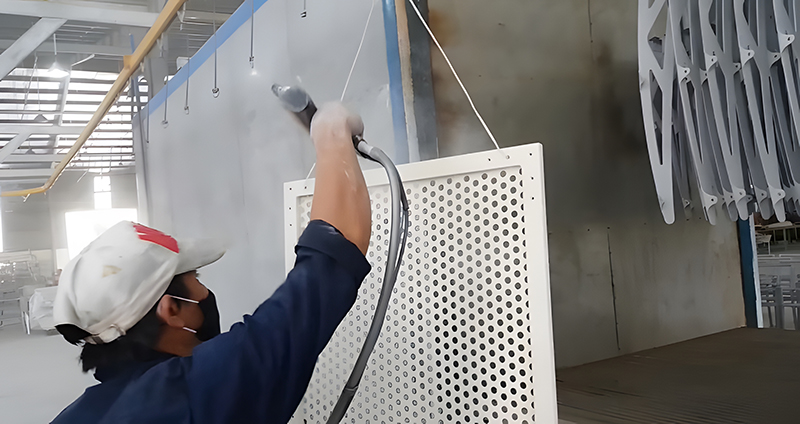
2) Plastic powder spraying. After sandblasting the mesh and columns for powder spraying, powder spraying should pay attention to the surface spraying complete, uniform thickness.
(3) heating curing. Plastic spraying mesh and columns into the curing furnace, heated to a predetermined temperature (generally 185 degrees), and keep warm for a corresponding period of time (15 minutes), open the furnace will be taken out of the finished product.
7.Quality Inspection
Inspect the shape, size, surface quality and welding quality of the products.
Food & Beverage Line Reconfiguration: How Mefence Frameless Safety Fencing Turns Plant Zoning into a Reusable Asset
Short SKU lifecycles and frequent production-line changes make welded partitions expensive to abandon. Mefence frameless 3D industrial safety fencing uses clip-fixed modules, on-site cutting and reusable components for warehouse zoning, machine guarding and pedestrian-vehicle separation.
Food & Beverage Line Reconfiguration: How Mefence Turns Industrial Safety Fencing into a Reusable Asset
Shorter SKU life cycles force food and beverage plants to redraw production zones. Mefence frameless 3D industrial safety fencing can be dismantled, cut on site, moved, and reused as layouts change.
Food & Beverage Line Reconfiguration: Turn Mefence Safety Fencing into a Reusable Plant Asset
When seasonal SKUs and pilot runs repeatedly change a food and beverage production layout, Mefence Safety Fencing replaces welded-in zoning with a frameless, modular barrier that can be dismantled, cut on site, and reused.