PT
PT  EN
EN  DE
DE  RU
RU  JA
JA  ES
ES  IT
IT 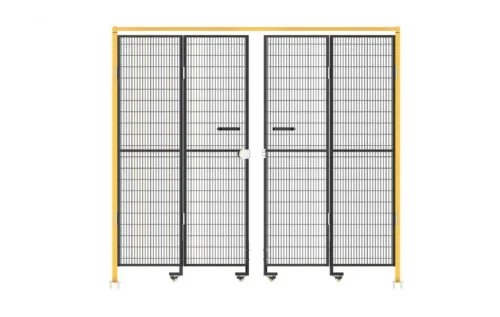

|
In a high-throughput automotive facility, an AGV carrying a chassis doesn’t have time to hesitate. Yet, a single operator crossing the yellow line can trigger a safety scanner, halting the entire fleet and killing your cycle time. Stop relying on floor tape alone. We engineer physical barriers that integrate directly with your traffic logic, ensuring your AMRs keep moving while your team stays safe. |
The integration of Automated Guided Vehicles (AGVs) and Autonomous Mobile Robots (AMRs) into the automotive manufacturing ecosystem has shifted the paradigm of plant layout. You are no longer just guarding a static stamping press or a welding cell; you are managing a dynamic traffic system where heavy steel meets human unpredictability. Designing Cerca de Segurança Industrial for these zones requires a strategy that goes beyond simple perimeter isolation. It requires a “handshake” between the physical barrier and the mobile robot’s control logic.
1. The “Ghost Stop” Phenomenon: Why Tape Isn’t Enough
In many legacy intralogistics setups, facility managers rely on painted lines or virtual walls mapped into the AGV’s LiDAR. The problem? Humans are analog. An operator taking a shortcut across an AGV lane to reach the sub-assembly station triggers the robot’s safety scanner (E-stop or slow-down zone).
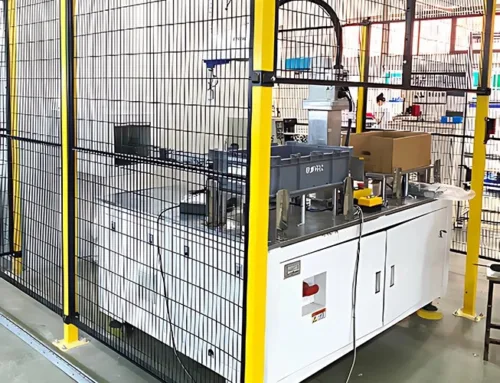
This results in the “Ghost Stop”—unexplained downtime where the fleet halts, waiting for a clearance that has already passed. For a Tier 1 supplier, these micro-stoppages accumulate into significant production losses. A physical Machine Guarding Fence Panel system eliminates this variable by enforcing designated crossing points, effectively channeling human traffic away from the robot’s dynamic path.
2. Structural Integrity: Withstanding the Impact
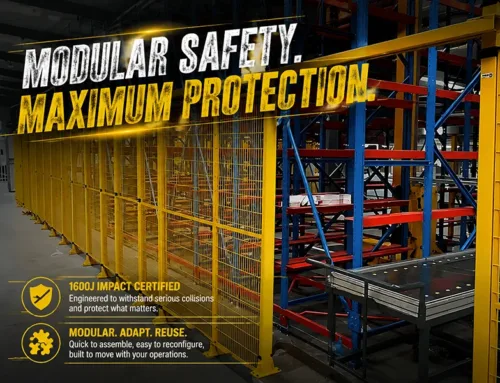
Unlike a static robot arm, an AGV is a moving mass. If a navigation error occurs or a sensor fails, a 2,000 lb loaded pallet mover hitting a barrier generates significant kinetic energy. A standard aluminum profile fence will likely buckle, potentially spilling the load into the pedestrian walkway.
The Mdfence design utilizes Aço carbono Q235 for the main structure. Our standard posts are 60 x 60mm with a wall thickness of up to 2.0mm. Crucially, the system is anchored using heavy-duty expansion bolts (M10 x 70mm). This provides the necessary shear strength to contain a low-speed collision from material handling equipment, protecting both the expensive AGV hardware and the personnel on the other side.

Detailed cross-section of the 60x60mm Q235 steel post and heavy-duty anchoring system designed for high impact resistance.
3. The Handshake: Integrating Interlocks with AGV Logic
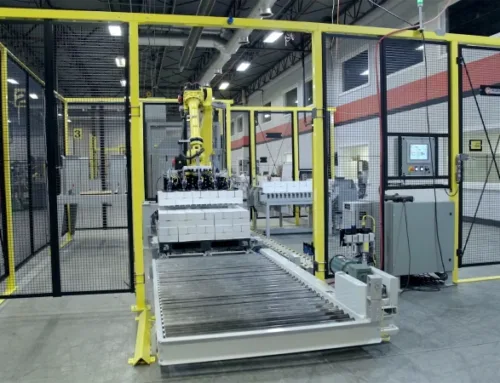
The most critical design element in an AGV zone is the transfer point—where the robot enters a cell to drop off a powertrain component or pick up a finished assembly. You cannot have a manual latch here.
The fencing system must accommodate a Safety Interlock Carrier. Mdfence systems are engineered with pre-drilled, customized mounting plates compatible with major safety switches (like Omron or Pizzato). The workflow changes from passive to active:
- Request: AGV approaches the gate and sends a Wi-Fi signal to the PLC.
- Verify: PLC checks the cell status (human-free).
- Action: The automated gate (often a sliding or high-speed roll-up door integrated into our posts) opens.
- Secure: Once the AGV clears the sensors, the gate closes and locks, re-arming the machine guarding circuit.

Single sliding door configuration, ideal for AGV entry/exit points where swing radius is limited.
4. Layout Strategy: Managing Large Perimeters
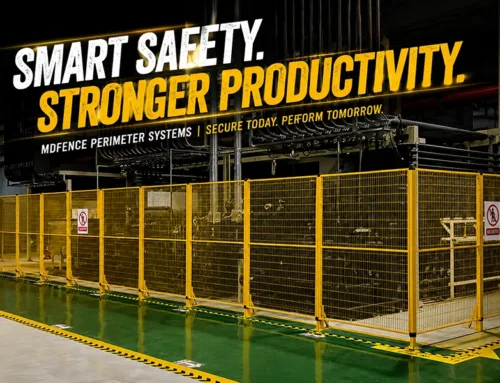
AGV paths often span hundreds of feet, connecting warehousing to assembly. A “one-size-fits-all” panel width often leads to cutting and welding on-site, which introduces sparks and debris into a clean manufacturing environment.
We utilize a modular approach with variable panel widths. As seen in our large-scale US projects, we can design a perimeter that follows the complex geometry of your AGV highway, including non-90-degree turns and specific cutouts for conveyor pass-throughs.

CAD layout for a large-scale perimeter isolation project, demonstrating modular adaptability for complex factory floors.
5. Rapid Deployment and Modification
Automotive production lines are rarely static. When a new model year launches, the AGV paths might change. A welded-in-place fence is a nightmare to move.
Our system uses a frameless or framed panel design that clips into the posts via secure fixing rings. This allows maintenance teams to remove a section of the fence in minutes to service an AGV that has faulted, or to completely reconfigure the layout over a weekend shutdown without hot work permits.

Standard installation steps showing the modular fixing rings and bolt-down process, enabling rapid assembly and reconfiguration.
Frequently Asked Questions (AGV Zone Safety)
A: While ISO standards vary, we generally recommend a minimum clearance of 20 inches (approx. 500mm) from the widest point of the loaded AGV to the fence panel to prevent crushing hazards if a human were somehow trapped, and to allow for minor navigation deviations without collision.
A: Yes. We provide specific “Safety Interlock Carrier” kits (e.g., KKCK-LCK-B-D4NL-SET) designed to mount third-party switches directly to our posts and door frames, ensuring seamless integration with your PLC.
A: Yes. Polycarbonate is often preferred in AGV zones to prevent “tunnel vision.” It allows operators to see the robots approaching the intersection, and prevents laser scanners from getting confused by the mesh pattern (though modern scanners handle mesh well).
A: We recommend installing a hinged service gate with a “request to enter” button. This pauses the AGV fleet via the system controller, unlocks the gate, and allows safe retrieval. Our modular panels can also be unbolted quickly for major equipment extraction.
A: Absolutely. Our components undergo powder coating (Standard RAL 1023 Yellow for posts, RAL 9005 Black for mesh) that meets GB/T9286-1998 standards and passes ISO9227 salt spray testing, resisting corrosion from coolants and oils common in machining areas.