PT
PT  EN
EN  DE
DE  RU
RU  JA
JA  ES
ES  IT
IT 
For automation system integrators, cell commissioning is a race against the clock. Waiting for hot work permits, dealing with weld spatter near sensitive electro-optical elements, and shutting down adjacent CNC machining centers just to erect a perimeter barrier destroys your profit margins. You need a turnkey solution that deploys instantly. Machine fence assembly without welding isn’t just a convenience—it is a critical requirement for high-speed manufacturing lines.
The Hidden Cost of On-Site Welding in Automation Integration
In automotive manufacturing and robotics integration, the “Before” scenario of installing Cerca de Segurança Industrial is notoriously inefficient. Traditional fabricators rely on on-site welding to secure posts and brackets. This means pulling hot work permits, isolating the area to protect PLC cabinets and servo drives from grinding sparks, and dealing with the inevitable toxic fumes. Worse, welding destroys the protective powder coating, guaranteeing that the joints will rust within months in a humid facility. When the robotics layout inevitably changes for a new car model assembly, those welded barriers become zero-value scrap metal that must be destructively cut away.
Why Modular Cold Assembly is the New Standard
The Mdfence system engineers the welding out of the equation. By utilizing a completely modular, bolt-on architecture, the entire perimeter can be erected using simple hand tools. This “Cold Assembly” method means zero sparks, zero dust, and zero downtime for adjacent dedicated manufacturing lines. Two technicians can install up to 160 feet of perimeter in a single shift.

As shown in the installation workflow above, the process relies on high-strength connection clips and M8x10 flange bolts. The Q235 carbon steel posts (approx. 2.36″ x 2.36″) are anchored to the polished concrete via expansion bolts, while the panels simply slot into pre-aligned brackets. This maintains the integrity of the ISO 9227 salt-spray tested powder coating and ensures a flawless aesthetic that passes the strict EHS audits of top-tier automotive clients.
Engineering the “No-Weld” Machine Guarding System
A common misconception is that a bolted system lacks the rigidity of a welded frame. However, the structural integrity of this Cerca de Segurança para Robôs comes from its pre-fabricated component design.

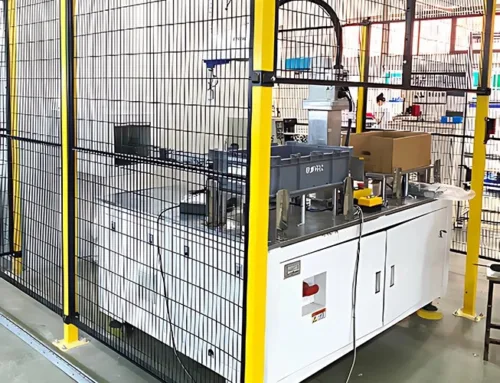
Unlike cheap, frameless wire mesh that sags when an operator leans against it, Mdfence uses a continuous 20x30x1.5mm (approx. 0.78″ x 1.18″) seamless steel tube frame for every panel. The 3.0mm or 4.0mm wire is flattened and resistance-welded to this frame at the factory—long before it reaches your facility. When these rigid panels are bolted to the posts, the out-of-plane stiffness effectively dissipates kinetic energy across the entire structure.
Seamless Integration with Safety Interlocks
System integrators frequently struggle with mounting electronic safety interlocks (like Omron D4NL or Pizzato switches) to generic fencing. Drilling and tapping holes on-site introduces metal shavings into the cleanroom or assembly area and often leads to misaligned door keys, causing nuisance machine trips and plummeting OEE. The Mdfence modular system includes pre-engineered “Safety Interlock Carriers”. These mounting plates are pre-drilled to match industry-standard PLe/SIL3 switches, allowing you to bolt the interlock directly to the post. The mechanical separation action reliably triggers the Safety Torque Off (STO) to the robot controller without a single custom weld.
Real-World Impact: Traditional Fabrication vs. Modular Assembly
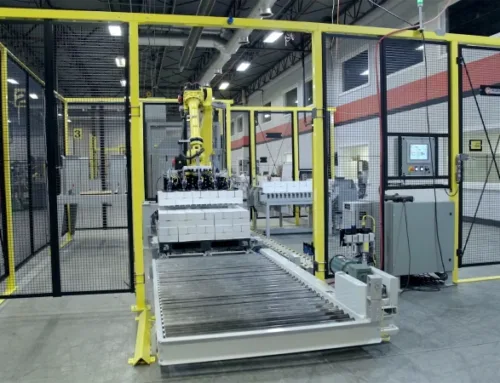
When evaluating Painéis de cerca de proteção para máquinas for a turnkey automation project, the total cost of ownership heavily favors the weld-free approach.
| Integration Metric | On-Site Welding (Before) | Mdfence Modular System (After) |
|---|---|---|
| Velocidade de instalação | Slow; requires hot work permits and fire watches. | Up to 70% faster; cold assembly using standard wrenches. |
| Asset Reusability | 0% – Must be cut and scrapped during layout changes. | 95%+ – Unbolt and reconfigure for the next automation line. |
| MTTR (Mean Time To Repair) | 2-4 hours to cut out and re-weld a forklift-damaged section. | 10 minutes to unbolt and swap a damaged mesh panel. |
| EHS Compliance | High risk of toxic fumes and fire hazards in active plants. | Zero emissions; compliant with ISO 14120 and OSHA standards. |
Door Systems That Don’t Sag (No Welding Required)
Access control is critical for material handling areas and CNC machining centers. A common failure point in custom-welded fences is the door hinge, which eventually sags under the weight of the steel, causing the safety interlock to misalign.

The Mdfence hinged door system utilizes heavy-duty, bolt-on hinges and a rigid upper door frame beam. This crossbeam ties the two door posts together, ensuring they remain perfectly parallel. The entire door assembly, including handles, door stops, and LOTO (Lockout/Tagout) padlock hasps, is installed using standard fasteners. For wider openings required by AGVs or forklifts, the system seamlessly transitions to sliding doors on bearing rails—again, all assembled without striking a single arc.
Achieving ISO 14120 Compliance Without the Sparks
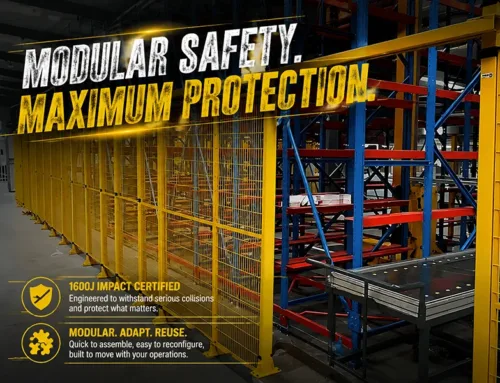
Ultimately, the goal of any Cerca de segurança industrial application is compliance and protection. The Mdfence bolt-on architecture is TUV certified to withstand a 1600 Joule impact—equivalent to stopping a 220 lbs (100kg) object moving at 12.4 mph (20km/h). Furthermore, the precise 0.78″ x 3.9″ (20x100mm) anti-climb mesh strictly adheres to ISO 13857 reach distance standards, allowing the barrier to be placed as close as 4.7 inches (120mm) from the hazard. This saves valuable floor space in compact factory layouts, proving that you do not need on-site welding to achieve world-class, heavy-duty machinery protection.
Frequently Asked Questions (FAQs)
1. How does no-weld assembly affect the 1600J impact rating?
The 1600 Joules impact rating is achieved through the structural synergy of the Q235 steel posts, the 20x30mm framed panels, and the high-tensile bolt-on connection clips. The bolted joints are engineered to flex and absorb kinetic energy during a crash (like a car’s crumple zone), preventing the brittle fracture often seen in poor-quality site welds.
2. Can we mount our own Omron or Pizzato safety switches without drilling?
Yes. We provide pre-engineered Safety Interlock Carriers (e.g., KKCK-LCK-B-D4NL-SET) that bolt directly onto the standard posts and door frames. These plates have pre-tapped holes matching the exact footprints of major PLC-integrated safety switches, eliminating on-site drilling.
3. What happens if our robotics layout changes next year?
Because the system is 100% modular and assembled with standard hex bolts, you can easily unbolt the panels, relocate the posts, and reassemble the perimeter in a new configuration. The asset reusability rate is over 95%, making it ideal for dynamic automated production lines.
4. Do the bolted panels meet OSHA and ISO 13857 reach distance standards?
Absolutely. The standard 20x100mm mesh size prevents operators’ fingers from reaching through to dangerous pinch points. According to ISO 13857 calculations, this specific mesh density allows the fence to be installed as close as 120mm from the hazard source.
5. How fast can a standard robot cell perimeter be assembled?
By eliminating hot work permits, fire watches, and custom fabrication, a two-person crew using basic hand tools and hammer drills (for the floor anchors) can typically install up to 50 meters (164 feet) of standard perimeter fencing in a single 8-hour shift.