PT
PT  EN
EN  DE
DE  RU
RU  JA
JA  ES
ES  IT
IT 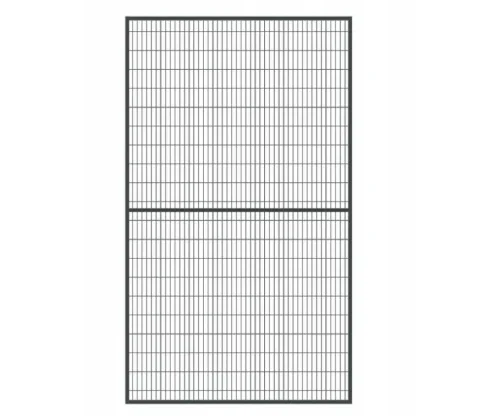

|
When integrating high-speed mechanical assembly machines or 6-axis robotics layouts, every square inch of your shop floor is premium real estate. Yet, using the wrong mesh size on your perimeter guarding forces you to push barriers up to 33.4 inches away from the hazard to pass EHS audits. Discover how the precise 20x100mm finger-safe mesh design reclaims your production footprint, prevents operator reach-through accidents during CNC tool changes, and keeps your AGV pathways wide open without triggering unnecessary safety interlock trips. |
The Integrator’s Dilemma: Space Constraints vs. Reach Distance Compliance
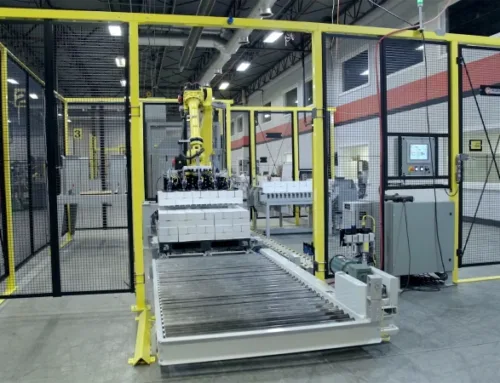
For automation system integrators and EHS managers, designing a compliant robotic work cell often feels like a losing battle against floor space. The traditional approach of using generic 50x50mm (2″x2″) chain-link or unframed wire mesh creates a severe operational pain point. Because a 50mm opening easily allows an operator’s fingers and hands to pass through, international standards require you to maintain a massive safety distance.
If a worker can stick their hand through the mesh while a CNC machining center is executing a tool change, or while a high-speed assembly line is cycling, the risk of amputation is unacceptably high. To compensate for this inadequate mesh size, safety engineers are forced to install the Cerca de segurança industrial barrier at least 850mm (approx. 33.4 inches) away from the hazard. In a modern automotive plant where AGVs (Automated Guided Vehicles) need wide aisles to navigate, sacrificing nearly 3 feet of perimeter space per machine is a layout disaster.
Decoding Safety Fence Industrial Mesh Size for Fingers

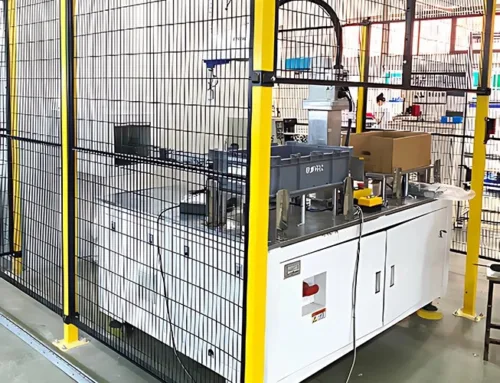
The solution to this spatial engineering problem lies in the precise calculation of the safety fence industrial mesh size for fingers. Mdfence systems utilize a highly engineered 20x100mm (0.78″ x 3.93″) mesh profile. This specific dimension is not arbitrary; it is strictly dictated by the ISO 13857 standard (Safety of machinery — Safety distances to prevent hazard zones being reached by upper and lower limbs).
Because the 20mm width physically restricts penetration to just the tip of the finger (preventing the first knuckle from passing through), the standard allows the Proteção de Máquinas panel to be installed as close as 120mm (4.72 inches) to the moving parts.
The Real-World Aftermath: By upgrading from a 50mm mesh to a 20mm finger-safe mesh, you instantly reclaim over 2.3 feet (700mm) of space along the entire perimeter of the automated production line. For a standard robotics layout, this can save up to 30 square feet per cell, allowing you to widen material handling areas, add additional conveyors, or simply reduce the facility real estate required for the project.
Structural Rigidity: Why Unframed Mesh Fails the “Lean Test”

A correct mesh size is useless if the panel itself bows under pressure. In busy automotive welding stations, operators frequently lean against the barriers, or material handling carts bump into them. Cheap, unframed wire mesh acts like a hammock—it stretches. If an operator leans on an unframed fence installed at the minimum 120mm distance, the elastic deformation of the wire can push the mesh right into the hazard zone, triggering an emergency stop (E-stop) or causing an accident.
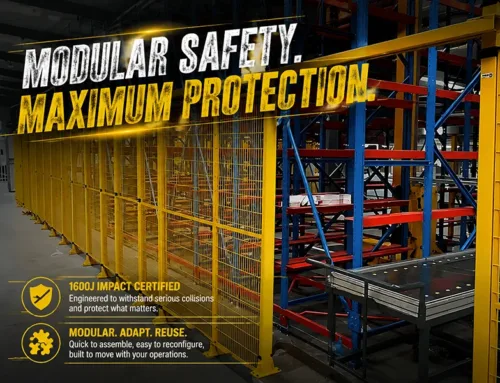
To guarantee the integrity of the safety distance, the Mdfence system employs a Framed Panel Architecture. The 3.0mm or 4.0mm steel wires are flat-welded directly onto a robust 20x30x1.5mm Q235 carbon steel tubular frame. This out-of-plane stiffness ensures zero sagging. Coupled with 60x60mm posts anchored by M10x70mm expansion bolts, the system is TUV-certified to absorb impact energies up to 1600 Joules (approx. 1180 ft-lbs)—equivalent to stopping a 220 lbs object moving at 12.4 mph without catastrophic failure.
Seamless Interlock Integration for Turnkey Solutions

System integrators know that a Cerca de Segurança para Robôs system is not just a passive wall; it is an active node in the machine’s safety circuit (PLC/HMI). When using standard fencing, integrators waste hours on-site drilling holes into powder-coated posts to mount safety interlocks, which inevitably leads to rust and misalignment. If a hinged door sags even a few millimeters, the safety switch (like an Omron D4NL or Pizzato) fails to align, causing phantom machine faults and tanking the line’s OEE (Overall Equipment Effectiveness).
Mdfence solves this with pre-engineered lock carriers and mounting plates. Because the framed mesh panels maintain absolute rigidity, the heavy-duty hinged and sliding doors never sag. Your technicians can bolt industry-standard safety switches directly to the pre-drilled brackets, ensuring perfect alignment on the first try. This “design for automation” method drastically reduces MTTR (Mean Time To Repair) and simplifies the final EHS sign-off.
Technical Comparison: 20x100mm vs. Standard Mesh
| Parameter | Mdfence 20x100mm Framed Mesh | Standard 50x50mm Unframed Mesh |
| ISO 13857 Compliance | Finger-Safe (Blocks past 1st knuckle) | Arm/Hand-Safe only |
| Minimum Safety Distance | 120mm (4.72 Inches) | 850mm (33.4 Inches) |
| Space Saved Per Machine | Up to 30 Sq. Ft. | 0 (Baseline) |
| Structural Deflection | Zero sag (20x30mm Q235 Steel Frame) | High elasticity (Push-through risk) |
| Integration Readiness | Pre-drilled interlock carriers available | Requires on-site hot work/drilling |
Frequently Asked Questions (FAQs)
1. Why is the 20x100mm mesh size critical for high-speed mechanical assembly lines?
In high-speed assembly, operators often work in close proximity to moving parts for visual inspection or material loading. The 20x100mm mesh prevents fingers from reaching through the barrier, allowing the fence to be placed safely at just 120mm away, saving space while maintaining full ISO 13857 compliance.
2. Can this finger-safe perimeter guarding integrate with our existing safety light curtains?
Yes. Mdfence offers specialized 80x80mm posts designed with internal cable routing to seamlessly mount safety light curtains. This creates a hybrid physical/electro-optical barrier perfect for frequent material handling access points without compromising the overall safety circuit.
3. Will the Q235 carbon steel panels withstand a collision from a warehouse AGV?
Absolutely. The fully welded framed panels and 60x60mm posts are TUV-certified to withstand impacts of up to 1600 Joules. Due to the ductile nature of Q235 steel, the barrier will deform elastically to absorb the kinetic energy of an AGV or forklift, preventing fragmentation and protecting the robotic cell inside.
4. How does the modular design speed up our robotics integration projects?
The system uses a bolt-on connection clip mechanism requiring no on-site drilling or welding. For system integrators, this means rapid, cold-assembly deployment. If a CNC layout changes, the panels can be unbolted and reconfigured in minutes, offering a 95% asset reuse rate.
5. Are the door systems compatible with our standard Omron or Pizzato PLC interlocks?
Yes. We provide pre-engineered lock carriers (e.g., KKCK-LCK-B-D4NL-SET) specifically designed for industry-standard safety switches. This eliminates the need for custom fabrication, ensuring perfect alignment on our hinged or sliding doors to prevent nuisance machine tripping.