PT
PT  EN
EN  DE
DE  RU
RU  JA
JA  ES
ES  IT
IT 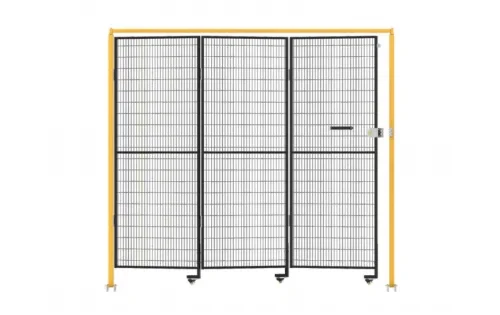

|
Your robot integration project is on a tight deadline. The last thing you need is a week of on-site welding, grinding, and hot work permits just for the safety guarding. What if you could deploy a fully compliant, bolt-together Cerca de Segurança para Robôs system in a fraction of the time, with pre-engineered mounts for your exact safety interlocks? |
Easy to assemble robot safety fencing kits?
The question isn’t just whether easy-to-assemble Cerca de Segurança para Robôs kits exist. They do. The real question for an automation system integrator is, what does “easy” actually mean when your project timeline is shrinking and your client’s EHS manager is scrutinizing every detail?
“Easy” isn’t just about fewer bolts. It’s about predictable installation, seamless integration with your control systems, and zero on-site fabrication. It’s the difference between a smooth project sign-off and a week of costly, frustrating delays. Let’s contrast the old way with a modern kit-based approach.
The Hidden Project Killers of Traditional Welded Cages
For years, the default for guarding a robot cell was to call a local welding shop. While seemingly straightforward, this approach is riddled with hidden costs and risks that directly impact an integrator’s bottom line and timeline.
The Installation Nightmare: Hot Work, Shutdowns, and Inconsistency
A “custom” welded fence means bringing a hot, dirty, and unpredictable manufacturing process into your client’s clean facility. This involves:
- Hot Work Permits: The administrative headache and potential fire hazard of on-site welding and grinding.
- Production Halts: Nearby production lines often need to be shut down due to fumes, sparks, and safety concerns.
- Inconsistent Quality: The final product’s quality, from weld integrity to the final coat of paint, depends entirely on the skill of the on-site fabricator that day.
The Integration Scramble: Where Safety Interlocks Become an Afterthought
Your control system design calls for a specific Pizzato or Omron safety interlock on the access door. But a welded cage has no pre-engineered mounting points. Your technicians are forced to drill and tap into freshly painted steel on-site. The result? Chipped powder coating that starts to rust in a few months, and misaligned switches that cause nuisance trips and frantic service calls long after you’ve left the site.
The Zero-Flexibility Trap: A One-Way Ticket to the Scrap Bin
What happens when the end-user needs to modify the cell layout in two years? The welded cage, a significant initial investment, must be destructively removed with an angle grinder. Its asset value is zero. This one-time solution becomes a recurring expense for your client, reflecting poorly on the initial integration’s foresight.
Deconstructing a True “Kit”: More Than Just Panels and Posts
A true Sistemas de Proteção de Máquinas kit is an engineered solution designed to eliminate these problems. It’s about thinking through the entire project lifecycle, from CAD design to final commissioning.
Bolt-Together Modularity: Slash Installation Time
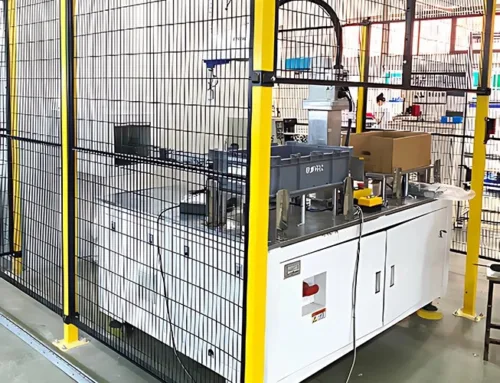
Modern systems like Mdfence are designed for cold assembly. Using high-strength steel clamps and pre-drilled posts, a two-person team can install over 150 feet of fencing in a single day with just a wrench. There’s no welding, no grinding, and no painting. Installation can happen over a weekend or even during a lunch break without disrupting adjacent operations.

Pre-Engineered for Safety Integration: Plug-and-Play Compliance
This is where a true kit shines. Instead of leaving interlock mounting to chance, the system comes with pre-engineered mounting plates and carriers specifically designed for industry-standard switches. This “adapter lock carrier” ensures your Omron D4NL or Pizzato FS series switch bolts on perfectly, every time. The alignment is precise, the installation is clean, and the integrity of the safety circuit is guaranteed from the start.

Engineered for Industrial Reality: Strength That Passes Audits
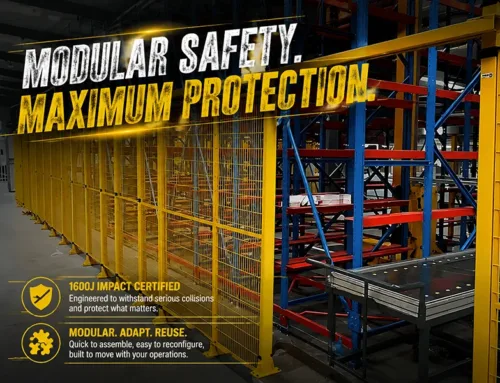
An integrator’s reputation rests on the system’s safety and durability. Mdfence kits are built from industrial-grade Q235 carbon steel with a full, welded 20x30mm tube frame around every panel. This isn’t flimsy chain-link. The system is certified to withstand over 1600 Joules of impact—enough to stop a 220 lb object moving at 12.5 mph. This isn’t just a feature; it’s the documented proof you need to pass a stringent EHS audit with confidence.
Case Study: A Complex Robot Cell for GBM Automation
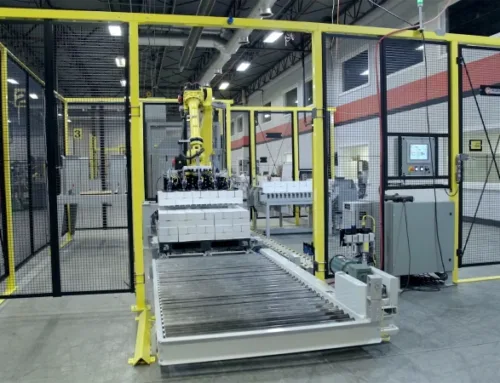
A perfect example is a project for GBM Automation Systems. They needed to guard a complex, multi-station automation line with very specific layout requirements and a mandate to use Omron and Pizzato interlocks.
- The Challenge: A complex footprint with multiple conveyors and access points, an aggressive timeline, and zero tolerance for on-site fabrication errors.
- The Mdfence Solution: We worked directly from their CAD drawings to deliver a complete, pre-configured kit. This included every post, panel, and fastener, plus the specific pre-engineered safety interlock carriers (our KKCK-LCK-B-D4NL-SET and KKCK-LCK-PIZZATO-SET) for their specified switches.
- The Result: GBM saved an estimated 30% on total installation time. The system passed the end-client’s rigorous EHS acceptance test on the first walkthrough, allowing them to commission the line ahead of schedule.
So, are easy-to-assemble robot safety fencing kits available? Yes. But for a system integrator, the right kit isn’t just “easy”—it’s a strategic tool that reduces project risk, accelerates timelines, and delivers a higher quality, more compliant solution to your client.
Perguntas Frequentes
1. Can your kits integrate with our preferred safety switches, like Schmersal or Allen-Bradley?
Absolutely. While we have off-the-shelf mounting solutions for common models like the Omron D4NL and Pizzato series, our system’s core strength is flexibility. The robust Q235 steel posts and frames provide a stable platform for any hardware. We can provide universal mounting plates or work with your specifications to ensure a clean, pre-engineered fit for any safety interlock, light curtain, or E-stop button.
2. How quickly can we get a kit for a custom robot cell layout?
Our process is built for speed. You provide us with your CAD file (STP, DWG, etc.), and our team generates a precise Bill of Materials (BOM) and layout drawing. Because our system is 100% modular, we pull standard components (posts, panels, doors, fasteners) from stock. This means even for a complex, custom layout, lead times are measured in days, not the weeks required for custom fabrication.
3. Does this fencing system meet key US safety standards like ANSI/RIA R15.06?
Yes. The Mdfence system is designed and engineered in accordance with global safety standards, including ISO 14120 (General requirements for the design and construction of fixed and movable guards). This foundation ensures our system provides the strength, stability, and proper safety distances (per ISO 13857) required to satisfy the risk assessment portion of the ANSI/RIA R15.06 standard for robot system safety.
4. What happens if a panel gets damaged by a forklift after installation?
This is a critical advantage over welded solutions. A damaged panel doesn’t require a hot work permit and hours of downtime. Using a single tool, a maintenance technician can unbolt the four retaining clips, swap out the damaged panel for a spare, and have the cell back online in under 10 minutes. This drastically reduces Mean Time to Repair (MTTR) and improves your client’s Overall Equipment Effectiveness (OEE).
5. Do you provide 3D CAD models for us to use in our master assembly drawings?
Yes, and we consider this essential. We provide complete 3D STP models of our components. This allows your design engineers to drop the entire safety fencing system into your master layout at the design stage. You can verify clearances, check for interferences with cable trays or EOAT (End-of-Arm Tooling), and finalize your design with complete confidence before a single part is ordered.