PT
PT  EN
EN  DE
DE  RU
RU  JA
JA  ES
ES  IT
IT 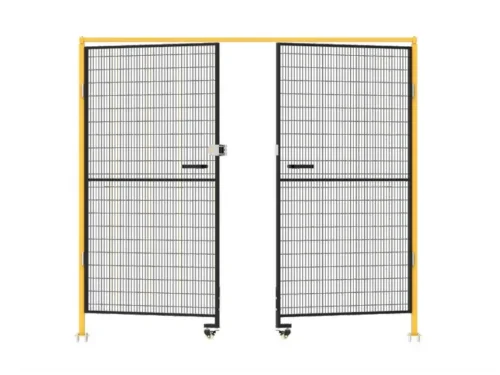

|
Your new robotic cell is running at peak capacity, but what happens when a 200 lb workpiece slips from the gripper at high speed? Is the ‘safety’ fence you specified a genuine, engineered barrier, or just a visual marker waiting to fail? The difference is measured in Joules, and it’s the critical detail that prevents a multi-thousand-dollar accident from becoming a catastrophic, line-stopping disaster. |
When specifying a Cerca de Segurança para Robôs system, the most critical question isn’t “Is it strong?” but rather, “How does it fail?” The force an industrial safety fence can withstand is not a simple number measured in pounds of pressure. It’s a complex engineering equation involving dynamic energy, material science, and system-level design. For any EHS manager or automation engineer, understanding this is key to ensuring true safety and operational continuity.
The correct unit of measurement for this capability is the **Joule (J)**, which quantifies energy. A static load rating might tell you if a fence can support a person leaning on it, but it says nothing about its ability to absorb the sudden, violent energy of a projectile—like a piece of end-of-arm-tooling breaking loose from a robot arm.
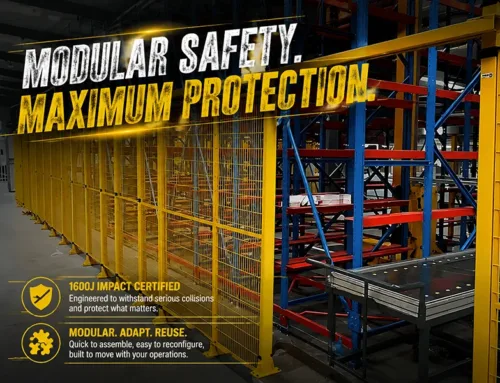
Mdfence systems are certified to withstand an impact of **1600 Joules**. To put that in perspective, this is the energy equivalent of stopping a 220 lb (100 kg) solid object traveling at 12.4 mph (20 km/h). This isn’t just a marketing claim; it’s a verifiable performance benchmark that dictates whether an incident is a minor inconvenience or a major shutdown.
## The Anatomy of an Impact: Deconstructing a Resilient Machine Guarding System
A fence’s ability to absorb 1600J of energy is not derived from one single feature, but from the intelligent design of the entire system. The force of an impact is progressively transferred and dissipated through a chain of engineered components, preventing catastrophic failure at any single point.
### The Foundation: Q235 Steel Posts & Robust Anchoring
The backbone of the system is the 60x60mm post, constructed from Q235 cold-rolled carbon steel. This material is chosen specifically for its excellent ductility. Unlike brittle cast iron or less resilient aluminum, Q235 steel will bend and deform under extreme impact—a process known as plastic deformation. This action actively absorbs kinetic energy, much like a car’s crumple zone, preventing the post from snapping and becoming a secondary projectile. Each post is anchored directly to the concrete floor with four M10x70mm expansion bolts, ensuring the impact load is ultimately transferred into the facility’s foundation.

### The Core Barrier: Fully Welded, Framed Panels
The initial point of contact is the mesh panel. Unlike cheaper, frameless “chain-link” style mesh that deforms easily and can be penetrated, Mdfence utilizes a **framed panel** architecture. The steel wire mesh is fully welded inside a rigid 20x30mm rectangular steel tube frame. This frame acts like a chassis, instantly distributing the point load of an impact across the entire panel surface and transferring it outward to the posts, rather than allowing the mesh to tear or “bellow” out.

### The Complete System: The Load Path from Impact to Dissipation
When a projectile strikes the fence, a precise sequence of events occurs:
1. **Contact:** The wire mesh absorbs the initial shock.
2. **Transfer:** The full welds transfer the energy from the mesh to the 20x30mm tubular frame.
3. **Distribution:** The frame distributes the force to the high-strength steel connection clips.
4. **Absorption:** The clips transfer the load to the 60x60mm Q235 steel posts, which begin to flex and absorb the energy.
5. **Dissipation:** The posts transfer the remaining force through the welded baseplate and M10 anchor bolts directly into the concrete floor.
This engineered load path ensures that the system works in unison to contain the hazard, protecting both personnel and high-value machinery within the work cell.
## Beyond the Spec Sheet: The Real-World Cost of an Under-Engineered Fence
In a high-speed automation environment, the difference between a certified system and a low-cost alternative is measured in downtime and repair complexity.
| Impact Scenario | Low-Cost / Welded Fence Failure | Mdfence Modular System Performance |
|---|---|---|
| Robot drops a 150 lb casting part. | The fence shatters or tears. The projectile damages a nearby conveyor or control cabinet. The line is down for 8-10 hours for cleanup, assessment, and repair. A full safety incident report is required. | The Mdfence panel deforms but contains the part. The maintenance team isolates the cell, unbolts the single damaged panel using a wrench, and installs a replacement from stock. Total MTTR (Mean Time To Repair): < 30 minutes. |
| A forklift accidentally clips a fence post. | The welded-in-place post is permanently bent. A hot work permit is required to cut out the damaged section with an angle grinder. Fumes and sparks force a shutdown of adjacent operations. Total Downtime: 4+ hours. | The post is bent, but the modular system is intact. The team unbolts the two adjacent panels, unbolts the damaged post from the floor, and installs a new one. No hot work, no fumes. Total Downtime: < 1 hour. |
Choosing an Cerca de Segurança Industrial system based on its certified impact rating and modular repairability isn’t an expense—it’s a direct investment in your facility’s OEE (Overall Equipment Effectiveness) and a crucial element of a robust risk mitigation strategy.
The true strength of an industrial safety fence is not just its ability to withstand force, but its ability to do so intelligently, ensuring that in the event of an accident, the outcome is controlled, predictable, and quickly resolved.
—
## Frequently Asked Questions (FAQ)
### 1. What is the difference between impact resistance in Joules and a static load rating?
A static load rating measures a fence’s ability to resist a steady, constant force, like a person leaning against it. Impact resistance, measured in Joules, quantifies its ability to absorb the sudden kinetic energy of a moving object. For machine guarding applications where projectiles are a risk, the Joule rating is the far more critical safety metric.
### 2. Does the Mdfence system comply with ANSI/RIA R15.06 for robotic cell guarding?
Yes. The Mdfence system is designed and engineered in accordance with key international safety standards, including ISO 14120 (General requirements for the design and construction of fixed and movable guards) and is suitable for use in applications requiring compliance with ANSI/RIA R15.06 for robot safety.
### 3. How does Q235 carbon steel perform during an impact compared to aluminum?
While aluminum is lighter, Q235 carbon steel has a higher modulus of elasticity and superior ductility. This means that under a severe impact, steel is more likely to bend and absorb the energy (plastic deformation), whereas aluminum is more prone to cracking or shearing (brittle failure). For high-inertia industrial applications, steel provides a more resilient and predictable failure mode.
### 4. If a single panel or post is damaged by a forklift, how quickly can it be replaced?
Thanks to the fully modular, bolt-together design, a single damaged component can be replaced without affecting the rest of the installation. A trained maintenance worker with standard hand tools can typically replace a damaged panel or post in under an hour, minimizing production downtime. This is a significant advantage over welded systems that require cutting and re-welding.
### 5. Can your fencing system integrate with our existing safety interlocks and E-stop circuits?
Absolutely. Mdfence is designed to be a platform for a complete safety solution. We offer a range of pre-engineered mounting plates and lock carriers specifically designed to integrate with industry-standard safety interlock switches from brands like Omron, Pizzato, Schmersal, and others. This ensures your physical barrier communicates seamlessly with your machine’s PLC and safety control system.