PT
PT  EN
EN  DE
DE  RU
RU  JA
JA  ES
ES  IT
IT 

|
A forklift glancing blow shouldn’t cost you an entire shift’s production. Traditional barriers fail catastrophically, turning a minor incident into a major downtime event. Your facility’s OEE and safety record demand a more resilient, engineered solution designed to withstand the realities of a busy factory floor, not just pass a minimal checklist. |
Impact resistant industrial safety fencing for forklifts?
The question isn’t *if* a forklift will eventually collide with your safety guarding, but *when*. In a high-traffic logistics center or a bustling automotive production line, the tight corners and constant movement make these encounters inevitable. The real question is: will your Cerca de Segurança Industrial absorb the impact and protect your multi-million dollar robotic cell, or will it shatter, turning a minor error into a catastrophic failure?
The “Before” Scenario: When a Welded Cage Meets a 5-Ton Forklift
Imagine the scene: a forklift, loaded with parts, rounds a corner too quickly. There’s a sharp bang as it clips the corner post of the welded cage surrounding your primary welding robot. What happens next is a cascade of costly problems:
- Catastrophic Failure: The weld at the base of the post snaps. The entire panel folds inward, striking the robot’s controller cabinet. The robot emergency-stops. The entire line goes down.
- Downtime Dominoes: Production is halted. Your maintenance team can’t just “fix” it. They need an angle grinder to cut out the damaged section. They need a “hot work permit” to weld in a new piece. This process takes hours, not minutes, and creates a fire hazard.
- Hidden Costs: The shift’s production target is missed. The robot’s controller may be damaged. The floor is scarred. Your OEE (Overall Equipment Effectiveness) plummets, all because of a barrier that failed its one critical job.
The “Why It Works” Logic: An Engineered System vs. a Simple Barrier
A truly impact-resistant barrier is not just about thick steel; it’s an entire engineered system designed for energy absorption and dissipation. This is where Mdfence fundamentally differs from locally fabricated or flimsy “安平网” (Anping mesh) alternatives.
1. The Foundation: Q235 Steel and Robust Anchorage
It starts at the floor. Our system is anchored by 60x60mm posts made from Q235 carbon steel. Unlike brittle materials, Q235 steel is ductile; when subjected to extreme force, it is designed to bend and deform, absorbing energy much like a car’s crumple zone. It doesn’t shear off at the base. The heavy-duty baseplate is secured with four M10 expansion bolts, transferring the impact’s overturning moment directly into the concrete slab.

2. The Core: Full-Frame Panels that Distribute the Load
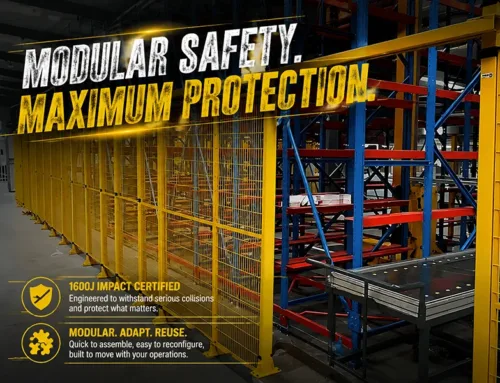
Unlike frameless mesh that collapses like a net, every Mdfence panel features a full 20x30mm tubular steel frame. When a forklift’s forks strike the mesh, the impact force isn’t concentrated on a few wires. It’s instantly transferred to the rigid frame, which then distributes the load across the entire structure and into the robust posts. This architecture is key to achieving the certified 1600 Joules impact resistance—enough to stop a 220 lbs (100 kg) object moving at 12.5 mph (20 km/h) dead in its tracks.

3. The Detail: Sacrificial and Replaceable Components
We understand that high-traffic areas will see impacts. That’s why we offer protective post base covers. These durable plastic shields cover the anchor bolts and provide a visual guide for drivers, but more importantly, they act as the first point of contact. In a low-speed collision, this inexpensive part may be all that needs replacing. It protects the post’s powder coating and, more importantly, the anchor integrity.

The “After” Scenario: A 15-Minute Repair, Not an 8-Hour Shutdown
Now, let’s replay that forklift incident with an Mdfence Proteção de Máquinas system in place.
The forklift clips the corner. The post’s base protector is scuffed. The post itself shows a visible bend, having absorbed the bulk of the energy. The panel is deformed, but critically, the entire system remains standing. The robot inside is untouched. The production line is paused.
Your maintenance technician arrives, not with a grinder and a welder, but with a single socket wrench. In less than 15 minutes, they have unbolted the four fasteners holding the damaged panel, removed it, unbolted the four anchor bolts for the bent post, and replaced both with standard components from your spare parts stock. The line is back up and running before the end of the hour.
The result? You’ve transformed a potential production disaster into a routine maintenance task. You’ve protected your assets, kept your people safe, and preserved your OEE. That is the true ROI of an impact-resistant, modular safety system.
Perguntas Frequentes
1. What is the specific impact rating of the Mdfence system?
Our standard system is certified to withstand an impact energy of 1600 Joules. To put that in perspective, it’s equivalent to the force of a 220-pound (100 kg) object hitting the barrier at 12.5 mph (20 km/h) without penetration or structural failure. This level of protection is crucial for areas with AGV, forklift, or robotic arm activity.
2. How does the repair process for Mdfence compare to traditional welded guarding after a forklift collision?
The difference is dramatic. Repairing welded guarding requires cutting, grinding, welding (often requiring a hot work permit), and repainting—a process that can take 4-8 hours and introduces fire hazards. With our modular system, a damaged panel or post can be unbolted and replaced with a standard wrench in as little as 15-20 minutes, drastically reducing your MTTR (Mean Time To Repair).
3. Can this Cerca de Segurança para Robôs be integrated with our plant’s safety PLC and interlock switches?
Absolutely. Our system is designed as a platform for modern safety integration. We offer pre-engineered mounting plates and lock carriers specifically for industry-standard interlock switches like Omron, Pizzato, or Schmersal. This eliminates the need for on-site drilling and fabrication, ensuring a clean, compliant, and reliable connection to your safety circuit (e.g., for STO functionality).
4. Our factory floor has some uneven sections. Can the system be adjusted during installation?
Yes. The connection between our panels and posts is made via adjustable steel clips. This design allows for minor height adjustments during installation to compensate for slight variations in floor level, ensuring a consistent and secure fit without gaps.
5. Do you provide 3D CAD models for us to use in our facility layout planning?
Yes, we provide a full library of 3D STP files for all standard components. This allows your engineers or system integrators to import our fencing directly into their layout software (like AutoCAD or SolidWorks) to verify fit, check for interferences, and ensure compliance with safety distance standards like ISO 13857 before a single bolt is ordered.