PT
PT  EN
EN  DE
DE  RU
RU  JA
JA  ES
ES  IT
IT The maximum extension length of the mobile retractable guardrail

Portable retractable fences are versatile security barriers commonly used in a variety of settings to protect individuals and demarcate boundaries. The flexibility and ease of use of these portable guardrails make them ideal for construction sites, events, warehouses, and more.
The maximum extension length of a portable retractable fence is the distance it can be extended or expanded to provide a barrier. This length can vary depending on the specific model and manufacturer. It is critical to consider this factor when selecting a guardrail as it directly affects the ability of the guardrail to cover a large area and create a secure perimeter.
The maximum extension length of a mobile retractable guardrail is an important aspect of ensuring optimum safety and security. Longer extension lengths allow for greater coverage, effective crowd control, hazard prevention, and restricted area demarcation. It ensures that the guardrail can span wide openings, such as entry points or construction zones, providing a strong barrier against unauthorized entry.
On construction sites, where safety is paramount, removable retractable guardrails with considerable extension lengths can be used to create a secure perimeter around hazardous areas, machinery, or excavations. Likewise, at events or festivals, guardrails with long extended lengths facilitate crowd management by effectively directing and controlling the flow of participants.
Warehouses and industrial facilities can also benefit from mobile retractable guardrails with longer extension lengths. They can be used to separate pedestrian access from forklift or vehicle traffic, ensuring the safety of employees and preventing accidents.
The maximum extension length of a mobile retractable guardrail plays a key role in its effectiveness as a safety barrier. By choosing guardrails with longer extension lengths, companies can create safe perimeters, effectively manage crowds, and improve overall safety in a variety of environments.
Interlock Switch Mounting Without Drilling: Why Alfence T-Slot Posts End Phantom Stops
Bolting an interlock switch bracket through a powder-coated steel post drills the coating, drops swarf into the cell and leaves a rust line — and when the hinged leaf sags, the tongue misaligns and the PLC reports a phantom guard fault. Alfence mounts sensors, e-stops and conduit in the T-slot groove of a 40×40 mm or 45×45 mm aluminum post, with door hardware sized to keep the safety switch aligned.
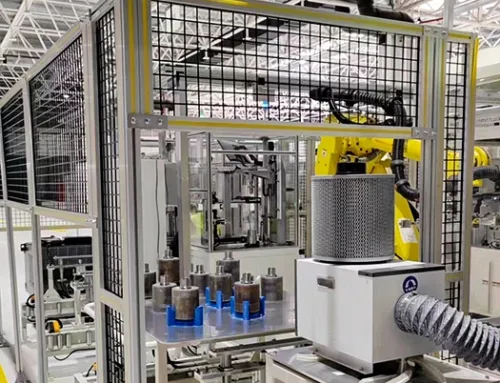
Phantom Safe Torque Off Stops: T-Slot Guarding Fence Posts Mount Interlocks Without Drilling
Painted steel guarding posts force maintenance to drill for interlock switches, dropping swarf in the cell and breaking the coating where rust starts. Sagging hinge doors then misalign the interlock tongue and the PLC trips Safe Torque Off while the gate is closed. Alfence industrial safety fence mounts sensors, e-stops and cable routing into the T-slot aluminum profile post without drilling, and uses hinged, folding or sliding door frames that keep interlock geometry stable - protecting OEE through phantom stops and line changes.
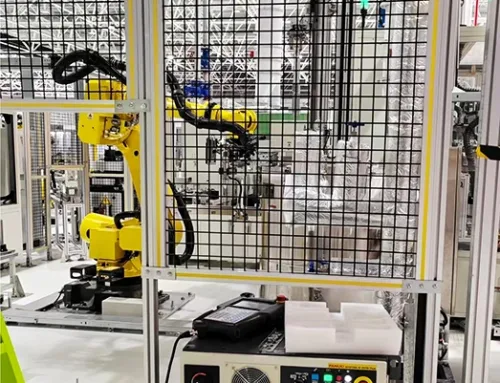
Automotive Plant Industrial Safety Fence: Keep the Robot Cell Close to the Hazard
Automotive plants cannot afford to lose production floor to an oversized machine guarding perimeter. Alfence combines 20×100 mm mesh with slim 40×40 mm or 45×45 mm aluminum posts for a compact, reconfigurable industrial safety fence layout, with final clearance confirmed by the project risk assessment.