PT
PT  EN
EN  DE
DE  RU
RU  JA
JA  ES
ES  IT
IT Robot safety fence standards for OSHA and ISO-minded global sites
Robot safety fence standards for North American audits: how Mdfence gives multi-site buyers one defensible baseline
When a headquarters team has to pass OSHA review in one country and keep the same machine-guarding rule set across every plant, a fence is no longer just a barrier. It becomes part of the compliance record. Mdfence helps standardize robot safety fence standards with a repeatable structure, clear installation logic, and visual evidence that is easy for safety teams to document.
What safety teams need before they sign off
Global manufacturers do not just need a fence that looks industrial. They need a guarding system that supports robot safety fence standards in a way that can survive internal EHS review, contractor handoff, and government audit. That means the structure must be clear, the install method must be traceable, and the layout must be easy to replicate across sites.
| Audit concern | Mdfence proof point |
|---|---|
| Guarding must be consistent across global plants | The same modular fence logic can be repeated site to site, which helps HQ keep one standard instead of one-off local fixes. |
| Install details must be visible and documentable | The installation image shows base plate drilling, expansion bolts, and retaining rings, making the mounting method easy to explain and record. |
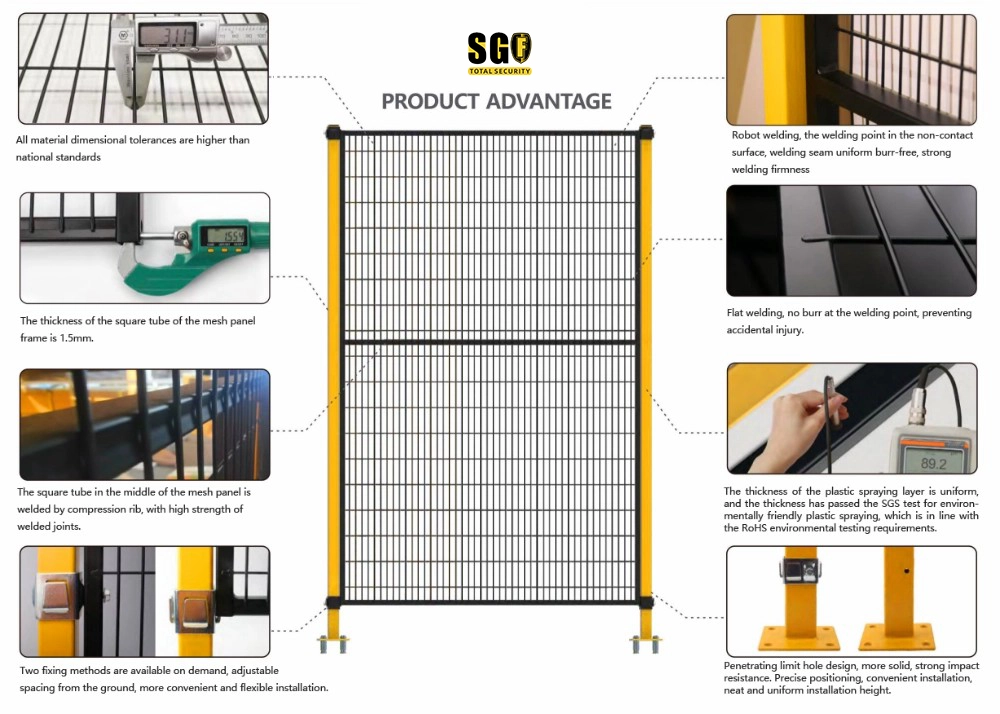
| Structure must be readable during inspection | The technical layout image labels the post and mesh panel relationship, which helps teams explain panel alignment and clamp positioning. |
| Safety hardware should not look improvised | The weld seam, coating, and base plate details show a built system rather than a makeshift barrier. |
Why Mdfence fits robot safety fence standards work
1) The structure gives auditors something concrete to inspect
In a cross-border compliance review, vague promises do not help. The first thing a safety manager wants is a visible structure they can trace from frame to floor. The composite proof image highlights weld seam quality, coating coverage, and base plate detail. That matters because a machine guarding system should not depend on guesswork. It should present a repeatable, inspectable build that supports a documented safety baseline.

2) The layout is simple enough to standardize at scale
Many sites fail compliance not because the fence is absent, but because every line is built differently. Mdfence uses a clear post-and-panel arrangement with fixing clamp logic shown in the technical front view. That makes it easier to define a standard perimeter around robot cells, transfer zones, and machine lines without redesigning each project from scratch.

3) The application image proves the system works in a real automation cell
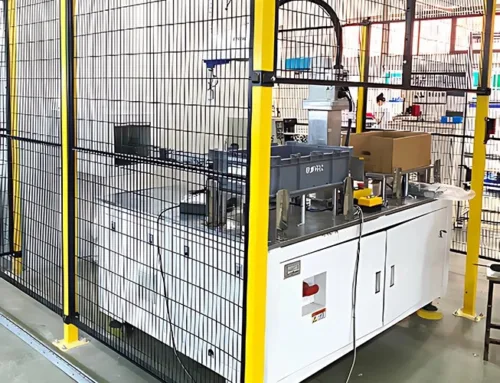
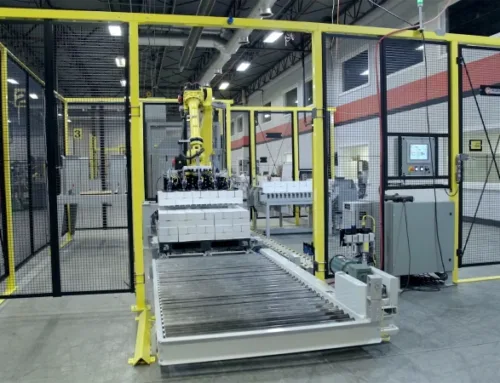
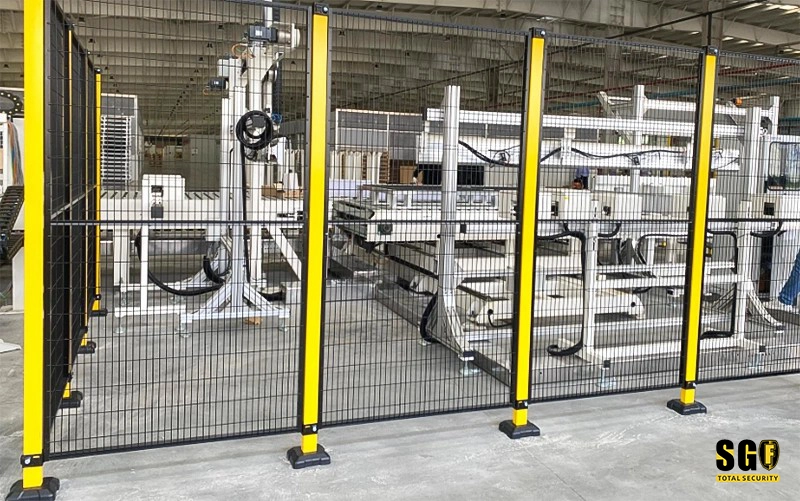
The enclosure photo shows the fence doing the job it is meant to do: separating people from an active automation station while keeping the workspace organized. For a North American group facing OSHA scrutiny, that kind of evidence matters. It shows the product is not only about materials or dimensions, but about creating a controlled zone that can be recognized by operators, contractors, and auditors.
Onde isso importa mais
- Robot cells that need a documented perimeter before a safety review.
- Plants that must align OSHA expectations with an ISO-style internal standard.
- Multi-site programs that want the same guarding baseline in every country.
- Automation upgrades where the old barrier was informal, inconsistent, or hard to audit.
Mdfence is a practical fit when the requirement is not just to block access, but to support a repeatable compliance story. That is the value of robot safety fence standards done properly: less local improvisation, fewer arguments during review, and a cleaner handoff from engineering to EHS.
What the old approach gets wrong
Legacy guarding is often pieced together from mixed components, unclear mounting methods, and ad hoc repairs after line changes. That creates three problems: it is difficult to standardize, difficult to document, and difficult to defend when a regulator asks how the cell was protected. Mdfence addresses that by making the build visible in the structure itself, so the compliance discussion starts from proof rather than assumption.
Build one robot safety fence standard, not 20 local exceptions
If your team needs a perimeter system that can support OSHA review, internal audits, and global rollout, Mdfence gives you a stronger starting point. Send us the site layout, and we will help map a guarding approach that fits the cell, the workflow, and the compliance file.